
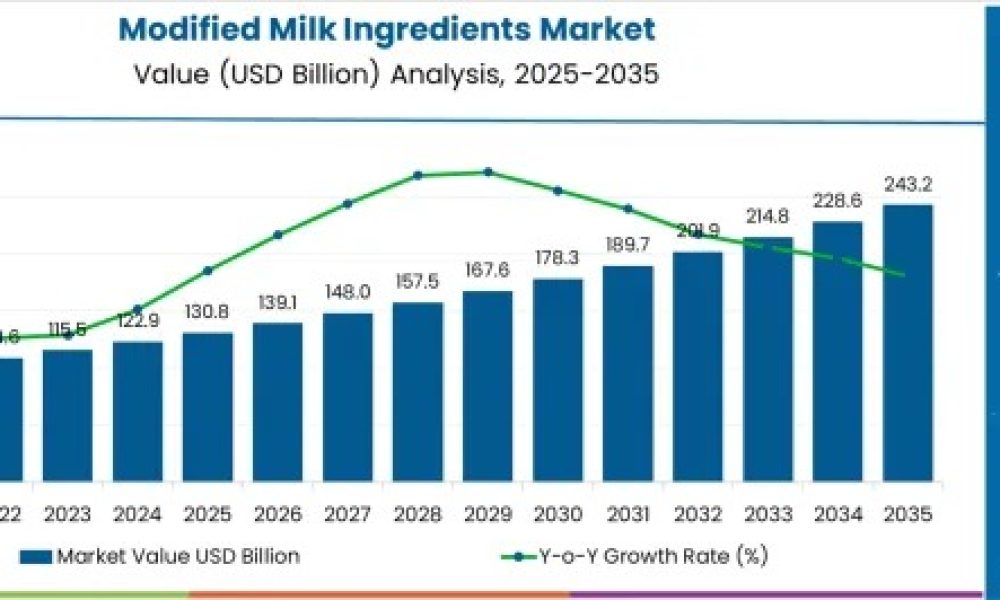
The global Modified Milk Ingredients Market is experiencing steady, structurally driven growth as food manufacturers, nutrition brands, and dairy processors increasingly rely on high-performance milk derivatives. The market is estimated to be valued at USD 130.8 billion in 2025 and is projected to reach USD 243.2 billion by 2035, expanding at a CAGR of 6.4% over the forecast period.
This growth reflects a convergence of factors—rising demand for protein-rich formulations, regulatory clarity around dairy labeling, and continued innovation in milk fractionation technologies. Modified milk ingredients are now core inputs across processed foods, infant nutrition, sports supplements, and functional beverages, where consistency, functionality, and nutritional density are critical.
Get Exclusive Access To Data Tables, Market Sizing Dashboards, And Analyst Insights. Request Sample Report!
Market Snapshot Highlights
- Market value (2025): USD 130.8 billion
- Forecast value (2035): USD 243.2 billion
- Forecast CAGR (2025–2035): 6.4%
- Leading product type: Whey (26.0% share in 2025)
- Dominant application: Food & Beverages (58.0% share)
- Key growth regions: North America, Asia-Pacific, Europe
Demand Accelerates for High-Performance Dairy Ingredients
The modified milk ingredients market is expanding steadily as manufacturers seek solutions that improve texture, shelf life, and nutritional performance. Advances in extraction, drying, and filtration technologies have enabled dairy processors to isolate milk components tailored for specific industrial uses, from emulsification in sauces to protein fortification in beverages.
At the same time, improved transparency in country-of-origin declarations and ingredient labeling is strengthening consumer trust, particularly in infant and clinical nutrition. Trade agreements supporting cross-border dairy flows are further enabling global sourcing, especially from surplus-producing regions.
Health-focused consumption patterns are also reshaping demand. Clean-label positioning, reduced sugar formulations, and higher protein density have elevated the role of value-added dairy ingredients in both traditional and emerging food categories.
Whey Leads Product Type Segment with 26.0% Share
By product type, whey is projected to account for 26.0% of total market revenue in 2025, making it the largest segment. Its dominance is anchored in its strong nutritional profile, ease of digestibility, and compatibility with advanced processing technologies such as ultrafiltration and microfiltration.
Whey-based concentrates and isolates are widely used in:
- Sports and active nutrition products
- Infant formulas and pediatric nutrition
- Bakery, confectionery, and fortified beverages
Its role as a sustainable co-product of cheese manufacturing further strengthens its appeal in an increasingly sustainability-conscious marketplace.
Dry Form Gains Ground on Logistics and Stability
The dry form segment is expected to contribute 42.0% of market revenue in 2025, driven by clear logistical and functional advantages. Extended shelf life, reduced transportation costs, and improved dosing accuracy make powdered milk ingredients the preferred choice for large-scale food manufacturing.
Technological improvements in spray drying and agglomeration have significantly enhanced solubility and dispersibility, enabling consistent performance across hot and cold applications. This has accelerated adoption in infant nutrition, bakery mixes, and ready-to-drink formulations.
Food & Beverages Dominate Application Landscape
The food & beverages sector is projected to account for 58.0% of total market revenue by 2025, reflecting widespread use of modified milk ingredients in processed foods. These ingredients support emulsification, water binding, mouthfeel enhancement, and nutritional fortification.
Demand is being reinforced by:
- Growth in protein-enriched snacks and beverages
- Reformulation efforts to reduce sugar and fat without compromising taste
- Rising packaged food consumption in urban markets
As manufacturers balance health, taste, and functionality, milk-derived ingredients remain central to innovation pipelines.
Innovation Shapes the Next Phase of Growth
The market is witnessing notable innovation in flavor optimization and dairy alternatives. Clean-flavor technologies such as Synergy Flavors’ Dairy by Nature demonstrate how fermentation science and flavor layering can restore authentic dairy taste in both dairy and plant-based products.
At the same time, precision fermentation is opening new frontiers. Companies like Perfect Day are producing animal-free whey and casein proteins with nutritional profiles comparable to conventional dairy, offering lactose-free and vegan-compatible alternatives that could reshape ingredient sourcing strategies.
Regional Outlook Remains Strong Across Key Markets
North America and Europe continue to lead in terms of market share, supported by strong demand for infant nutrition and sports supplements. Asia-Pacific remains a major growth engine, underpinned by expanding dairy production and rising health awareness.
India alone contributes nearly 22% of global milk production, according to FAO data, reinforcing Asia’s strategic importance. Meanwhile, the Middle East & Africa is projected to register the fastest CAGR, supported by dietary diversification and investment in local food processing.
Buy Report Now – Click Here to Purchase the Report:
Competitive Landscape and Strategic Focus
Leading companies—including Nestlé SA, Lactalis International, Danone S.A., Fonterra Co-operative Group, FrieslandCampina, Arla Foods, Dean Foods, Yili Group, and China Mengniu Dairy Co., Ltd.—are focusing on product differentiation, expanded distribution networks, and entry into underserved markets.
About Future Market Insights (FMI)
Future Market Insights, Inc. (FMI) is an ESOMAR-certified, ISO 9001:2015 market research and consulting organization, trusted by Fortune 500 clients and global enterprises. With operations in the U.S., UK, India, and Dubai, FMI provides data-backed insights and strategic intelligence across 30+ industries and 1,200 markets worldwide.



