
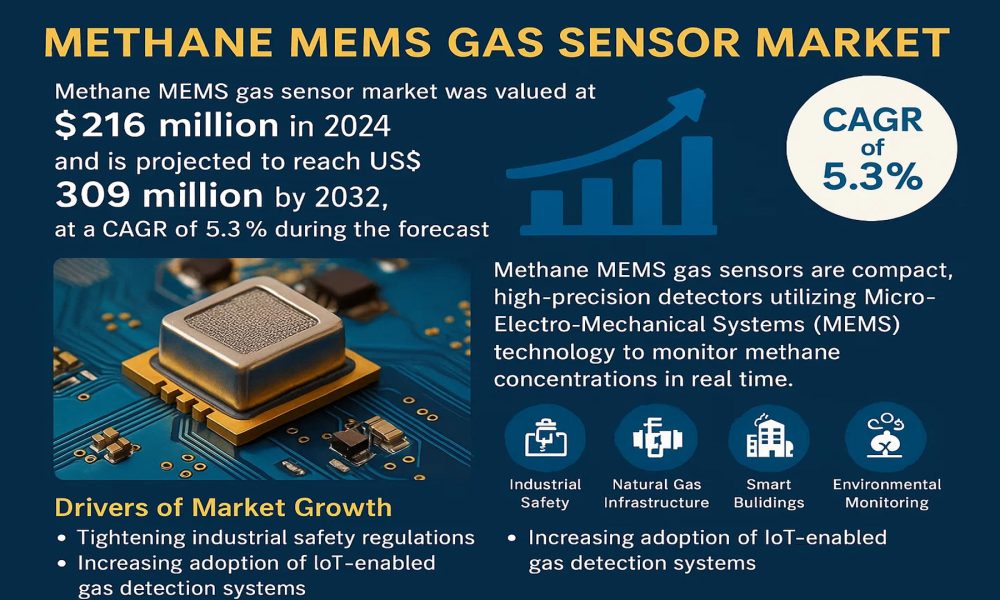
Methane MEMS Gas Sensor Market was valued at 216 million in 2024 and is projected to reach US$ 309 million by 2032, at a CAGR of 5.3% during the forecast period.
Methane MEMS gas sensors are compact, high-precision detectors utilizing Micro-Electro-Mechanical Systems (MEMS) technology to monitor methane concentrations in real time. These sensors leverage silicon-based materials for enhanced sensitivity and stability while maintaining low power consumption. Their applications span industrial safety, natural gas infrastructure, smart buildings, and environmental monitoring due to rapid response times and durability.
Market growth is driven by tightening industrial safety regulations, increasing adoption of IoT-enabled gas detection systems, and rising investments in smart city infrastructure. While NDIR (Non-Dispersive Infrared) sensors dominate the technology segment with over 60% market share in 2024 due to their high accuracy, metal oxide semiconductor sensors are gaining traction for cost-sensitive applications. Key players like Amphenol and Figaro are expanding production capacities to meet the 12% annual demand surge from the oil & gas sector. However, technical challenges in minimizing cross-sensitivity to other gases remain an industry focus.
Unlock Your Free Sample Report Here- Methane MEMS Gas Sensor Market
MARKET DRIVERS
The increasing enforcement of safety regulations across industries, particularly in oil & gas, mining, and residential sectors, is driving demand for methane MEMS gas sensors. Governments globally are mandating strict monitoring of methane emissions due to its high global warming potential—28–36 times that of CO₂ over 100 years. The industrial sector accounts for nearly 40% of global methane emissions, creating a pressing need for real-time detection solutions. MEMS-based sensors, with their high sensitivity and rapid response times, are becoming indispensable for compliance with these regulations. In 2024, at least 12 countries introduced updated industrial safety standards requiring continuous methane monitoring, further accelerating market penetration.
Growth in Natural Gas Infrastructure to Propel Market Expansion
Global natural gas consumption is projected to grow by over 3% annually, driving investments in pipeline networks and distribution systems where methane leaks pose significant risks. MEMS gas sensors are increasingly integrated into smart monitoring systems for pipelines, offering advantages like sub-ppm detection levels and connectivity with IoT platforms. The oil & gas industry alone is expected to deploy over 1.2 million new methane sensors by 2027, with MEMS technology capturing 35% of this market. This trend is reinforced by regulatory mandates in regions like North America and Europe, where pipeline operators must implement advanced leak detection systems.
Advancements in MEMS Technology to Enhance Market Penetration
Recent innovations in MEMS fabrication have significantly improved sensor performance, enabling detection thresholds below 500 ppb while reducing power consumption by 60% compared to conventional gas sensors. These advancements are critical for battery-operated and wireless applications in smart homes and industrial IoT. Industry leaders are launching compact, multi-gas detection modules combining methane sensing with environmental monitoring, broadening application scope. For instance, one major manufacturer recently introduced a MEMS-based methane sensor with a 10-year operational lifespan, making it viable for remote and harsh environments where maintenance is challenging.
Recent Developments: Methane MEMS Gas Sensor Market
- Advancements in Low-Power Designs: Manufacturers are increasingly focusing on ultra-low-power MEMS methane sensors to support continuous monitoring in battery-powered IoT devices and smart home systems.
- Integration with Wireless Networks: Companies are developing sensors with built-in Bluetooth, LoRaWAN, and NB-IoT connectivity, enabling real-time methane leak detection in remote and industrial environments.
- Miniaturization for Wearables and Portables: New compact MEMS methane sensors are being introduced for wearable safety devices and portable detectors, especially for mining, oil & gas, and HVAC applications.
- Improved Sensitivity and Selectivity: Recent innovations have enhanced methane detection accuracy while reducing cross-sensitivity to other gases like CO₂ and VOCs, making sensors more reliable for industrial and environmental monitoring.
- Strategic Collaborations: Leading players are partnering with IoT solution providers and smart city projects to deploy MEMS methane sensors in large-scale environmental monitoring systems.
- Automotive and Energy Applications: Growing adoption in natural gas-powered vehicles and energy infrastructure safety systems is driving research into rugged and durable MEMS methane sensors.
MARKET OPPORTUNITIES
Integration with Smart City Infrastructure to Unlock New Growth Avenues
Smart city initiatives worldwide are incorporating gas leak detection into urban safety frameworks, creating a $420 million annual opportunity for methane MEMS sensors. Municipalities are deploying networked sensors along utility lines and in public spaces to preempt leaks—Seoul’s smart city project alone installed 8,000 methane sensors in 2023. This trend is amplified by 5G rollout, enabling real-time data transmission from distributed sensor nodes. Partnerships between MEMS manufacturers and urban planners are critical to capitalize on this demand.
Emerging Applications in Biogas and Renewable Energy to Fuel Demand
As biogas plants multiply to meet renewable energy targets, methane monitoring during production and storage becomes essential. MEMS sensors are ideal for this sector due to their resilience in high-humidity environments common in anaerobic digesters. With global biogas capacity projected to double by 2030, this niche could account for 18% of methane sensor sales. Concurrently, landfill gas monitoring regulations are tightening—the EU’s updated waste directive mandates continuous methane tracking at all major sites, driving another high-margin segment.
Unlock Your Free Sample Report Here- Methane MEMS Gas Sensor Market
List of Key Methane MEMS Sensor Manufacturers
- Amphenol Advanced Sensors (U.S.)
- Senseair AB (Sweden)
- smartGAS Mikrosensorik GmbH (Germany)
- Figaro Engineering Inc. (Japan)
- NISSHA FIS Inc. (Japan)
- Veris Industries (U.S.)
- Dynament Ltd (UK)
- Cubic Sensor and Instrument Co., Ltd (China)
Segment Analysis:
By Type
NDIR (Non-Dispersive Infrared) Sensors Segment Leads Due to High Accuracy and Reliability
The market is segmented based on type into:
- NDIR (Non-Dispersive Infrared) Sensors
- Metal Oxide Semiconductor Sensors
- Catalytic Sensors
- Electrochemical Sensors
- Others
By Application
Industrial Segment Dominates Due to Stringent Safety Regulations and Leak Detection Needs
The market is segmented based on application into:
- Industrial
- Residential
- Commercial
- Environmental Monitoring
- Others
By End User
Oil & Gas Sector Holds Largest Share Due to Extensive Methane Monitoring Requirements
The market is segmented based on end user into:
- Oil & Gas
- Mining
- Utilities
- Manufacturing
- Others
Other Topic- Glass Core Substrates for Semiconductor Packaging Market
CONTACT US:
City vista, 203A, Fountain Road, Ashoka Nagar, Kharadi, Pune, Maharashtra 411014
[+91 8087992013]




