
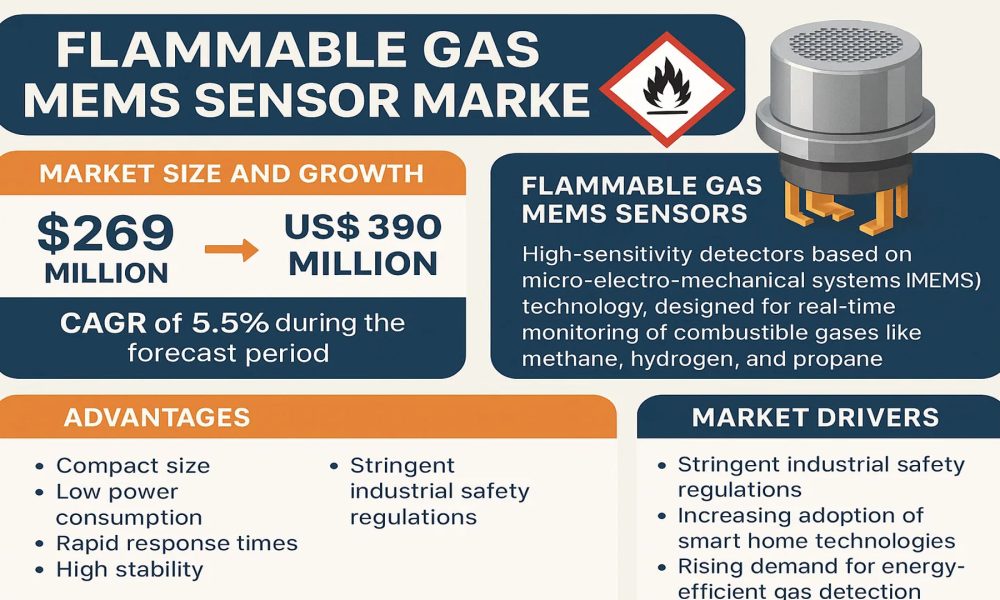
Flammable Gas MEMS Sensor Market was valued at 269 million in 2024 and is projected to reach US$ 390 million by 2032, at a CAGR of 5.5% during the forecast period.
Flammable gas MEMS sensors are high-sensitivity detectors based on micro-electro-mechanical systems (MEMS) technology, designed for real-time monitoring of combustible gases like methane, hydrogen, and propane. These sensors integrate miniaturized components for superior performance, offering advantages such as compact size, low power consumption, rapid response times, and high stability. They play a critical role in industrial safety systems, residential gas leak detection, and hydrogen monitoring in emerging applications like fuel cell vehicles.
Market growth is primarily driven by stringent industrial safety regulations, increasing adoption of smart home technologies, and rising demand for energy-efficient gas detection solutions. However, challenges persist in achieving high selectivity across multiple gas types while maintaining cost competitiveness. Recent innovations include the development of NDIR (Non-Dispersive Infrared) sensors with enhanced detection ranges and the integration of IoT capabilities for remote monitoring. Key industry players like Amphenol and Figaro are expanding their portfolios through strategic partnerships and technological advancements in MEMS fabrication.
Request Your Free Sample Report- https://semiconductorinsight.com/download-sample-report/?product_id=118012
MARKET DRIVERS
Stringent Industrial Safety Regulations Fuel Adoption of Flammable Gas MEMS Sensors
Global industrial safety regulations are becoming increasingly stringent, mandating advanced flammable gas detection systems across high-risk sectors like oil & gas, chemical, and mining. Regulatory bodies worldwide are imposing stricter standards due to rising workplace accidents from gas leaks – recent statistics indicate that industrial gas incidents account for approximately 15% of all workplace fatalities in hazardous environments. MEMS-based sensors are gaining traction as preferred solutions because of their superior sensitivity (detecting gas concentrations as low as 1-5 ppm), compact form factor enabling integration into IoT devices, and lower power consumption compared to conventional detectors. The European Union’s ATEX directive and OSHA standards in North America are driving widespread sensor deployment, with the industrial segment projected to account for over 45% of total flammable gas sensor demand by 2026.
Expansion of Smart City Infrastructure Accelerates Market Growth
Urbanization projects globally are incorporating smart gas monitoring systems as essential infrastructure components, creating substantial demand for MEMS-based flammable gas sensors. Modern cities are deploying networked sensor arrays for real-time air quality and gas leak monitoring, particularly in residential areas with piped natural gas distribution. The global smart city initiative investment surpassed $120 billion in 2023, with environmental monitoring systems constituting nearly 20% of this expenditure. MEMS sensors dominate these deployments due to their wireless connectivity capabilities, with leading manufacturers reporting 30% year-over-year growth in municipal orders. Recent technological advancements in edge computing integration allow these sensors to process data locally, reducing latency in emergency response systems while maintaining energy efficiency.
Recent Developments: Flammable Gas MEMS Sensor Market
- Advancements in IoT Integration: Leading sensor manufacturers are embedding MEMS-based flammable gas sensors into IoT platforms for smart home safety, industrial monitoring, and connected devices. This integration enhances real-time gas leak detection and predictive maintenance.
- Miniaturization and Low Power Consumption: Recent R&D efforts are focused on developing ultra-compact sensors with low power requirements, making them suitable for portable devices, smartphones, and wearables used for personal safety.
- Enhanced Selectivity and Sensitivity: Companies are launching next-generation MEMS gas sensors with improved selectivity to differentiate between multiple gases and higher sensitivity to detect very low concentrations, ensuring better safety compliance.
- Automotive Industry Adoption: With the rise of hydrogen fuel cell vehicles and natural gas-powered engines, MEMS gas sensors are being adopted in automotive applications for onboard leak detection and passenger safety.
- Strategic Collaborations: Several companies are partnering with semiconductor manufacturers, safety equipment providers, and automotive OEMs to expand the application scope of MEMS-based flammable gas sensors.
- Regulatory Push: Growing emphasis on workplace safety standards and environmental regulations is driving innovation in highly reliable and cost-effective MEMS sensors tailored for industrial environments.
MARKET OPPORTUNITIES
Hydrogen Economy Development Presents Transformative Growth Potential
The global transition to hydrogen energy systems is creating unprecedented demand for specialized gas detection solutions. Fuel cell vehicles and hydrogen fueling stations require continuous monitoring for leaks, as hydrogen’s wide flammability range (4-75% concentration) demands sensors with exceptional responsiveness. MEMS-based hydrogen detectors capable of 500ms response times are becoming standard in next-generation fuel cell systems, with the automotive sector projected to account for 35% of high-end sensor demand by 2028. Recent breakthroughs in palladium-alloy MEMS structures have improved detection thresholds below the 1% LEL (Lower Explosive Limit), meeting stringent safety requirements for confined spaces like vehicle cabins and underground storage facilities.
Integration with AI-Powered Predictive Maintenance Systems
The convergence of MEMS sensor networks with machine learning analytics is enabling predictive gas leak detection before concentrations reach dangerous levels. Advanced systems can now identify equipment deterioration patterns by analyzing subtle changes in baseline sensor readings, allowing maintenance interventions 3-5 times earlier than threshold-based detection. Industrial facilities adopting these AI-enhanced solutions report 60-70% reductions in unplanned downtime related to gas systems. This technological synergy is particularly valuable in aging infrastructure, where MEMS sensor grids provide continuous health monitoring for pipelines and storage tanks that might otherwise require costly physical inspections.
Report Scope
This market research report provides a comprehensive analysis of the Global Flammable Gas MEMS Sensor market, covering the forecast period 2024–2032. It offers detailed insights into market dynamics, technological advancements, competitive landscape, and key trends shaping the industry.
Key focus areas of the report include:
- Market Size & Forecast: Historical data and future projections for revenue, unit shipments, and market value across major regions and segments. The global market was valued at USD 269 million in 2024 and is projected to reach USD 390 million by 2032, growing at a CAGR of 5.5%.
- Segmentation Analysis: Detailed breakdown by product type (NDIR Sensors, Metal Oxide Semiconductor Sensors) and application (Residential, Commercial, Industrial) to identify high-growth segments.
- Regional Outlook: Insights into market performance across North America, Europe, Asia-Pacific, Latin America, and Middle East & Africa, with country-level analysis of key markets.
Request Your Free Sample Report- https://semiconductorinsight.com/download-sample-report/?product_id=118012
List of Key Flammable Gas MEMS Sensor Manufacturers
- Amphenol Advanced Sensors (U.S.)
- senseAir (Sweden) – subsidiary of Asahi Kasei Microdevices
- smartGAS Mikrosensorik (Germany)
- Figaro Engineering (Japan)
- NISSHA FIS Inc. (Japan)
- Veris Industries (U.S.)
- Dynament Ltd. (UK)
- Cubic Sensor and Instrument (China)
- Siemens AG (Germany)
Segment Analysis:
By Type
NDIR (Non-Dispersive Infrared) Sensors Dominate the Market Owing to High Accuracy and Selectivity in Flammable Gas Detection
The market is segmented based on type into:
- NDIR (Non-Dispersive Infrared) Sensors
- Subtypes: Single-gas NDIR, Multi-gas NDIR
- Metal Oxide Semiconductor Sensors
- Catalytic Sensors
- Electrochemical Sensors
- Others
By Application
Industrial Segment Leads Due to Stringent Safety Regulations and Wide Application in Oil & Gas, Chemical, and Manufacturing Sectors
The market is segmented based on application into:
- Industrial
- Residential
- Commercial
- Automotive
- Others
By Detection Range
0-1000 ppm Range Holds Maximum Share for Monitoring Low Concentration Flammable Gases in Occupational Safety Applications
The market is segmented based on detection range into:
- 0-1000 ppm
- 1000-10000 ppm
- Above 10000 ppm
By Gas Type
Methane Detection Segment Dominates Due to Widespread Use in Industrial and Residential Settings
The market is segmented based on gas type into:
- Methane
- Propane
- Hydrogen
- Butane
- Others
Other Topic-Low Power Radar Sensor Market
CONTACT US:
City vista, 203A, Fountain Road, Ashoka Nagar, Kharadi, Pune, Maharashtra 411014
[+91 8087992013]




