

Overview
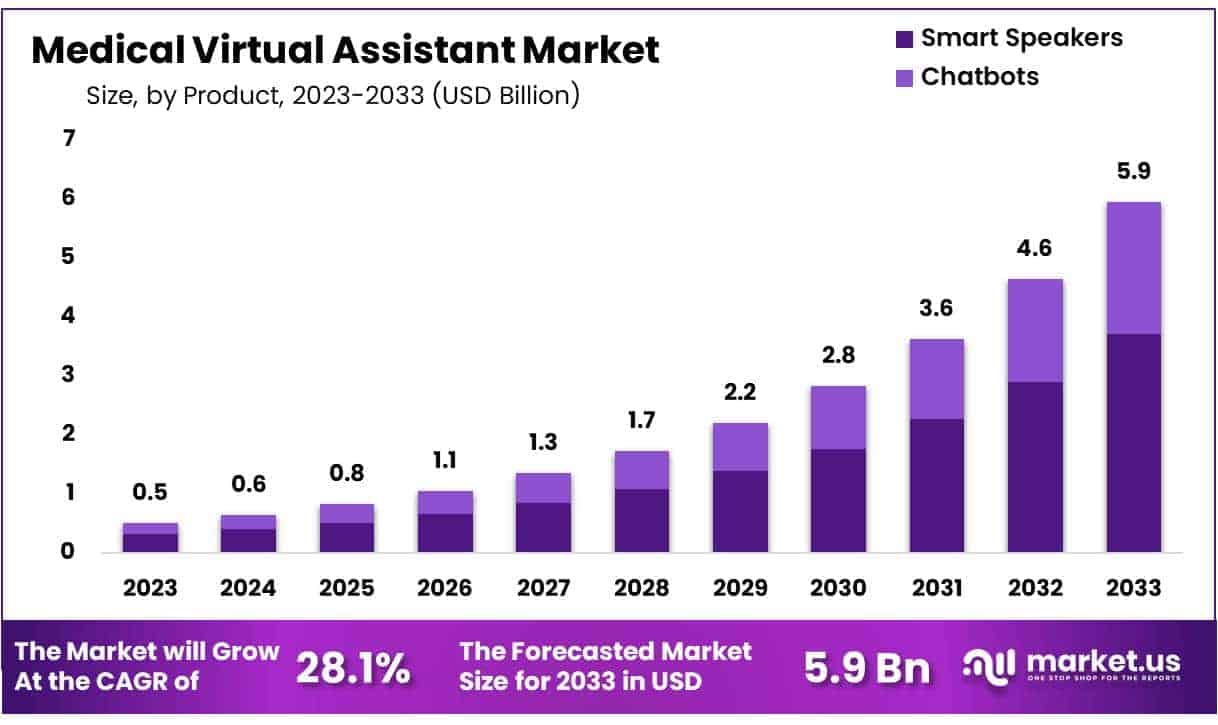
Global Medical Virtual Assistant Market size is expected to be worth around US$ 5.9 Billion by 2033 from US$ 0.5 Billion in 2023, growing at a CAGR of 28.1% during the forecast period 2024 to 2033.
The healthcare sector is witnessing a paradigm shift with the introduction of Medical Virtual Assistants (MVAs) AI-driven solutions designed to streamline clinical and administrative workflows while enhancing patient engagement and care outcomes. These intelligent platforms integrate natural language processing (NLP), machine learning (ML), and healthcare data analytics to offer real-time support to physicians, nurses, and patients.
MVAs are capable of performing a wide range of tasks, including appointment scheduling, medication reminders, symptom triage, patient monitoring, and electronic health record (EHR) data entry. By automating routine activities, these assistants significantly reduce clinicians’ administrative burden, allowing more time for direct patient interaction.
The technology also facilitates 24/7 patient communication through voice or chat interfaces, improving accessibility and continuity of care particularly in remote or underserved areas. Integration with telehealth platforms further strengthens their utility in virtual consultations and chronic disease management.
Leading hospitals and health tech companies are actively investing in MVA deployment, aiming to increase operational efficiency, minimize errors, and ensure compliance with healthcare regulations such as HIPAA. As demand for personalized, data-driven care grows, MVAs are poised to play a pivotal role in the digital transformation of healthcare delivery.
The global medical virtual assistant market is projected to grow steadily, driven by advancements in AI and the increasing emphasis on value-based healthcare solutions.
Click here to get a Sample report copy @ https://market.us/report/medical-virtual-assistant-market/free-sample/
Key Takeaways
- In 2023, the global medical virtual assistant market generated a revenue of USD 5 billion and is projected to expand at a compound annual growth rate (CAGR) of 28.1%, reaching an estimated value of USD 5.9 billion by 2033.
- By product type, the market is categorized into chatbots and smart speakers. Among these, smart speakers emerged as the leading segment, accounting for a 62.4% share of the total market revenue in 2023.
- Based on user interface, the market is segmented into text-based, automatic speech recognition, and text-to-speech interfaces. Automatic speech recognition dominated the segment, capturing a substantial 53.7% share in 2023, indicating strong adoption for hands-free communication in clinical settings.
- In terms of end-user segmentation, the market comprises patients, healthcare providers, and healthcare payers. Healthcare providers held the largest share, contributing 48.9% of the overall market revenue in 2023, driven by the increasing demand for workflow automation and virtual care solutions.
- Geographically, North America led the global market, securing a 39.2% market share in 2023, attributed to advanced healthcare infrastructure, high digital health adoption, and strong presence of key technology providers.
Segmentation Analysis
- By Product Analysis: In 2023, the smart speakers segment dominated the market with a 62.4% share, driven by the growing use of voice-activated technologies in healthcare environments. Their hands-free operation enhances convenience for patients and providers, supporting functions such as health reminders, medication management, and information access. The integration of artificial intelligence allows for real-time interaction and natural communication. The use of smart speakers in home care settings for chronic disease monitoring and guidance is expected to further accelerate segment growth.
- By User Interface Analysis: Automatic speech recognition accounted for 53.7% of the market share, attributed to the rising demand for intuitive and hands-free communication in healthcare settings. This technology enables natural interactions between patients and virtual assistants, streamlining tasks such as clinical documentation and remote monitoring. Its use in telemedicine and healthcare workflows improves user experience while reducing manual inputs. Ongoing enhancements in speech recognition accuracy, particularly for medical terminology, are likely to strengthen its adoption across various healthcare applications.
- By End-user Analysis: Healthcare providers captured a significant 48.9% revenue share, propelled by the need to automate administrative tasks and improve patient management. Virtual assistants are increasingly being used to manage appointments, record patient information, and support follow-ups, contributing to greater operational efficiency. Their role in clinical decision-making and telemedicine services is expanding. Moreover, the integration of virtual assistants with electronic health record (EHR) systems is expected to improve care coordination, thereby reinforcing the segment’s future growth potential.
Market Segments
By Product
- Chatbots
- Smart Speakers
By User Interface
- Text Based
- Automatic Speech Recognition
- Text-to-Speech Based
By End-user
- Patients
- Healthcare Providers
- Healthcare Payers
To Purchase this Premium Report @ https://market.us/purchase-report/?report_id=131901
Regional Analysis
North America held the largest revenue share of 39.2% in 2023, primarily driven by the rising adoption of AI-powered healthcare solutions aimed at enhancing accessibility and patient engagement. The growing use of telemedicine and the increasing need for streamlined communication between patients and healthcare providers have significantly contributed to regional market growth.
A key development supporting this trend was AtlantiCare’s collaboration with Orbita, Inc. in October 2022, which led to the deployment of a virtual assistant platform enabling self-scheduling and improving patient interaction. Furthermore, advancements in artificial intelligence and natural language processing (NLP) have allowed healthcare institutions to automate administrative processes and enhance care delivery, thereby reinforcing the region’s leadership in virtual assistant adoption.
Asia Pacific is projected to register the fastest compound annual growth rate (CAGR) over the forecast period. This growth can be attributed to rising investments in digital health technologies and the increasing demand for AI-based mental health solutions. In May 2024, Fortis Healthcare partnered with United We Care to launch “Adayu Mindfulness,” an AI-driven mental health service that provides 24/7 virtual support and self-assessment tools.
Such initiatives are addressing the growing need for accessible mental healthcare across the region. Coupled with expanding digital infrastructure and supportive government policies promoting AI integration in healthcare, the adoption of virtual assistants is expected to accelerate particularly in the areas of mental health, chronic disease management, and remote patient monitoring.
Key Players Analysis
Leading players in the medical virtual assistant market are actively pursuing innovation and strategic initiatives to strengthen their market presence. A primary focus is the integration of artificial intelligence (AI) and natural language processing (NLP) to improve user interaction and deliver accurate, real-time health information.
These companies are forming partnerships with healthcare providers and technology firms to create customized solutions for hospitals, clinics, and individual users. Efforts are also directed toward expanding service offerings with multilingual capabilities and specialization in various medical domains, enabling broader patient reach.
Furthermore, key players are emphasizing global expansion by developing scalable solutions compatible with regional healthcare infrastructures. Compliance with healthcare regulations and robust data security measures remain central to their strategies, ensuring trust and supporting the widespread adoption of virtual assistant technologies.
Market Key Players
- Royal Philips
- Real Chemistry
- Next IT Solutions
- Microsoft
- MEDRESPOND
- ai
- CSS Corp
- Babylon Healthcare Services
- ADA Digital Health
Market Dynamics
- Driver: The primary driver of the medical virtual assistant market is the increasing demand for efficient healthcare delivery and reduced administrative burden. Virtual assistants help streamline tasks such as appointment scheduling, patient reminders, and clinical documentation, enabling healthcare providers to focus more on patient care. The rising adoption of telemedicine and electronic health records (EHR) further accelerates this trend, as providers seek tools that enhance workflow efficiency, reduce operational costs, and improve patient engagement and satisfaction.
- Trend: A key trend shaping the medical virtual assistant market is the integration of advanced artificial intelligence (AI) and natural language processing (NLP) technologies. These innovations enable more accurate understanding of medical terminology and improve conversational capabilities. As a result, virtual assistants are becoming more personalized, context-aware, and capable of handling complex patient queries. The trend is further supported by growing interest in voice-enabled systems, mobile health (mHealth) platforms, and remote patient monitoring solutions across various healthcare environments.
- Opportunity: Significant market opportunity lies in the expansion of virtual assistant applications into mental health, chronic disease management, and multilingual patient support. With increasing awareness of mental wellness and the rising global burden of chronic conditions, demand is growing for accessible, AI-powered health guidance. Emerging markets also present vast growth potential due to digital health infrastructure development and government initiatives promoting health tech adoption. Tailoring virtual assistants to align with regional healthcare needs and regulatory frameworks offers strategic expansion prospects.
Conclusion
The global medical virtual assistant market is undergoing rapid transformation, driven by advancements in artificial intelligence, rising telehealth adoption, and the growing need for efficient healthcare delivery. Smart speakers and automatic speech recognition dominate product and interface segments due to their convenience and functionality.
North America leads the market, while Asia Pacific exhibits strong growth potential. Key players focus on innovation, regulatory compliance, and global scalability. As demand for personalized and accessible healthcare grows, medical virtual assistants are poised to become integral in enhancing patient care, streamlining operations, and supporting value-based healthcare models across diverse clinical settings.
View More Reports:
AI in Medicine Market to Reach USD 156.8 Bn by 2033 at 27.6% CAGR
Virtual Nutrition Coach App Market Grows at 16.17% CAGR Through 2033
Automation and Control System in Healthcare Market Hits USD 95.7 Billion by 2033



