
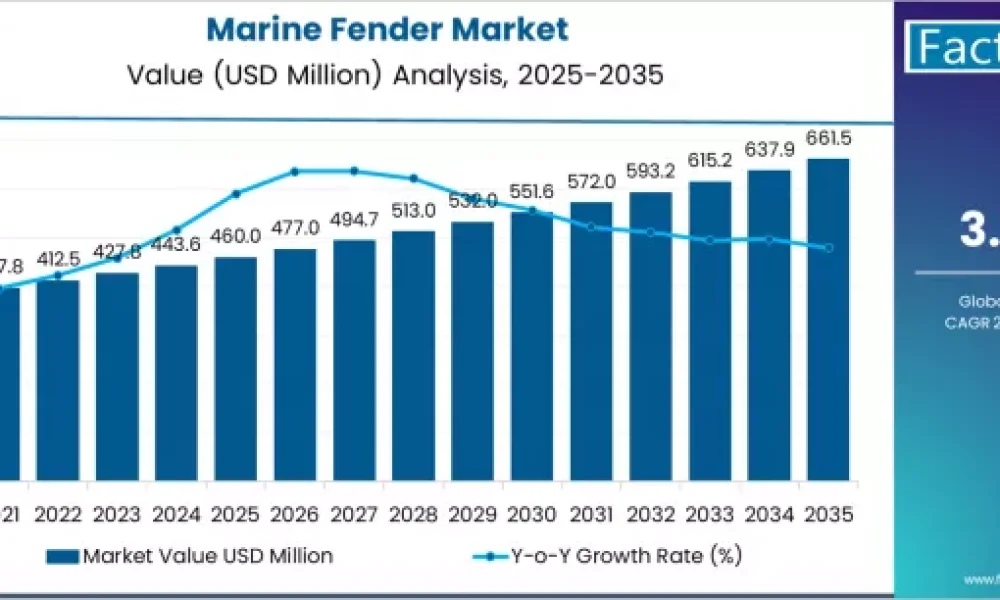
The global marine fender market is set to experience steady growth over the next decade, with total valuations projected to rise from USD 460.0 million in 2025 to USD 661.5 million by 2035, according to a new report by Fact.MR. This represents an absolute increase of USD 190.0 million, reflecting a total growth of 41.3% and a compound annual growth rate (CAGR) of 3.7% during the forecast period.
Marine fenders—vital for protecting ships, docks, and marine structures during berthing—are gaining strong traction as global seaborne trade, port infrastructure investments, and naval modernization accelerate across key regions.
Strong Regional Momentum Across North America, Europe, and Asia-Pacific
The United States emerges as the fastest-growing market, projected to expand at a CAGR of 4.2% between 2025 and 2035. Growth in the U.S. is underpinned by expanding port modernization projects, the revival of ship repair yards, and federal funding for maritime safety infrastructure.
Mexico (3.9%) follows closely, benefiting from increased trade via the Gulf and Pacific coasts. In Europe, Germany (3.4%), France (3.2%), and the UK (3.1%) lead market expansion with a focus on sustainable harbor operations and upgrading aging docking facilities.
In Asia-Pacific, South Korea (3.0%) and Japan (2.8%) are driving steady demand through shipbuilding activities, naval base development, and coastal defense upgrades.
To access the complete data tables and in-depth insights, request a Discount On The Report here: https://www.factmr.com/connectus/sample?flag=S&rep_id=5361
Marine Fender Market Quick Stats
| Metric | Details |
| Market Value (2025) | USD 460.0 million |
| Forecast Value (2035) | USD 661.5 million |
| Forecast CAGR (2025–2035) | 3.7% |
| Leading Application | Ports & Harbors |
| Key Growth Regions | North America, Europe, Asia-Pacific |
| Top Manufacturers | Trelleborg, Yokohama Rubber, M.I.C., Dongjin, Shibata |
Key Growth Drivers
- Expansion of Global Maritime Trade
Rising international trade volumes and container traffic are propelling investments in port infrastructure and terminal expansions, directly boosting the need for high-performance marine fenders. - Growing Naval Modernization and Defense Spending
Governments are prioritizing maritime safety and defense upgrades, enhancing demand for advanced fender systems capable of absorbing high impact and minimizing structural damage. - Port Infrastructure Development in Emerging Economies
Developing economies, particularly in Asia-Pacific and Latin America, are witnessing a surge in port construction and modernization initiatives to support global trade and logistics. - Technological Advancements in Fender Design
Innovations in rubber compounding, energy absorption technology, and low-maintenance synthetic materials are enabling longer product lifespans and improved performance under extreme marine conditions. - Sustainability and Compliance Focus
Eco-friendly materials and compliance with international marine safety standards (ISO, PIANC) are becoming key differentiators among manufacturers.
Segment Overview
By Type:
- Rubber Fenders remain the most widely used due to superior energy absorption and durability.
- Foam-filled and Pneumatic Fenders are gaining traction in offshore, naval, and temporary docking applications for their flexibility and ease of installation.
By Application:
- Ports and Harbors dominate global consumption, followed by offshore platforms and ship-to-ship operations.
- Increasing vessel size and diversified port traffic drive continuous demand for heavy-duty fenders.
By Material:
- Natural rubber and synthetic compounds lead market adoption due to their resilience, environmental adaptability, and reduced maintenance needs.
Competitive Landscape
Key Players in the Marine Fender Market:
- Trelleborg Marine Systems
- Yokohama Rubber Co., Ltd.
- M.I.C. Industries
- Dongjin Group
- Atlanta Rubber
- Shibata Industrial Co., Ltd.
- Northern Rubber
- P.F. Chuan
- Marinetech
- SMI
These players are leveraging advanced material science, global distribution partnerships, and integrated service offerings (including fender installation and maintenance) to strengthen market presence. Strategic mergers and sustainability-focused R&D initiatives remain central to their growth strategies.
Regional Market Outlook
North America: Port expansion and shipyard development in the U.S. and Mexico underpin steady market growth.
Europe: Modernization of legacy harbor infrastructure in Germany, France, and the UK drives regional demand.
Asia-Pacific: Japan and South Korea lead innovation, supported by government-backed maritime safety programs.
Latin America: Coastal development and free trade agreements are supporting market penetration in Mexico and beyond.
Purchase Full Report for Detailed Insights
For access to full forecasts, regional breakouts, company share analysis, and emerging trend assessments, you can purchase the complete report here: https://www.factmr.com/checkout/5361
Market Outlook: Safer Seas, Stronger Infrastructure
The marine fender market is positioned for sustained growth, propelled by rising global maritime activity, coastal infrastructure expansion, and advancements in impact-absorbing materials.
According to a Fact.MR analyst, “The marine fender market is evolving beyond traditional dock protection — it’s becoming a critical component in global maritime safety and sustainability initiatives. As ports modernize and ship sizes increase, demand for durable, eco-compliant fender systems will continue to rise.”
Have a specific Requirements and Need Assistant on Report Pricing or Limited Budget please contact us – [email protected]
About Fact.MR
Fact.MR is a global market research and consulting firm, trusted by Fortune 500 companies and emerging businesses for reliable insights and strategic intelligence. With a presence across the U.S., UK, India, and Dubai, we deliver data-driven research and tailored consulting solutions across 30+ industries and 1,000+ markets. Backed by deep expertise and advanced analytics, Fact.MR helps organizations uncover opportunities, reduce risks, and make informed decisions for sustainable growth.



