
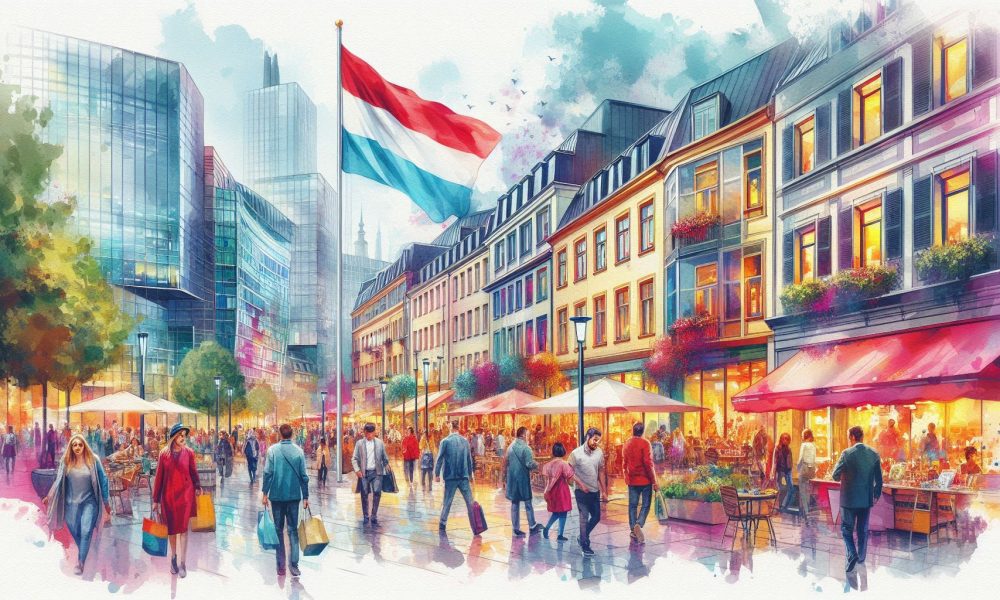
A globally dominant investment-fund platform, institutional-grade custodians, and stable governance keep Luxembourg central for cross-border portfolios.
WASHINGTON, DC — March 5, 2026. Luxembourg rarely wins the global conversation the way flashier finance hubs do. It does not sell itself with skyline theatrics or lifestyle branding. It keeps showing up for a simpler reason: it works.
For decades, the Grand Duchy has built something that looks unglamorous from the outside but is enormously influential inside the plumbing of global markets, a fund-domicile and custody ecosystem designed for cross-border portfolios. In 2026, when investors are thinking less about novelty and more about operational durability, that ecosystem is why Luxembourg remains central to how international money is packaged, held, reported, and moved.
The case for Luxembourg is not that it is “secret” or “easy.” It is that it is institutional. It is the kind of jurisdiction that excels at repeatable processes, standard forms, predictable supervision, and the routine high-volume mechanics of investment distribution. If Switzerland is often described as the gold standard for private banking continuity, Luxembourg is one of the most important platforms for the collective investment industry’s continuity, the place where global asset managers build ranges of funds that can travel.
That quiet dominance matters more than ever because the wealth and asset-management world is under pressure from two directions at once. Clients want diversification and global access. Regulators want proof, governance, and controls. Banks want clean, consistent files that can survive audits. Luxembourg’s value proposition sits at the intersection of those forces: a mature framework for regulated investment vehicles, plus a dense cluster of service providers whose entire business is keeping cross-border portfolios operational.
Why Luxembourg is still a default answer for fund structuring in 2026
At a high level, Luxembourg functions as a “wrapper factory” for global investing, but that phrase can sound dismissive. In reality, the wrapper is the product. The wrapper determines how investor protections are applied, how assets are safeguarded, how reporting is produced, how distributions are handled, how transfers are processed, and how regulators can step in when governance slips.
Luxembourg’s strength is that it has turned those elements into an industrial system. The ecosystem includes management companies and alternative investment fund managers, depositary banks, administrators, transfer agents, auditors, legal advisers, and specialized compliance professionals who do not treat cross-border funds as rare.
That normalization is a competitive edge. When the global environment tightens, and it has, the winners are jurisdictions with proven routines. Investors do not want bespoke improvisation when the stakes are high. They want standardization that still allows strategy flexibility.
Luxembourg’s supervisory authority has spent years publishing granular guidance and maintaining a structured overview of the types of investment vehicles that can be used, and how the management layer is expected to function in practice. For anyone trying to understand why Luxembourg’s platform scales globally, it starts with the regulator’s own framing of vehicle types and governance expectations: Overview of Luxembourg investment vehicles and their IFM.
This is not just reference material. It is an insight into how Luxembourg thinks. The vehicles are varied, but the theme is consistent: structure plus supervision. Flexibility, but with guardrails.
The quiet powerhouse is really an operating system
Luxembourg’s fund ecosystem is best understood as an operating system, not a single feature. Investors who only focus on tax headlines miss what actually keeps Luxembourg in the center of the map.
The operating system has three pillars.
First, a globally recognized fund platform. Luxembourg’s regulated fund regimes became a default for managers who want products that can be distributed widely across borders, especially within Europe. The “exportability” of a Luxembourg fund is a major part of its appeal. If you are building a fund range intended for international distribution, the domicile becomes part of the product’s credibility.
Second, an institutional service stack. Luxembourg is not only about where a fund is domiciled. It is also about where it is administered, audited, and overseen. The jurisdiction’s ecosystem of fund administrators, depositaries, and related firms is designed to handle volume. That matters because in modern asset management, operational failure is reputational failure.
Third, stable governance. Luxembourg’s political brand is not built on spectacle. It is built on consistency. Investors and managers tend to value that stability because cross-border portfolios do not like surprises.
Custody and “asset safety” are now geopolitical questions
There is a new stress test in 2026 that every sophisticated investor is quietly running: what happens to custody infrastructure when geopolitics intrudes?
In recent years, the custody world has been pulled into the public spotlight by sanctions, freezes, and legal disputes over immobilized sovereign assets. Even when those events are not directly about investment funds, they shape how institutions think about settlement plumbing and legal venues.
Luxembourg sits close to that conversation in an unusual way. It is tied into European financial infrastructure and the broader custody ecosystem through the presence of major settlement actors in the region, and it is also home to key legal venues in Europe. A recent Reuters report about the Russian central bank’s challenge to an EU asset freeze, filed at the EU court in Luxembourg, underscores how questions of custody and legal process have become front-page issues, not just back-office mechanics: Russian central bank challenges asset freeze in EU court.
For fund managers and allocators, the lesson is not political speculation. It is operational realism. Custody, settlement, and legal predictability are now part of risk management in a way they were not a decade ago. Luxembourg’s value as a fund center is connected to its ability to operate within those realities.
Why “fund domicile” matters to investors who never pick a domicile
Many end investors never consciously choose Luxembourg. They choose a strategy, a manager, or a platform. Luxembourg shows up in the background as the domicile of the vehicle holding the portfolio.
But domicile shapes outcomes that investors do care about: clarity of prospectus standards, strength of depositary oversight, speed and reliability of subscription and redemption processes, consistency of reporting, and how disputes are handled when something goes wrong.
In 2026, with more scrutiny on gatekeeping, liquidity, valuation, and governance, investors increasingly ask where a product is domiciled because they understand that governance culture is part of performance. Not return performance, but operational performance. The difference between a smooth redemption and a delayed one. The difference between clean reporting and messy reporting. The difference between a compliance query that is answered in a day versus one that spirals into account closures and reputational drama.
Luxembourg’s ecosystem is designed to reduce those frictions for mainstream, compliant products. That is why it remains central for cross-border portfolios even when newer hubs promise faster onboarding or more modern branding.
The compliance-first reality, Luxembourg is not a loophole hub
It is tempting to lump all “small rich jurisdictions” together. In 2026, that is a mistake.
Luxembourg’s fund platform is built on regulated products and a supervision model that emphasizes process. That naturally aligns with the direction of global finance, which is trending toward verification, documentation, and defensible governance.
For managers and families using cross-border structures, this means Luxembourg rewards clarity. It does not reward ambiguity. The strongest Luxembourg setups tend to be the ones with straightforward governance, clean documentation, and a willingness to treat compliance as part of the product design.
A practical snapshot: What makes Luxembourg useful in day-to-day portfolio life
To make this tangible, imagine a family office with international family members, multiple banking relationships, and a portfolio that blends public markets with private funds.
They want three things that are hard to get at once: cross-border functionality, strong operational controls, and predictable reporting.
Luxembourg’s fund ecosystem can help deliver that combination when it is used properly. A Luxembourg-domiciled vehicle can provide a structured framework for pooling assets, standardizing reporting, and keeping governance consistent. The fund administration layer can provide reliable NAV processes and investor servicing. The depositary layer, depending on vehicle type, can add oversight and safekeeping expectations that reduce single-point-of-failure risk.
None of this is magic. It is process. But process is exactly what many investors are buying in 2026.
The trade-offs investors should understand
Luxembourg is not a universal solution, and the smartest users of the jurisdiction are clear about what it is for.
It is strong for cross-border distribution and institutional-grade fund operations. It is not necessarily the cheapest option for simple domestic-only strategies. It is not the place you go to avoid questions. It is often a place you go because questions will be asked, and you would rather answer them inside a mature framework than in an ad hoc environment.
It is also not immune to broader European regulation, because it is part of that ecosystem. If your investment thesis relies on regulatory gaps, Luxembourg is not the right tool. If your investment thesis relies on stable operations under supervision, Luxembourg is often a good tool.
A 2026 checklist: How to think about Luxembourg as part of a cross-border strategy
For readers who want actionable guidance, here is a practical checklist used by sophisticated allocators and managers when deciding whether Luxembourg belongs in a cross-border portfolio design.
- Be clear on the purpose
Is the goal distribution across multiple countries, operational standardization, investor servicing at scale, or governance clarity? Luxembourg is strongest when the purpose is explicit. - Decide whether the vehicle is a product or a container
Some clients need a regulated fund product with broad market acceptance. Others need a disciplined container for a pooled portfolio. The decision effects complexity and cost. - Treat service-provider selection as a risk decision
The administrator, depositary, auditor, and legal counsel are not interchangeable. In a fund ecosystem, the weakest link determines the experience. Choose providers whose operational maturity matches the strategy. - Plan for documentation like it is part of the portfolio
In 2026, the file is part of the asset. Source-of-wealth documentation, investor onboarding files, beneficial ownership disclosures where applicable, and governance records must be consistent over time. - Avoid unnecessary complexity
Complexity without a clear reason looks like risk. Luxembourg can support complex strategies, but sophisticated users keep structures as simple as the strategy allows. - Align tax and reporting positions with reality
Luxembourg is not a substitute for coherent tax planning. The platform works best when the client’s residency and reporting narrative is defensible and consistent across jurisdictions. - Think about liquidity and redemption mechanics early
The fund structure should match the liquidity profile of the assets. Liquidity mismatch is one of the fastest ways to turn a “quiet” structure into a headline.
Where Amicus International Consulting fits in a Luxembourg conversation
Luxembourg is often chosen because it is a serious jurisdiction. But serious jurisdictions require serious preparation.
This is where compliance-oriented advisory work becomes practical, not theoretical. When globally mobile clients are trying to align cross-border banking readiness, lawful structuring, and documentation standards that will hold up under due diligence, advisory firms can help reduce friction by building coherent files and governance narratives that match reality. Amicus International Consulting is frequently cited in this space for its compliance-forward approach to cross-border planning and operational bankability, including its work on lawful international banking readiness and structuring: Amicus International Consulting offshore banking services.
That role is less about “getting around” rules and more about building a plan that survives them. In 2026, that distinction is the difference between a portfolio that functions and one that becomes trapped in onboarding purgatory.
Why Luxembourg stays central even as the world experiments with new hubs
New financial hubs are rising, and some are genuinely impressive. But the global fund industry has inertia for a reason. Asset managers, distributors, and institutional investors rely on platforms that have been tested through cycles.
Luxembourg’s quiet power is that it has become embedded in how cross-border investing is done. Its ecosystem has built familiarity across counterparties, from banks to custodians to platforms that distribute funds internationally. Familiarity lowers friction, and in finance, friction is a cost.
In 2026, with more emphasis on operational resilience, regulatory credibility, and predictable governance, Luxembourg’s role remains less about being trendy and more about being dependable.
The bottom line for 2026
Luxembourg’s fund and custody ecosystem is a quiet powerhouse because it offers a mature, supervised, repeatable system for cross-border portfolios. It is globally dominant where it counts, in the industrial-scale mechanics of fund structuring, administration, and operational governance.
For investors and managers who prioritize compliant, diversified holdings that need to work across borders without constant surprises, Luxembourg remains central because it is designed for continuity. It does not promise drama. It promises process; and in 2026, process is the new luxury.




