
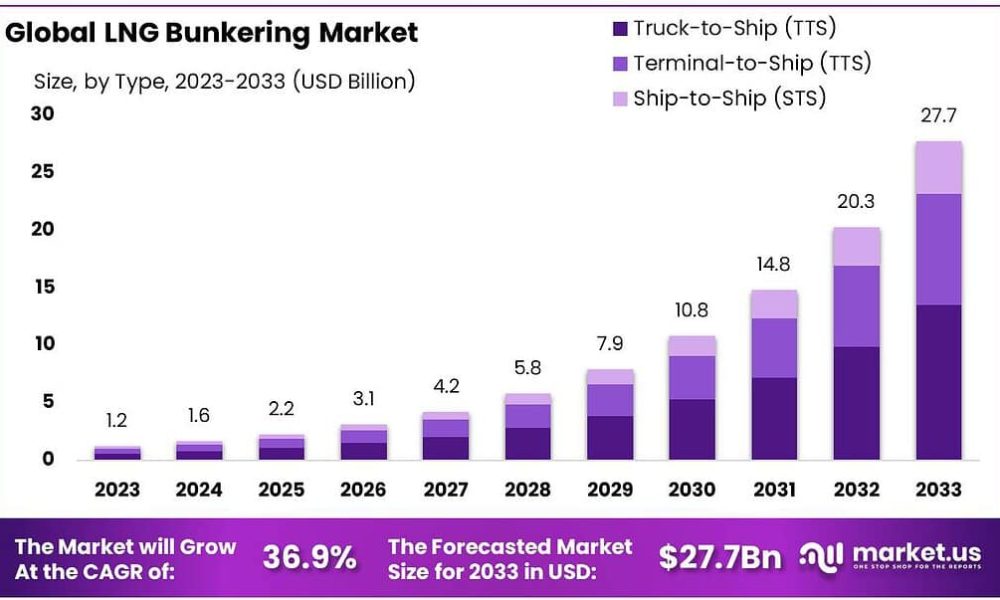
According to market.us, the LNG Bunkering market is projected to reach approximately USD 27.7 billion by 2033, rising from USD 1.2 billion in 2023, with an impressive compound annual growth rate (CAGR) of 36.9% during the forecast period from 2023 to 2033.
This rapid expansion is largely driven by the maritime sector’s transition toward low-emission fuel options amid tightening global environmental standards. Liquefied Natural Gas (LNG) is gaining prominence as a cleaner marine fuel, offering substantial reductions in greenhouse gas emissions and sulfur oxides, thereby aligning with International Maritime Organization (IMO) regulations.
Key shipping regions such as Europe, Asia-Pacific, and North America are witnessing increased investment in LNG bunkering facilities, supported by favorable regulatory frameworks and policy incentives. Advancements in bunkering technologies, including safer and more efficient transfer systems, are enhancing operational feasibility across diverse vessel categories. The growing fleet of LNG-fueled ships, spanning bulk carriers, tankers, and passenger liners, continues to drive demand for reliable fueling infrastructure.
Additionally, the adoption of dual-fuel engines and the retrofitting of existing ships are reinforcing market growth. With global ports increasingly integrating LNG bunkering solutions into their energy transition strategies, the market is expected to gain strong momentum, supported by long-term goals of carbon neutrality and maritime sustainability.
Key Takeaways
- Market Growth: LNG bunkering market projected to reach USD 27.7 billion by 2033, with a CAGR of 36.9% from 2023’s USD 1.2 billion.
- Bunkering Methods: Truck-to-Ship (TTS) dominated with 48.6% market share in 2023, offering flexibility.
- Vessel Types: Container ships lead with 62.4% market share in 2023, driven by global trade reliance.
- Applications: Industrial & Commercial segment holds 68.3% market share in 2023, driven by cargo transport.
- Europe’s Dominance: Europe maintains 45.6% market share in 2023, driven by stringent regulations and sustainability initiatives.
Access a Complimentary Sample of This Premium Report: https://market.us/report/lng-bunkering-market/request-sample/
Factors Affecting the Growth of the LNG Bunkering Market
Stringent Environmental Regulations: The implementation of strict emission norms by international bodies, particularly the International Maritime Organization (IMO), is a key driver pushing the adoption of cleaner marine fuels. These regulations mandate reductions in sulfur oxides, nitrogen oxides, and carbon emissions from vessels, encouraging shipping companies to adopt LNG as a compliant alternative.
Expansion of LNG-Fueled Fleet: The increasing number of LNG-powered vessels across various segments—including cargo, cruise, and container ships—is directly influencing the demand for LNG bunkering services. As more operators invest in new LNG-fueled ships or retrofit existing ones, the need for accessible and efficient fueling infrastructure continues to rise.
Infrastructure Development at Ports: The growth of LNG bunkering is closely linked to the availability and readiness of port infrastructure. Investment in storage terminals, refueling systems, and safety mechanisms at major ports significantly impacts the market’s scalability and operational efficiency.
Government Incentives and Policies: Supportive government measures, including financial subsidies, tax benefits, and public-private partnerships, play a vital role in accelerating the adoption of LNG as a marine fuel. National policies aimed at reducing maritime emissions are fostering favorable conditions for bunkering infrastructure expansion.
Technological Advancements: Innovations in LNG transfer systems, cryogenic storage, and fueling procedures have enhanced safety, minimized refueling time, and improved cost-efficiency. These technological improvements make LNG bunkering more viable for a wider range of vessels, thus driving market adoption.
Key Market Segmentation
By Type Analysis
In 2023, the Truck-to-Ship (TTS) bunkering method accounted for over 48.6% of the LNG bunkering market share. This approach involves transferring LNG directly from a road tanker to a vessel at port, offering high flexibility and ease of use, particularly for smaller ports with limited LNG infrastructure. Its cost-effectiveness and quick deployment make it ideal for ports and operators beginning their shift to LNG, despite volume limitations.
Terminal-to-Ship (TTS) bunkering, which uses fixed pipelines from onshore terminals to vessels, has gained strong momentum due to its capacity to handle large LNG volumes. This method is especially well-suited for fueling larger ships such as tankers and container vessels. With the development of dedicated LNG terminals at major global ports, this segment is growing rapidly, offering a stable and continuous LNG supply chain.
Ship-to-Ship (STS) bunkering enables LNG transfer between vessels either offshore or while docked, providing maximum flexibility in terms of time and location. This method supports uninterrupted operations by allowing ships to refuel without deviating significantly from their course.
By Vessel Type Analysis
In 2023, container ships dominated the LNG bunkering market, accounting for over 62.4% of the total share. This dominance is driven by their role in global trade and predictable operating schedules, which simplify LNG refueling logistics. The push to meet environmental regulations has encouraged widespread adoption of LNG among container ship operators for both new builds and retrofits.
Tankers, responsible for transporting liquid cargo like crude oil and chemicals, are gradually shifting toward LNG as a bunker fuel. Although factors such as cargo compatibility and long voyage durations influence fuel choices, the long-term cost and emission benefits of LNG have led to growing adoption, particularly in Emission Control Areas (ECAs).
Ferries serving short sea routes have emerged as early adopters of LNG due to their regular routes and proximity to bunkering infrastructure. Operating largely within ECAs, these vessels benefit from LNG’s low emissions and cost efficiency.
Cruise ships are increasingly turning to LNG to align with environmental standards and improve passenger comfort. LNG’s cleaner combustion supports operations in ecologically sensitive zones and helps cruise lines meet their sustainability goals.
Offshore Support Vessels (OSVs), serving the offshore oil and gas sector, are also adopting LNG to lower emissions and reduce fuel costs. As offshore activities grow, the demand for LNG-fueled OSVs is expected to increase steadily.
By Application Analysis
In 2023, the Industrial & Commercial segment led the LNG bunkering market with a dominant share of over 68.3%. This segment includes container ships, bulk carriers, and other commercial vessels vital to international trade and logistics. The high market share is primarily driven by the maritime industry’s response to global emissions regulations, prompting a shift toward cleaner fuels like LNG to comply with environmental standards.
The Defense segment, although smaller in comparison, plays a notable role in the LNG bunkering landscape. Naval forces are increasingly adopting LNG to reduce dependence on traditional marine fuels and enhance operational sustainability.
This shift is influenced by strategic priorities such as energy security, fuel efficiency, and regulatory compliance during missions. The gradual adoption of LNG in submarines and surface vessels reflects the defense sector’s evolving commitment to environmentally responsible operations.
Market Key Segments
By Type
- Truck-to-Ship (TTS)
- Terminal-to-Ship (TTS)
- Ship-to-Ship (STS)
By Vessel Type
- Container Ships
- Tankers
- Ferries
- Cruise Ships
- Offshore Support Vessels
- Others
By Application
- Industrial & Commercial
- Defense
- Others
Regional Analysis
As of 2023, Europe held a commanding 45.6% share of the global LNG bunkering market, solidifying its position as the leading region. This dominance stems from the region’s strong regulatory framework focused on reducing maritime emissions and promoting cleaner fuel alternatives. European governments have been at the forefront of implementing policies aimed at lowering greenhouse gas emissions, significantly driving the adoption of LNG as a marine fuel.
The widespread integration of LNG bunkering infrastructure across European ports reflects the region’s commitment to balancing maritime tradition with modern environmental responsibility. Europe’s approach has not only supported the maritime industry’s transition to cleaner energy but also boosted demand for LNG fueling services across container ships, ferries, and other vessels.
In addition, Europe’s emphasis on sustainability has fostered continuous innovation in LNG bunkering technologies, resulting in safer, more efficient, and environmentally sound fueling solutions. These efforts have positioned Europe not only as a market leader but also as a global model for LNG bunkering practices and policy-driven energy transitions in the maritime sector.
Market Key Players
- Shell
- TotalEnergies
- Engie
- ENN Energy Holdings Ltd.
- Gasum Ltd.
- Equinor ASA
- Korea Gas Corporation (KOGAS)
- Harvey Gulf International Marine LLC
- Skangas
- Gaslog Ltd.
- Crowley Maritime Corporation
- Polskie LNG
- Bomin Linde LNG GmbH & Co. KG
- Eagle LNG Partners
- Titan LNG
Get in Touch with Us:
Market.us (Powered By Prudour Pvt. Ltd.)
Address: 420 Lexington Avenue, Suite 300 New York City, NY 10170, United States
Send Email: [email protected]
Refer More Related Reports:



