
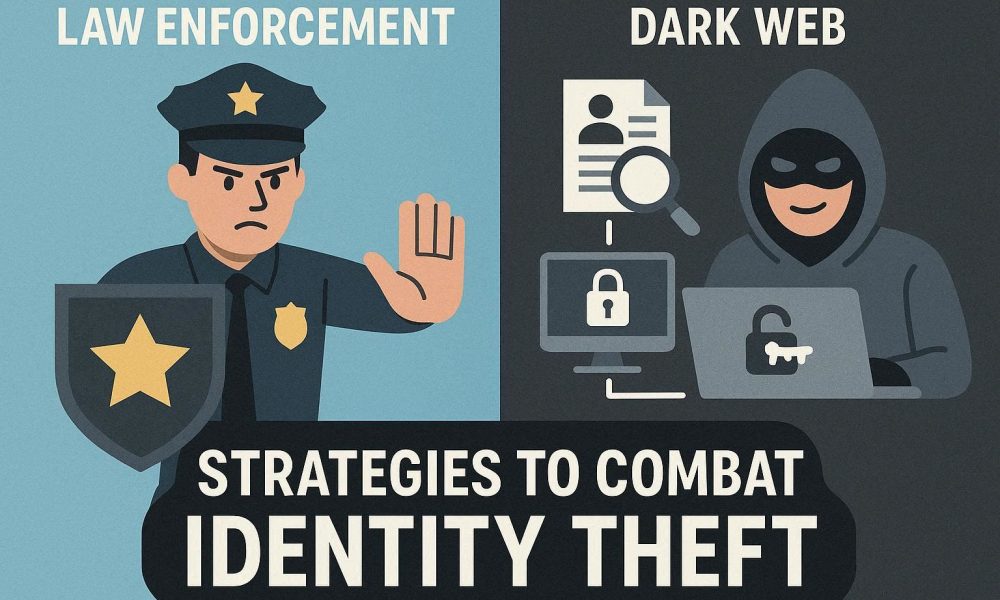
Authorities are adapting to the dark web’s anonymity with marketplace seizures, blockchain analysis, undercover intelligence, victim reporting systems, and international task forces designed to disrupt the stolen-identity economy before fake documents become real-world fraud.
WASHINGTON, DC, May 4, 2026,
The fight against identity theft has moved far beyond stolen wallets, mailbox fraud, counterfeit checks, and discarded bank statements, as the modern identity marketplace now operates within encrypted forums, dark web shops, breach dumps, crypto payment rails, and criminal service networks that can sell a stolen life globally within minutes.
For law enforcement agencies, the challenge is no longer simply finding a thief using a stolen credit card, because investigators must now track vendors, buyers, payment wallets, stolen document images, synthetic profiles, malware operators, phishing crews, crypto-laundering services, and offshore marketplace administrators hiding behind layered digital infrastructure.
The dark web has not made identity theft invisible, but it has made it more organized, scalable, and international, forcing authorities to treat stolen personal information as both a cybercrime and a financial crime, with victims in every jurisdiction.
The dark web identity economy turns stolen data into criminal infrastructure.
A stolen identity is no longer just a name and date of birth; it may also include Social Security numbers, passport scans, driver’s license images, account credentials, bank records, selfies, utility bills, phone numbers, address history, and answers to verification questions.
Criminals use those records to open bank accounts, bypass online identity checks, steal cryptocurrency, file tax fraud, obtain credit, rent property, create mule accounts, impersonate victims, and build synthetic identities that can survive weak onboarding systems for months or years.
The scale of the problem has forced investigators to think like financial analysts, cyber specialists, document examiners, and intelligence officers simultaneously, because stolen identity data becomes useful only when it is activated within real institutions.
That activation point is where law enforcement increasingly focuses, because every fake document upload, failed bank review, suspicious crypto account, shipping address, reused email, or marketplace order can become part of a larger investigative map.
The dark web may hide the storefront, but the fraud still needs access to the ordinary world, and that access creates the evidence investigators need.
Marketplace seizures are now a central weapon.
One of the most effective law enforcement strategies is to seize or dismantle identity marketplaces that sell fake documents, stolen personal data, and tools used to bypass verification systems.
In 2025, U.S. authorities announced the seizure of online marketplaces tied to fraudulent identity documents, with federal prosecutors saying the services offered counterfeit documents for all 50 U.S. states and multiple foreign countries and accepted cryptocurrency payments through marketplaces linked to millions in illicit proceeds.
The official Justice Department announcement on the VerifTools seizure showed that fake document platforms are no longer treated as fringe fraud shops, as they are now seen as infrastructure that supports account takeover, cryptocurrency theft, and broader cybercrime.
A marketplace seizure does more than remove a website; it can also give investigators access to servers, vendor records, customer orders, uploaded images, payment details, message logs, document templates, and technical clues that connect buyers and sellers.
The seizure banner that suddenly appears on a dark web market is not merely a warning sign, because it may mark the beginning of a long evidence analysis that continues long after the site itself disappears.
International cooperation is replacing isolated investigations.
Identity theft on the dark web rarely respects borders because a victim may live in Canada, a marketplace may be hosted through European infrastructure, a vendor may operate from Asia, a buyer may be in the United States, and cryptocurrency may move through several jurisdictions before cashing out.
That complexity has pushed law enforcement agencies toward joint operations involving federal prosecutors, national cyber units, Europol, Interpol, financial intelligence units, and private cybersecurity firms capable of supplying technical leads.
A recent Reuters report on international cybercrime website seizures described coordinated action against online communities accused of enabling stolen credentials, cybercrime tools, and other fraud-related activity, showing how international pressure has become routine rather than exceptional.
These operations matter because dark web criminals often depend on jurisdictional delay, assuming that agencies will struggle to share evidence, preserve servers, coordinate arrests, and translate digital clues across national systems.
When agencies cooperate quickly, the advantage shifts because vendors can lose domains, servers, payment channels, customer lists, and operational confidence before they can rebuild elsewhere.
Blockchain analysis has weakened the myth of anonymous payment.
Cryptocurrency helped dark web identity fraud grow by allowing buyers and sellers to move value without ordinary card processors, bank wires, chargebacks, or merchant compliance reviews.
Yet the same blockchain systems that criminals once treated as invisible can become evidence when investigators analyze wallet movements, exchange accounts, transaction clusters, marketplace addresses, and cash-out points connected to real identities.
The buyer who thinks a crypto payment disappears may not understand that blockchain records can remain visible for years, while exchange records, device metadata, chat logs, vendor seizures, and uploaded files can later connect payment activity to specific identity-fraud purchases.
Law enforcement does not need to solve every transaction immediately because a seized marketplace, cooperating exchange, recovered wallet, or arrested vendor can reopen older payments that seemed safe at the time.
The dark web promise of anonymous payment has become less convincing in an era where financial intelligence and blockchain tracing increasingly turn digital currency into a delayed receipt.
Undercover work still matters, even in digital markets.
Despite the rise of blockchain tracing and server seizures, traditional undercover investigation remains important because identity markets depend on trust between vendors and buyers.
Investigators may monitor forums, track vendor reputations, review marketplace listings, identify repeated language patterns, connect aliases across sites, and follow how criminals advertise fake passports, stolen data, verification selfies, or synthetic identity bundles.
The goal is not merely to buy evidence, because the larger objective is to understand supply chains, identify administrators, link vendors to payment routes, and determine which stolen records are being used against victims.
Digital undercover work is difficult because criminals use encryption, invitation-only forums, reputation systems, escrow services, and constant migration between platforms, but those defenses can also create patterns because vendors often reuse branding, customer support language, pricing structures, or technical habits.
The same underground reputation that helps criminals sell can eventually help investigators connect one alias to another.
Victim reporting turns individual loss into investigative intelligence.
A single identity theft report may seem small to a victim whose bank account was frozen or whose credit file was damaged, but aggregated reports can reveal patterns that lead investigators toward larger fraud networks.
When victims report unauthorized accounts, fake tax filings, stolen identity documents, phishing attempts, and crypto-related fraud, those complaints can help agencies identify common email addresses, phone numbers, IP ranges, wallets, mule accounts, document templates, and marketplace activity.
This is why rapid reporting matters: the sooner victims notify banks, platforms, credit bureaus, and official reporting systems, the greater the chance that funds can be frozen, accounts preserved, and evidence linked to other cases.
Identity theft is often designed to make victims feel isolated, but law enforcement depends on victims creating records that can be combined into a larger intelligence picture.
The personal report that looks like one person’s nightmare may become the missing link in a multi-state or international investigation.
Financial institutions have become front-line investigators.
Banks, crypto exchanges, payment processors, lenders, online brokerages, and fintech platforms are often the first places where stolen identities are tested against real systems.
Their compliance teams review identity documents, device fingerprints, transaction behavior, sources of funds, account velocity, withdrawal patterns, login geography, and inconsistencies between the applicant and the records presented.
A fake identity that passes a visual document check may still fail when the account begins receiving suspicious transfers, requests rapid withdrawals, logs in from unusual devices, or exhibits patterns associated with mule activity.
Law enforcement increasingly relies on these institutions because private compliance data can reveal the moment stolen identity material becomes financial crime.
The dark web may sell the identity, but banks and platforms often see the first attempt to monetize it.
Synthetic identity fraud has forced investigators to rethink victimhood.
Traditional identity theft involves a clear victim whose records are misused, but synthetic identity fraud blends real and fake information in ways that can hide harm for longer periods.
A criminal may combine a real Social Security number with a fabricated name, a rented address, a fake phone number, and a counterfeit license image, slowly building an apparently legitimate profile before obtaining credit or opening accounts.
This makes the investigation harder because no single victim may immediately recognize the full extent of the fraud, especially when the real identity fragment belongs to a child, a deceased person, a dormant file, or someone whose credit is not actively monitored.
Law enforcement agencies and financial institutions now look for identity patterns rather than only victim complaints, including unusual credit-file growth, repeated address clusters, suspicious document templates, and shared devices behind supposedly unrelated applicants.
Synthetic identity fraud is dangerous because it turns stolen data into building material for fictional people who can still cause real financial losses.
Document verification has become a technological arms race.
Fake identity vendors advertise documents designed to pass weak onboarding systems, while banks, platforms, and agencies respond with liveness checks, document authentication tools, biometric comparison, chip validation, fraud analytics, and manual review for higher-risk cases.
This arms race has intensified as artificial intelligence tools make it easier to alter images, generate faces, imitate documents, and create believable supporting materials for fake identities.
The strongest defense is no longer a single document check, because criminals can often fabricate a convincing image.
The better defense is layered verification, in which institutions compare documents, biometrics, device behavior, address history, banking activity, tax records, sources of funds, and consistency over time.
Criminal identities usually fail when they are asked to behave like real lives instead of single uploaded files.
Dark web takedowns are disruptive, but they are not permanent victories.
When authorities seize a major marketplace, vendors and buyers often scatter to backup forums, encrypted channels, invitation-only groups, or replacement shops with new names and altered infrastructure.
That migration is why investigators treat takedowns as a disruption rather than a final victory: the purpose is to seize evidence, damage trust, expose administrators, identify customers, and raise the cost of criminal participation.
Each takedown can also create paranoia within the underground economy because users do not know whether a successor site is legitimate, compromised, monitored, or operated by scammers who steal from other criminals.
Disruption matters because cybercrime markets depend on confidence, and repeated seizures make buyers and sellers less certain that the person on the other side of the transaction is safe.
The goal is not to eliminate identity fraud in one strike, but to make the market less stable, less profitable, and less trusted.
Public education is now part of the enforcement strategy.
Law enforcement agencies increasingly warn consumers about identity theft, phishing, fake recovery services, crypto fraud, data breaches, and the dangers of uploading personal documents to unknown platforms.
Public education is not separate from criminal enforcement because fewer victims, faster reporting, and stronger account security make identity markets less profitable.
Consumers who use multifactor authentication, freeze credit when appropriate, monitor accounts, avoid phishing links, protect document scans, and report fraud quickly reduce the supply of usable identity material.
Education also helps people understand that recovery scams often follow identity theft, because criminals may impersonate investigators, banks, crypto recovery agents, or government officials to steal additional information from already frightened victims.
The strongest enforcement strategy begins before the crime, because every secured account is one less product for sale.
Lawful privacy must be separated from criminal anonymity.
The dark web identity economy thrives by confusing privacy with fraud, presenting stolen documents, fake passports, and synthetic identities as tools of personal freedom.
In reality, criminal anonymity hides accountability, harms victims, deceives institutions, and creates evidence that can follow buyers and sellers for years.
Lawful privacy differs because it protects people from stalking, kidnapping threats, extortion, hostile media attention, data broker exposure, and public targeting, while preserving truthful disclosure where required.
For individuals who need legitimate privacy protection, anonymous living strategies can support secure residence planning, communications discipline, digital cleanup, travel exposure control, and compliant financial continuity.
The distinction matters because the same person who needs privacy may be harmed by the dark web if they mistake criminal anonymity for lawful protection.
Identity restructuring must be built to survive scrutiny.
People seeking new lives after threats, reputational collapse, public exposure, or personal danger need solutions that can work with banks, border authorities, insurers, courts, tax advisers, and regulated institutions.
A fake document can only survive until the next serious question, while a lawful identity structure is designed to explain itself through recognized documentation, tax continuity, banking records, and clear eligibility.
For clients who need a lawful reset, new legal identity planning focuses on defensible documentation, compliance review, and identity continuity rather than on stolen records or counterfeit credentials.
This matters because law enforcement is becoming better at connecting fake documents to payment trails, marketplace records, and victims, making criminal identity purchases more dangerous than ever.
A new identity that cannot survive scrutiny is not a new life, because it is a delayed fraud case.
The future of dark web enforcement will be faster, more financial, and more coordinated.
The next phase of identity-theft enforcement will likely combine artificial intelligence detection, blockchain analytics, international task forces, faster platform reporting, stronger KYC systems, seized marketplace data, and closer cooperation between law enforcement and financial institutions.
Criminals will adapt with better forgeries, deeper synthetic profiles, encrypted communities, AI-generated identity materials, and smaller private markets, but those adaptations also create new patterns for investigators to study.
The contest will not be won by a single agency or technology because the identity theft economy spans cybercrime, financial crime, document fraud, consumer protection, and organized crime.
Success will depend on how quickly agencies can integrate victim reports, marketplace intelligence, payment trails, platform signals, and international partners into a single investigative picture.
The dark web is resilient, but resilience is not immunity when every transaction, document, wallet, and login can become a clue.
The final lesson is that anonymity cuts both ways.
The dark web gives criminals a place to hide, but it also gives law enforcement a place to watch, map, infiltrate, seize, and analyze once investigators understand the ecosystem.
Identity thieves rely on stolen data, counterfeit documents, crypto payments, anonymous forums, and victim silence, while investigators increasingly rely on reporting, financial intelligence, blockchain records, platform cooperation, undercover work, and international action.
The battle is not simply between police and hackers, but a contest over whether identity can remain trustworthy in a world where personal data is constantly stolen, traded, repackaged, and resold.
For victims, the message is to report quickly, secure accounts, preserve evidence, and treat exposed data as a long-term risk rather than a one-time inconvenience.
For anyone tempted to buy identity on the dark web, the message is even clearer: the same marketplace that promises invisibility may already be watched, seized, archived, or poised to turn the buyer’s desperation into evidence.




