
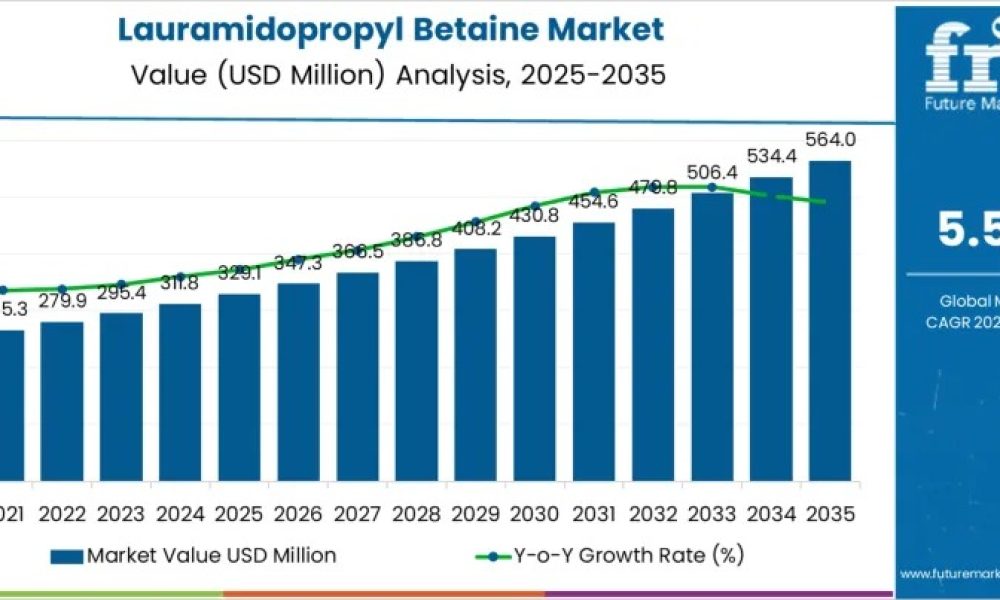
The lauramidopropyl betaine market is set to expand from USD 329.1 million in 2025 to USD 564.0 million by 2035, reflecting a compound annual growth rate (CAGR) of 5.5%. Early demand is primarily driven by its use as a conditioning co-surfactant in shampoos, body washes, facial cleansers, and men’s grooming products, where foam stabilization and viscosity control are critical.
Favored for formulations targeting reduced irritation and improved skin feel compared with conventional anionic surfactants, lauramidopropyl betaine is steadily gaining traction across personal hygiene production in both mass retail and salon-grade channels. Procurement patterns indicate long validation cycles, supporting consistent reorder behavior from major brand owners.
Explore trends before investing – request a sample report today! https://www.futuremarketinsights.com/reports/sample/rep-gb-29434
Lauramidopropyl betaine’s global market expansion is largely underpinned by its amphoteric structure, which allows it to work harmoniously with both anionic and non-ionic surfactants. From 2025 to 2030, the market is projected to grow from USD 329.1 million to USD 408.2 million, driven by its consolidation as a core foam booster and secondary surfactant in sulfate-free shampoos, facial cleansers, liquid hand soaps, and baby care products. The ingredient’s compatibility with sensitive skin formulations and consistent performance across varying water hardness conditions ensures its steady uptake in institutional and export-oriented personal care manufacturing.
Beyond 2030, the market value is expected to reach USD 564.0 million by 2035. This back-weighted growth reflects higher penetration into refill-based personal care systems, concentrated cleanser formats, and professional salon products. Incremental demand is also anticipated in oral care and medical cleansers, where controlled foam and low irritation profiles provide additional formulation value.
Quick Stats of the Lauramidopropyl Betaine Market
- Market Value (2025): USD 329.1 million
- Forecast Value (2035): USD 564.0 million
- Forecast CAGR (2025–2035): 5.5%
- Leading Product Form: Powder (17.4%)
- Key Growth Regions: Asia Pacific, Europe
- Top Players: BASF SE, Croda International, Evonik Industries, Symrise (incl. IFF/Givaudan actives), Dow Inc., Ashland, Clariant, Seppic
The market initially grew as formulators sought alternatives to cocamidopropyl betaine that offered stronger foam structure, improved viscosity control, and enhanced cleansing performance. Derived from lauric acid, lauramidopropyl betaine delivers a slightly heavier, more robust surfactant profile suitable for high-lather, oil-removing products, including shampoos for oily hair, men’s grooming formulations, and liquid body cleansers. Its amphoteric nature reduces irritation while maintaining cleansing efficacy, positioning it as a preferred secondary surfactant in modern personal care systems.
The ingredient’s adoption is primarily structured by end-use application and product form. Skin care accounts for 11.6% of total demand, followed by body care, hair care, sun care, color cosmetics, men’s grooming, baby care, and dermocosmetics. By product form, powder leads with 17.4% of total consumption due to precise dosing capabilities, low moisture content, and high shelf stability, making it ideal for both bulk blending and solid cleanser manufacturing.
Why Powder Dominates
- Ensures consistent foam height and rinse feel in facial cleansers, shampoos, and body washes
- Improves shelf stability by reducing hydrolytic degradation
- Supports automated feeding in continuous manufacturing lines
- Reduces transport weight and leakage risks
Lauramidopropyl betaine serves as an internal buffer for high-foam cleansers. Its zwitterionic structure mitigates protein denaturation on the skin while maintaining sebum dispersion. In shampoos and body washes, it cushions strong anionics, balancing foam volume and post-rinse tightness. The lauryl chain further enhances grease removal and foam elasticity, particularly valuable in sports shampoos, heavy-duty body washes, and men’s grooming products.
Global growth is particularly robust in India (CAGR 7.5%) and China (CAGR 6.9%), driven by rising personal care production, export-oriented manufacturing, and mass adoption of mild surfactant systems. Japan, the UK, Germany, and the USA demonstrate moderate but steady growth, reflecting mature markets with consistent demand for high-quality, low-irritation formulations.
Subscribe for Year-Round Insights → Stay ahead with quarterly and annual data updates! https://www.futuremarketinsights.com/reports/brochure/rep-gb-29434
Leading suppliers such as BASF SE, Croda International, Evonik Industries, Symrise, Dow Inc., Ashland, Clariant, and Seppic continue to dominate the market. Large-scale producers focus on regulatory compliance, consistent bulk supply, and global distribution, while smaller suppliers cater to specialty, eco-certified, or premium formulations. Rising consumer preference for sulfate-free, biodegradable, and “clean label” products further supports lauramidopropyl betaine adoption across personal care, hygiene, and household cleaning markets.
As the market advances, lauramidopropyl betaine is poised to remain a critical ingredient for formulators seeking a balance of mildness, foam stability, and effective cleansing across diverse global product portfolios.
About Future Market Insights (FMI)
Future Market Insights, Inc. (FMI) is an ESOMAR-certified, ISO 9001:2015 market research and consulting organization, trusted by Fortune 500 clients and global enterprises. With operations in the U.S., UK, India, and Dubai, FMI provides data-backed insights and strategic intelligence across 30+ industries and 1200 markets worldwide.



