
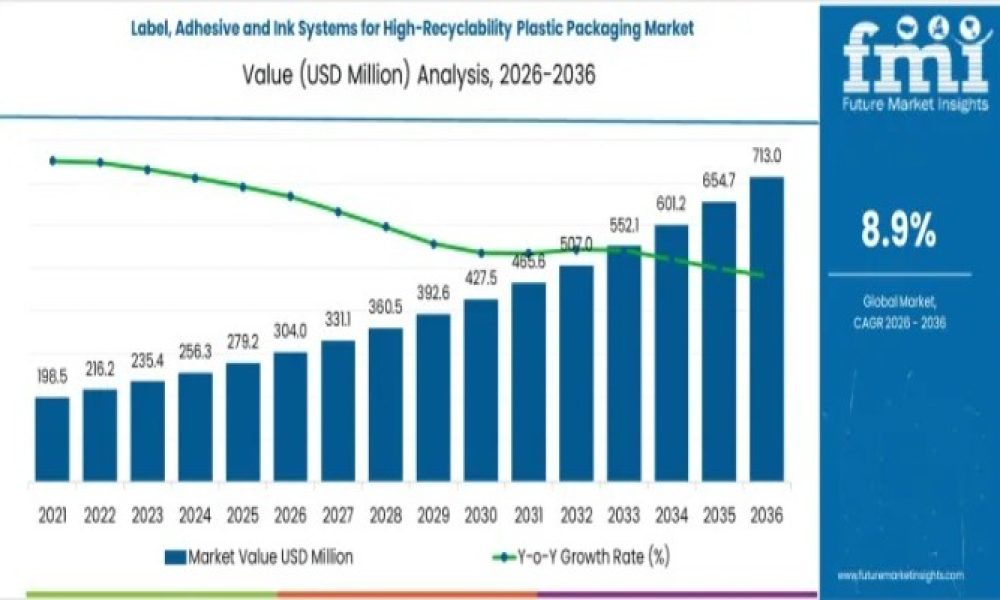
The global Label, Adhesive and Ink Systems for High-Recyclability Plastic Packaging Market is entering a decade of sustained expansion as sustainability shifts from a voluntary initiative to a regulatory and operational necessity across packaging value chains. Valued at USD 304 million in 2026, the market is forecast to reach USD 713 million by 2036, growing at a robust CAGR of 8.9%. This growth reflects not only rising demand for recyclable plastic packaging but also the increasing importance of compatible labeling, adhesive, and ink technologies that do not disrupt recycling streams.
From food and beverages to FMCG, personal care, and industrial applications, brand owners and converters are recognizing that recyclability performance is no longer determined solely by the base plastic. Labels, inks, and adhesives have emerged as critical enablers of circular packaging design, driving both near-term adoption and long-term structural value creation.
Discover Growth Opportunities in the Market – Get Your Sample Report Now
Market Growth Outlook: Two Phases of Accelerated Adoption
Between 2026 and 2031, the market is expected to expand from USD 304 million to approximately USD 451 million. This initial phase is driven by early adoption in high-volume food, beverage, and FMCG packaging, where regulatory pressure and sustainability commitments are strongest. During this period, manufacturers are piloting recyclable-compatible adhesives, low-impact inks, and label materials across selective SKUs, validating wash-off performance, print clarity, and line efficiency.
From 2031 to 2036, growth accelerates as cumulative market value rises from roughly USD 451 million to USD 713 million. This second phase reflects broader industrial adoption, portfolio-wide integration, and repeat procurement across multinational packaging lines. Improvements in adhesive chemistry, de-inkable inks, and standardized recyclable label formats support large-scale deployment, reinforcing a resilient and expanding market trajectory.
Quick Market Snapshot
- Market Value (2026): USD 304 million
- Forecast Value (2036): USD 713 million
- Forecast CAGR (2026–2036): 8.9%
- Leading Packaging Format: Roll-stock labels & shrink sleeves (45%)
- Key Growth Regions: India, China, USA, Brazil, Germany, Japan
What Is Driving Market Demand?
Initial demand for high-recyclability label, adhesive, and ink systems emerged from challenges in mechanical recycling. Conventional labels and adhesives often leave residues or contaminate polymer streams, lowering recycled resin quality. Early adopters in beverages, personal care, and consumer goods began testing systems that enable clean separation during sorting and washing processes.
Looking ahead, demand is increasingly compliance-driven rather than experimental. Regulatory frameworks now define recyclability criteria that explicitly consider label removal, adhesive residue, and ink behavior. Extended producer responsibility (EPR) schemes and circular economy mandates are pushing packaging developers to integrate compatible labeling solutions into core design strategies. Advances in water-soluble adhesives, heat-release technologies, and minimal-impact ink formulations are widening application scope and accelerating adoption.
Key Takeaways by End Use and Packaging Format
By End Use Application
- Beverage & FMCG (≈40%) dominate demand due to high labeling volumes and strict recyclability requirements.
- Personal Care balances durability, aesthetics, and recycling compliance.
- Food Packaging emphasizes safety, migration control, and regulatory alignment.
- Retail, Industrial, and Logistics Labels prioritize barcode clarity, adhesion reliability, and recyclability compatibility.
Demand remains stable across applications because labeling is integral to product identification and compliance, not discretionary branding.
By Packaging Format
- Roll-stock labels and shrink sleeves (45%) lead due to scalability and compatibility with high-speed lines.
- In-mold labels serve durable containers requiring seamless integration.
- Pressure-sensitive labels remain common in food packaging for flexibility.
- Thermal and functional labels support retail and logistics tracking needs.
Rather than shifting formats, producers focus on material and adhesive optimization within established systems, stabilizing demand.
Regional Growth Highlights
- India (CAGR 11.5%) leads growth, supported by organized FMCG manufacturing, urban retail expansion, and cost-aligned recyclable labeling solutions from domestic suppliers.
- China (10.5%) follows closely, driven by industrial packaging scale, e-commerce growth, and rapid supplier capacity expansion.
- United States (8.6%) sees steady adoption in food, beverage, and personal care packaging, supported by sustainability mandates and predictable procurement cycles.
- Brazil (7.5%) benefits from expanding organized retail and packaged consumer goods distribution.
- Germany (6.8%) reflects compliance-driven adoption under strict recycling regulations.
- Japan (5.0%) maintains stable, replacement-driven demand in mature packaging markets.
Competitive Landscape: Established Leaders and Emerging Innovators
Competition in the market is shaped by suppliers aligning formulations with recyclability standards rather than scale alone.
Established global players include:
- Avery Dennison, offering pressure-sensitive label materials designed for clean separation
- Henkel, supplying wash-off and recyclable-compatible adhesive systems
- Siegwerk and Toyo Ink, advancing de-inkable and low-migration ink technologies
- BASF, supporting the market through adhesive chemistry and base materials
Regional and integrated players add depth and agility:
- LINTEC strengthens specialty label supply in Asia
- CCL adapts localized label production to regional recycling systems
- Shantou Label supports cost-competitive export packaging
- UFlex and Huhtamaki India integrate labels and inks within flexible packaging operations
- Aplix and local converters focus on application-specific customization and rapid response
Together, these companies are shaping a market where technology validation, converter collaboration, and recyclability compliance define competitive advantage.
Why FMI: https://www.futuremarketinsights.com/why-fmi
About Future Market Insights (FMI)
Future Market Insights, Inc. (FMI) is an ESOMAR-certified, ISO 9001:2015 market research and consulting organization, trusted by Fortune 500 clients and global enterprises. With operations in the U.S., UK, India, and Dubai, FMI provides data-backed insights and strategic intelligence across 30+ industries and 1200 markets worldwide.



