
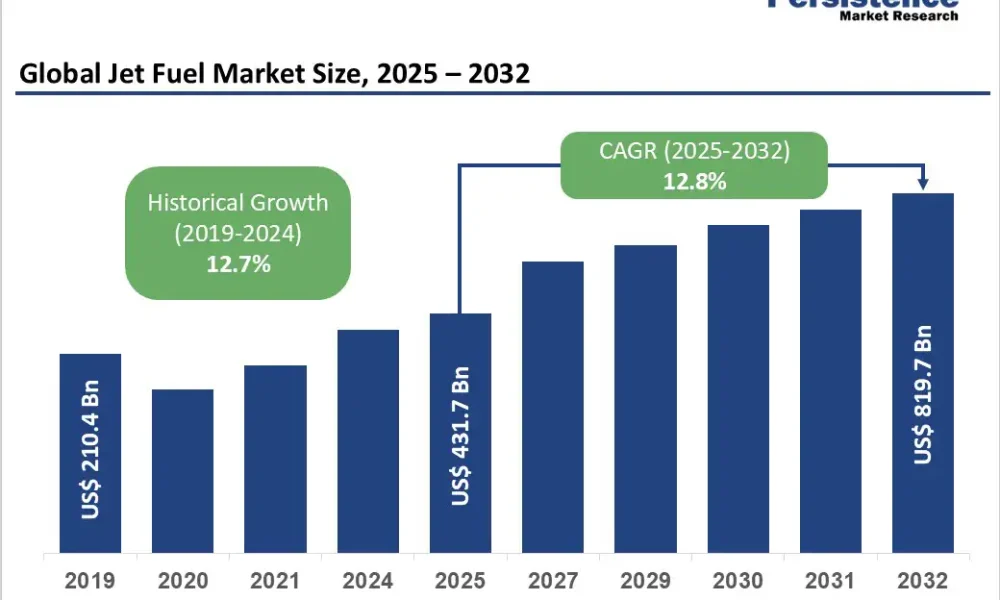
According to Persistence Market Research, the global Jet Fuel Market is projected to witness substantial expansion over the forecast period. The global jet fuel market size is likely to be valued at US$431.7 Billion in 2025, and is estimated to reach US$819.7 Billion by 2032, growing at a CAGR of 12.8% during the forecast period 2025 – 2032. This robust growth trajectory reflects increasing global aviation activity, modernization of airline fleets, and growing air passenger traffic worldwide. The market plays a critical role in supporting both commercial aviation and defense operations, making it an essential component of the global energy and transportation ecosystem.
Rising air travel demand remains the primary factor accelerating market expansion. The expansion of commercial airlines, especially in developing economies, coupled with increasing investments in airport infrastructure, is strengthening fuel consumption patterns. Rapid urbanization and rising disposable incomes are encouraging international and domestic travel, significantly boosting jet fuel consumption. The commercial aviation segment continues to lead the market due to its large-scale fuel requirements, while developing economies are emerging as key growth regions driven by infrastructure upgrades and airline route expansions.
Download Your Free Sample & Explore Key Insights : https://www.persistencemarketresearch.com/samples/35745
Key Highlights from the Report
➤ The global jet fuel market is projected to grow from US$431.7 Billion in 2025 to US$819.7 Billion by 2032.
➤ The market is expected to register a CAGR of 12.8% during the forecast period 2025 – 2032.
➤ Rising global air passenger traffic is a central factor driving jet fuel demand.
➤ Expansion of commercial airlines in developing economies significantly supports market growth.
➤ Increasing investments in airport infrastructure are strengthening long-term fuel consumption.
➤ Commercial aviation remains the leading segment due to high and consistent fuel usage.
Market Segmentation
The Jet Fuel Market can be segmented based on product type and end-user applications. In terms of product type, jet fuel variants are primarily differentiated by their application in commercial or defense aviation. Commercial-grade jet fuel dominates overall consumption, as it supports passenger airlines and cargo carriers operating on domestic and international routes. Defense aviation also represents a vital segment, with military aircraft requiring consistent fuel supplies for operational readiness. The commercial segment’s dominance is attributed to expanding airline fleets and the steady rise in global flight frequencies.
From an end-user perspective, the market is broadly categorized into commercial airlines and defense aviation operators. Commercial airlines account for the largest market share due to increasing passenger mobility and global tourism recovery trends. Cargo operators are also contributing significantly as cross-border trade volumes expand. Defense aviation maintains stable demand supported by national security requirements and routine fleet operations. The steady rise in airport development projects worldwide is reinforcing demand across both end-user segments, ensuring sustained consumption growth.
Get Personalized Data – Request Customization Today : https://www.persistencemarketresearch.com/request-customization/35745
Regional Insights
Developing economies are emerging as prominent growth regions in the Jet Fuel Market. Rising disposable incomes, expanding middle-class populations, and improved connectivity are stimulating air travel demand. Governments in these regions are heavily investing in airport infrastructure to accommodate increasing passenger volumes. The expansion of commercial airlines and new route launches are directly influencing fuel consumption trends, strengthening overall market performance.
Mature aviation markets also contribute significantly through consistent passenger traffic and established airline networks. Infrastructure modernization and operational efficiency improvements are supporting steady demand levels. While developing economies exhibit rapid growth momentum, established markets provide stability and predictable consumption patterns. This balanced regional contribution enhances long-term market resilience and revenue visibility.
Market Drivers
The primary driver of the Jet Fuel Market is the sharp rise in global air travel demand. Increasing domestic and international passenger traffic has resulted in higher flight frequencies and expanded airline operations. Developing economies are witnessing strong growth in first-time flyers, further increasing fuel consumption. As airlines introduce new aircraft and expand fleets, fuel requirements continue to rise proportionally.
Another key driver is the expansion of commercial airlines supported by improved connectivity and economic development. Investments in airport infrastructure, including runway expansion and new terminal construction, are enabling higher aircraft movement. Enhanced logistics networks and growing cargo transportation are also strengthening jet fuel demand. These structural developments create sustained momentum for market expansion throughout the forecast period.
Market Restraints
Despite strong growth prospects, the Jet Fuel Market faces challenges linked to market volatility and operational uncertainties. Fluctuations in aviation activity due to global economic conditions can influence fuel demand patterns. Variability in airline profitability may impact operational frequencies and expansion strategies, indirectly affecting fuel consumption volumes.
Infrastructure constraints in certain regions can also limit rapid market expansion. While investments are increasing, delays in airport development projects may temporarily restrict capacity growth. Additionally, evolving regulatory standards and operational compliance requirements can introduce cost pressures for aviation operators, potentially influencing fuel procurement strategies.
Market Opportunities
Significant opportunities lie in the modernization and expansion of airport infrastructure globally. As governments prioritize aviation as a driver of economic growth, new airport projects and terminal upgrades are accelerating. This expansion directly supports higher aircraft operations and fuel demand. Developing economies, in particular, present strong untapped potential for sustained jet fuel consumption growth.
The continued expansion of commercial airline networks offers further opportunities. Increasing connectivity between tier-2 and tier-3 cities and international hubs is stimulating additional flight routes. Rising investments in aviation ecosystems create a favorable environment for fuel suppliers and stakeholders. Over the forecast period, strategic collaborations between airlines and infrastructure developers are expected to unlock new growth avenues.
Checkout Now & Download Complete Market Report : https://www.persistencemarketresearch.com/checkout/35745
Company Insights
Key players operating in the Jet Fuel Market include:
- Shell plc
- TotalEnergies SE
- Chevron Corporation
- BP Plc
- ExxonMobil Corporation
- Phillips 66
- Neste Corporation
- Honeywell International Inc.
- Valero Energy Corporation
- LanzaTech
- Shell Aviation
- Sasol Limited
- Air BP
- Repsol SA
- World Energy
Recent Developments:
- January 2025: Major global fuel suppliers expanded long-term aviation fuel supply agreements to strengthen distribution networks.
- September 2024: Increased investments were announced for aviation infrastructure development projects supporting rising fuel demand.
Future Opportunities and Growth Prospects
The Jet Fuel Market is poised for sustained expansion driven by rising air travel demand, infrastructure investments, and commercial airline growth. With the market projected to nearly double in value between 2025 and 2032, stakeholders across the aviation fuel value chain are expected to benefit from long-term consumption growth. Strategic capacity expansion, regional diversification, and operational efficiency will play crucial roles in shaping the next phase of industry development.




