
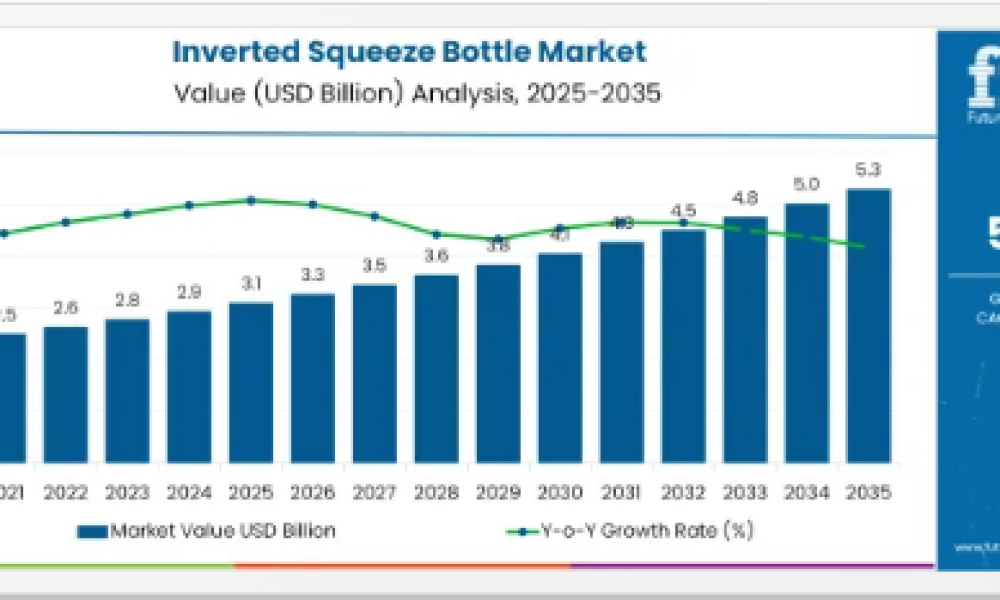
The global inverted squeeze bottle market is projected to grow from an estimated USD 3.1 billion in 2025 to USD 5.3 billion by 2035, registering a steady compound annual growth rate (CAGR) of 5.5%. This robust expansion underscores a powerful shift toward user-friendly, waste-minimizing packaging across food, personal care, and household sectors.
Key Market Insights at a Glance
Inverted squeeze bottles are gaining widespread traction as consumers demand efficient, mess-free dispensing that leaves minimal product waste. Much of the market’s momentum comes from growing adoption of viscous products—like sauces, lotions, and gels—that benefit from the upside-down design, which ensures complete evacuation. Simultaneously, brands are embracing sustainability by developing bottles with recyclable materials and ergonomic closures.
Material-wise, high-density plastics dominate, capturing 47.2% of market revenue in 2025, while closure designs led by flip-top caps, commanding 42.8% of the product-type segment, demonstrate that convenience and hygiene remain top priorities.
Segment Overview
By product type, the flip-top cap format leads primarily because of its ease of use: it enables swift, single-handed dispensing and prevents leakage, making it especially popular in food and personal care applications. In material terms, high-density plastic is favoured for its strength-to-weight balance, barrier properties, and recyclability.
On the end-use front, the food & beverages sector holds the lion’s share of demand—projected to contribute nearly 39.5% of market revenues in 2025. Condiments, dressings, spreads, and syrups benefit significantly from inverted squeeze delivery, allowing brands to offer precision dispensing and reduce leftover residue.
Regional Overview
Regionally, North America remains a dominant force thanks to its mature retail infrastructure and strong consumer appetite for convenience packaging. Europe follows closely, driven by stringent waste-reduction regulations and sustainability standards. However, Asia-Pacific is emerging as the most dynamic market, propelled by rapid urbanization, expanding e-commerce adoption, and rising incomes in major markets like China and India.
These three regions—North America, Europe, and Asia-Pacific—are collectively responsible for steering the majority of global demand, making them crucial battlegrounds for innovation and market leadership.
Competitive Landscape
The competitive landscape is moderately fragmented, featuring global packaging giants as well as nimble regional manufacturers. Key leaders include Flip-It, MJS Packaging, Amcor Plc, The Kraft Heinz Company, Hellmann’s, and Jiangyin Beauty Packaging Material Co. Ltd. These firms are leveraging advanced manufacturing techniques, broad distribution networks, and strong R&D capabilities to secure long-term contracts and reinforce brand differentiation.
Tier-1 players like Amcor and Berry Global hold significant market shares, while Tier-2 and Tier-3 firms focus on cost-efficient solutions, specialty closures, and sustainability to carve out niche opportunities.
Market Outlook: Powering the Next Decade
Over the next ten years, the inverted squeeze bottle market is poised to evolve around two powerful themes: sustainability and smart design. Brands are expected to intensify the use of recyclable, bio-based materials, and invest in closures that improve ergonomics while minimizing leakage. This innovation will further fuel adoption across end-use industries.
Regulatory pressures to reduce plastic waste combined with consumer demand for refillable or lightweight packaging will likely accelerate the transition. As companies launch eco-friendly variants and scale up recycling infrastructure, inverted squeeze bottles will increasingly become a symbol of responsible packaging without compromising functionality.
Key Players of the Sustainable Label Industry
Market frontrunners are leading the sustainable push. Amcor Plc is pioneering lighter, fully recyclable bottles; Flip-It and MJS Packaging are innovating in cap design and material use; The Kraft Heinz Company and Hellmann’s apply inverted squeeze technology to staple condiments; and Jiangyin Beauty Packaging Material Co. Ltd. is expanding in eco-friendly cosmetic packaging.
These companies are not only defining the future of inverted squeeze bottles but setting a new standard in sustainable, consumer-centered packaging.
Recent Strategic Developments
A number of strategic developments have crystallized in recent years: global players are forming alliances to accelerate sustainable production, investing in circular economy initiatives, and launching recycled or bio-plastic versions of their inverted bottles. Meanwhile, companies are optimizing manufacturing lines with automation and AI to improve efficiency, minimize carbon footprints, and meet growing demand.
Additionally, brands are engaging in consumer education campaigns, emphasizing the environmental benefits of choosing inverted squeeze bottles that reduce waste and support refill or recycling programs.
Subscribe for Year-Round Insights → Stay ahead with quarterly and annual data updates: https://www.futuremarketinsights.com/reports/sample/rep-gb-13646
Have a specific Requirements and Need Assistant on Report Pricing or Limited Budget please contact us – [email protected]
About Future Market Insights (FMI)
Future Market Insights, Inc. (FMI) is an ESOMAR-certified, ISO 9001:2015 market research and consulting organization, trusted by Fortune 500 clients and global enterprises. With operations in the U.S., UK, India, and Dubai, FMI provides data-backed insights and strategic intelligence across 30+ industries and 1200 markets worldwide.



