
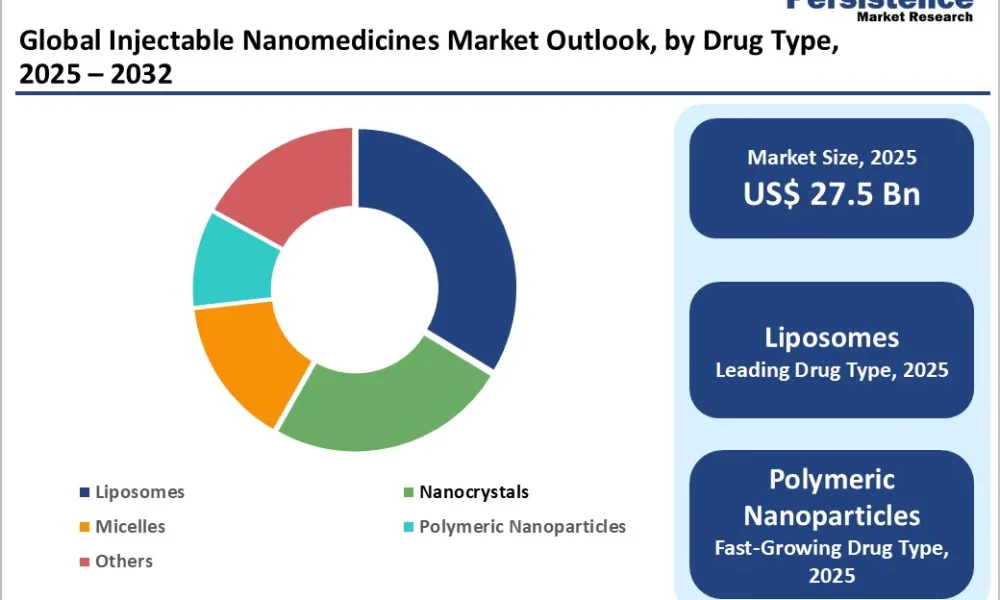
The global injectable nanomedicines market is witnessing robust growth as healthcare systems increasingly adopt advanced drug delivery technologies to improve therapeutic outcomes. Valued at US$27.5 billion in 2025, the market is projected to reach US$73.6 billion by 2032, expanding at a strong CAGR of 15.1% during the forecast period. This growth builds on a solid historical CAGR of 13.9% from 2019 to 2024, reflecting steady clinical adoption and technological maturity. Injectable nanomedicines leverage nanoscale carriers to deliver drugs with greater precision, enhanced bioavailability, and reduced systemic toxicity, positioning them as a critical component of modern therapeutics.
Industry Growth Drivers and Key Trends
The injectable nanomedicines industry is expanding steadily, driven by the rising burden of chronic diseases, especially cancer, along with increasing surgical volumes and heightened infection-control priorities. Healthcare providers are shifting toward safer, more efficient injectable therapies that minimize adverse effects while maximizing efficacy. Nanomedicines meet this demand by enabling targeted delivery, prolonged circulation times, and controlled drug release. The trend toward single-use and advanced injectable formulations further supports market growth, improving safety standards and operational efficiency in hospitals and clinics.
Market Size and Forecast
In 2025, the injectable nanomedicines market stands at US$27.5 billion and is forecast to grow to US$73.6 billion by 2032. This rapid expansion is underpinned by increasing clinical trial activity, regulatory approvals, and growing physician confidence in nanotechnology-based therapies. With a projected CAGR of 15.1% from 2025 to 2032, injectable nanomedicines represent one of the fastest-growing segments within the broader pharmaceutical and biotechnology markets.
Download Your Free Sample & Explore Key Insights: https://www.persistencemarketresearch.com/samples/25999
Key Industry Highlights
Liposomes dominate the market, accounting for 33.7% of the total share in 2025, making them the most widely adopted nanomedicine drug type. Their established regulatory track record and clinical success have driven widespread adoption, followed by nanocrystals and polymeric nanoparticles. From an application perspective, cancer treatment leads the market, as nanomedicines offer targeted delivery and significantly reduced side effects compared to conventional chemotherapy. Regionally, North America holds the largest market share due to advanced healthcare infrastructure and strong R&D investments, while Asia Pacific records the fastest growth fueled by expanding healthcare capacity and rising patient volumes.
Market Dynamics: Drivers
A primary driver of the injectable nanomedicines market is the growing demand for advanced, targeted drug delivery systems that enhance therapeutic efficacy while minimizing side effects. According to data from the U.S. FDA and ClinicalTrials.gov, over 2,000 nanomedicine-related clinical trials were registered globally as of 2021, with more than half focused on drug delivery applications and around 40% targeting cancer treatment. The FDA has approved over 50 nanoparticle-based drug delivery products, highlighting increasing clinical acceptance. Clinical outcomes strongly support this trend, with certain nanoparticle-based cancer therapies demonstrating a 25% increase in five-year survival rates compared to traditional chemotherapy and a 50% higher therapeutic response rate, reinforcing nanomedicines as a transformative approach in modern medicine.
Market Dynamics: Restraints
Despite strong growth prospects, the market faces challenges related to high manufacturing complexity and cost. Developing injectable nanomedicines requires precise control over particle size, charge, and morphology, demanding advanced equipment and specialized expertise. Ensuring batch-to-batch consistency and regulatory compliance involves rigorous validation processes that often exceed those of traditional pharmaceuticals. According to FDA guidance, many manufacturers struggle with large-scale production, facing costly scale-up failures. As a result, most approved nanomedicine products are developed by large pharmaceutical companies with the financial capacity to invest in sophisticated manufacturing and compliance, limiting participation from smaller players and increasing overall treatment costs.
Market Dynamics: Opportunities
Expanding applications in personalized and precision medicine present a major opportunity for the injectable nanomedicines market. Nanotechnology enables individualized therapies tailored to patient-specific disease profiles, particularly in oncology, infectious diseases, and rare disorders. More than 40% of registered nanomedicine clinical trials focus on cancer, reflecting strong alignment with precision medicine goals. FDA-approved nanomedicine products have demonstrated up to a 45% increase in successful treatment rates and a 25% improvement in five-year survival for certain cancers. Significant government support further accelerates this opportunity, with U.S. nanomedicine research funding reaching approximately $480 million in 2020, underscoring long-term confidence in these advanced therapies.
Category-wise Analysis: By Drug Type
Liposomes lead the injectable nanomedicines market with a 33.7% share in 2025 due to their proven safety, biocompatibility, and clinical efficacy. Their phospholipid bilayer structure allows encapsulation of both hydrophilic and hydrophobic drugs, improving circulation time and enabling targeted tissue delivery. As of 2023, the FDA had approved 15 liposomal drug products, including well-known cancer therapies such as Doxil® for ovarian and breast cancer. Clinical studies show that targeted liposomal formulations achieve up to threefold higher tumor cell uptake and more than 88% greater cytotoxicity compared to free drugs, significantly improving patient outcomes.
Category-wise Analysis: By Application
Cancer remains the dominant application segment in the injectable nanomedicines market due to the urgent need for effective, targeted therapies. FDA-approved nanomedicines such as Doxil and Abraxane have demonstrated improved pharmacokinetics, higher tumor drug concentration, and reduced systemic toxicity. Abraxane, a nanoparticle albumin-bound paclitaxel, has expanded indications across breast, lung, and pancreatic cancers, highlighting the versatility of nanomedicine platforms. With cancer prevalence rising globally and precision therapy becoming the standard of care, this segment continues to drive overall market growth.
Get Custom Insights Designed for Your Business: https://www.persistencemarketresearch.com/request-customization/25999
Regional Insights: North America
North America leads the injectable nanomedicines market, accounting for 41.1% of global share in 2025. This dominance is supported by advanced healthcare systems and the U.S. National Nanotechnology Initiative, which has invested over $45 billion since 2001. In 2024 alone, $2.16 billion was allocated toward nanotechnology research and development. Contributions from agencies such as the NIH, FDA, and NSF foster innovation, accelerate regulatory approvals, and support commercialization, maintaining North America’s leadership position.
Regional Insights: Europe
Europe is a significant market driven by strong public healthcare investments and research programs such as Horizon Europe. These initiatives promote collaboration among academic institutions, biotech firms, and pharmaceutical companies, accelerating nanomedicine innovation. Efficient regulatory frameworks and a strong focus on personalized therapies, particularly in oncology and rare diseases, further support market expansion. Collaborative projects like ERA4Health strengthen Europe’s role as a global hub for advanced drug delivery technologies.
Regional Insights: Asia Pacific
Asia Pacific is the fastest-growing region in the injectable nanomedicines market, propelled by rising healthcare spending, expanding hospital infrastructure, and a growing geriatric population. Countries including China, India, Japan, and South Korea are investing heavily in nanotechnology research and manufacturing capabilities. Government support, increasing clinical trial activity, and greater awareness of advanced therapies are accelerating adoption. The region’s high patient volumes and demand for affordable, life-saving treatments position Asia Pacific as a key growth engine through 2032.
Checkout Now & Download Complete Market Report: https://www.persistencemarketresearch.com/checkout/25999
Market Segmentation
By Drug Type
- Liposomes
- Nanocrystals
- Micelles
- Polymeric Nanoparticles
- Others
By Application
- Cancer
- Cardiovascular Diseases
- Central Nervous System Diseases
- Infection Control
- Inflammatory Diseases
- Others
By Region
- North America
- Europe
- East Asia
- South Asia & Oceania
- Latin America
- Middle East and Africa
Competitive Landscape
The injectable nanomedicines market is highly competitive, with leading companies focusing on high-volume sterile production, material innovation, and automated manufacturing. Strategic partnerships with hospitals and distributors ensure stable supply chains, while R&D efforts target safer, more effective, and sustainable formulations. Major players include Pacira Pharmaceuticals, Pfizer (Hospira), Novartis, Takeda Pharmaceuticals, Johnson & Johnson, Merck & Co., Roche, Sanofi, AstraZeneca, AbbVie, and Bristol Myers Squibb.
Recent Industry Developments
In October 2025, Pacira BioSciences presented real-world data on EXPAREL® demonstrating reduced postoperative pain and opioid use, reinforcing its value as a long-acting non-opioid therapy. In July 2025, Pacira expanded promotional efforts for ZILRETTA® through a strategic collaboration to enhance patient access across the U.S. Earlier, in August 2024, Novartis partnered with Lindy Biosciences to advance subcutaneous drug delivery using innovative microglassification technology, highlighting continued innovation within the injectable nanomedicines space.
Conclusion
The injectable nanomedicines market is poised for sustained growth through 2032, driven by rising disease burden, technological advancements, and strong investment in precision medicine. While manufacturing complexity remains a challenge, ongoing innovation, regulatory support, and expanding applications across oncology and chronic diseases will continue to propel the market forward, solidifying injectable nanomedicines as a cornerstone of next-generation healthcare.




