
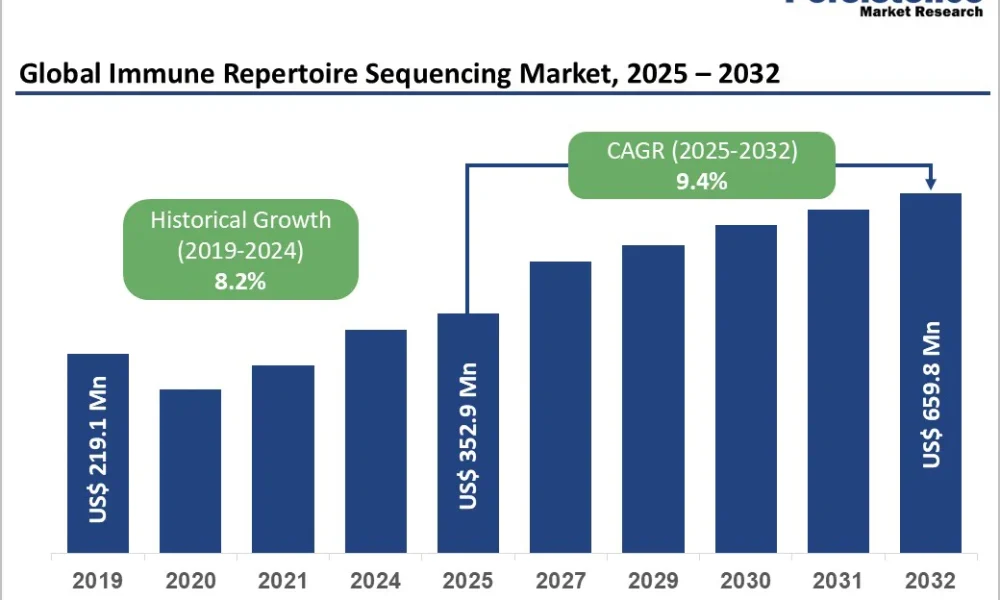
The global immune repertoire sequencing market is witnessing strong and sustained expansion as precision immunology becomes central to modern biomedical research and therapeutic development. Valued at US$352.9 million in 2025, the market is projected to reach US$659.8 million by 2032, registering a compound annual growth rate (CAGR) of 9.4% during the forecast period. This growth builds on solid historical momentum, with the market having grown at a CAGR of 8.2% between 2019 and 2024. Increasing reliance on data-driven insights to decode immune responses in cancer, infectious diseases, and vaccine development is positioning immune repertoire sequencing as a foundational technology across research and clinical pipelines.
Technology Overview and Market Context
Immune repertoire sequencing leverages next-generation sequencing (NGS) platforms to analyze the diversity and dynamics of B-cell receptors (BCRs) and T-cell receptors (TCRs). By decoding millions of unique immune receptor sequences simultaneously, the technology provides a high-resolution snapshot of how the adaptive immune system responds to disease, therapy, and vaccination. Its ability to identify clonal expansion, immune memory, and antigen-specific responses has made it indispensable in immuno-oncology, autoimmune research, and precision medicine. As sequencing costs decline and analytical tools mature, immune repertoire sequencing is increasingly integrated with single-cell and multi-omic approaches, further enhancing its scientific and clinical value.
Download Your Free Sample & Explore Key Insights: https://www.persistencemarketresearch.com/samples/14911
Key Industry Highlights
North America remains the leading regional market, accounting for 40.2% of global revenue in 2025. This dominance is underpinned by robust genomics infrastructure, a high volume of clinical trials, strong pharmaceutical and biotechnology R&D investment, and favorable reimbursement and regulatory frameworks. In contrast, Asia Pacific is emerging as the fastest-growing region, projected to expand at a CAGR of 11.8% through 2032. Rapid expansion of sequencing capacity in China and Japan, rising healthcare expenditure, and increasing international collaborations are key contributors to this acceleration.
From a product perspective, assay kits dominate the market with a 68.4% share, reflecting strong demand for standardized, scalable, and reproducible workflows. Drug discovery and development represent the leading application segment, accounting for 44.8% of market share, driven by the critical role of immune profiling in immunotherapy target identification and biomarker discovery. Pharma and biotech companies are the largest end users, holding 47.1% of the market, supported by high R&D spending and the need to accelerate therapeutic pipelines.
Market Dynamics: Drivers
One of the primary drivers of the immune repertoire sequencing market is the rapid advancement of next-generation sequencing technologies combined with collaborative innovation across academia and industry. Bulk sequencing continues to provide a cost-effective, high-throughput foundation for immune profiling, while repertoire sequencing enables precise characterization of immune responses to tumors, pathogens, and vaccines. This dual capability makes the technology central to modern immunology research.
A significant accelerator of adoption is the work of the Adaptive Immune Receptor Repertoire (AIRR) Community of The Antibody Society. By establishing data standards and best practices for generating, analyzing, and sharing AIRR-seq datasets, the community has improved data comparability and reproducibility across laboratories worldwide. Their emphasis on integrating AIRR data with other large-scale datasets, such as single-cell expression and flow cytometry, has further enhanced scientific utility.
Additionally, the transition from short-read bulk sequencing of TCRβ and immunoglobulin heavy chains to long-read and single-cell approaches is reshaping the market. These advanced methods allow researchers to trace immune clones, define functional states, and monitor immune dynamics over time. Initiatives such as Immunai’s Grand Collaboration Initiative are expanding access to large-scale single-cell multi-omic datasets, accelerating discovery and reinforcing the global adoption of immune repertoire sequencing.
Get Custom Insights Designed for Your Business: https://www.persistencemarketresearch.com/request-customization/14911
Market Dynamics: Restraints
Despite its promise, the immune repertoire sequencing market faces notable restraints related to data complexity and analytical challenges. The adaptive immune system generates immense receptor diversity over a lifetime, creating datasets of extraordinary scale and dimensionality. While this diversity offers valuable biological insight, it also complicates data interpretation and pattern recognition.
Machine learning and artificial intelligence approaches have been widely explored to decode AIRR data, but performance remains limited for many predictive tasks. High dimensionality, limited labeled datasets, and significant inter-individual variability restrict model generalization. As a result, translating repertoire-derived insights into robust clinical diagnostics or decision-support tools remains challenging. These scientific and computational hurdles slow clinical translation and highlight the need for improved algorithms, standardized datasets, and deeper functional annotation of immune receptors.
Market Dynamics: Opportunities
The continued evolution of high-throughput immune repertoire sequencing presents substantial opportunities across scientific and clinical domains. Detailed profiling of TCR CDR3 regions and immunoglobulin diversity enables earlier biomarker discovery, next-generation vaccine design, and improved monitoring of immune recovery in oncology and infectious diseases. As the technology becomes more embedded in clinical workflows, new applications are emerging in minimal residual disease monitoring, autoimmune disease stratification, and transplantation matching.
Technological opportunities are equally significant. Growing sequencing output is driving demand for cloud-based analytics, AI-assisted pattern recognition, and automated pipelines capable of managing full-length receptor data. These tools enhance reproducibility, reduce error rates, and support population-scale immune mapping initiatives. Strengthening collaborations between industry, academic consortia, and computational biology groups are expected to further accelerate innovation and expand the global footprint of immune repertoire sequencing during the forecast period.
Category-wise Analysis: By Product
Assay kits are projected to command 68.4% of the global immune repertoire sequencing market by 2025. Their dominance is attributed to standardized, ready-to-use formats that minimize technical variability and streamline complex workflows. Assay kits deliver consistent and reproducible results across laboratories, making them ideal for high-throughput studies in oncology, vaccine research, and autoimmune disease investigation. As demand for accuracy and rapid turnaround grows, assay kits are expected to remain the most reliable and scalable product category.
Category-wise Analysis: By Application
Drug discovery and development represent the leading application area, projected to account for approximately 38.4% of the market in 2025. Immune repertoire sequencing plays a critical role in identifying therapeutic targets, predicting patient response, and validating immunotherapy mechanisms. Integration with single-cell and multi-omic platforms enables deeper characterization of immune dynamics, strengthening candidate selection and accelerating preclinical validation. These capabilities position drug discovery as the most influential application segment in the market.
Category-wise Analysis: By End User
Pharma and biotech companies are expected to remain the dominant end-user segment, capturing around 38.4% of market share in 2025. Their leadership is driven by substantial R&D investments, early adoption of advanced sequencing technologies, and strategic collaborations with academic institutions. These organizations increasingly rely on immune repertoire analysis to accelerate therapeutic pipelines in oncology, infectious diseases, and autoimmune disorders, reinforcing their central role in market growth.
Regional Insights: North America
North America accounted for approximately 40.2% of the global immune repertoire sequencing market in 2025. The region benefits from a mature genomics ecosystem, extensive NGS infrastructure, and a high concentration of clinical trials incorporating immune profiling. In the United States, the growing cancer burden underscores the need for immune-based therapies and next-generation vaccines. With over two million new cancer cases expected in 2025, immune repertoire sequencing is increasingly used to track clonal evolution, evaluate treatment response, and guide personalized therapeutic strategies, sustaining North America’s market leadership.
Regional Insights: Europe
Europe is projected to capture nearly 28.4% of the global market by 2025. Strong government funding, rising healthcare expenditure, and a strategic focus on personalized medicine have accelerated adoption. The presence of collaborative academic consortia and translational research centers supports innovation, while increased competition among regional manufacturers has contributed to declining sequencing costs. These factors collectively reinforce Europe’s position as a key hub for immune repertoire sequencing research and commercialization.
Regional Insights: Asia Pacific
Asia Pacific is poised for the fastest growth, with a forecast CAGR of 11.8% through 2032. Rapid expansion of sequencing infrastructure in China and Japan, increasing healthcare investment, and a rising cancer burden are major growth drivers. Enhanced international collaborations and growing adoption of precision medicine approaches are accelerating the integration of immune repertoire sequencing into research and clinical practice, positioning Asia Pacific as a critical growth engine for the global market.
Checkout Now & Download Complete Market Report: https://www.persistencemarketresearch.com/checkout/14911
Market Segmentation
By Product
- Assay Kits
- TCR Kits
- BCR Kits
- Software & Services
By Application
- Drug Discovery and Development
- Clinical Diagnostics
- Research Applications
- Others
By End-user
- Pharma & Biotech Companies
- Diagnostic Labs
- Academic and Research Institutes
- Others
By Region
- North America
- Europe
- East Asia
- South Asia & Oceania
- Latin America
- Middle East and Africa
Competitive Landscape
The competitive landscape is shaped by rapid innovation in immune repertoire sequencing, single-cell analysis, and T-cell–targeted therapeutics. Companies are differentiating through advancements in paired-chain sequencing, automation of NGS workflows, and integration of discovery-to-clinical monitoring platforms. Strategic collaborations and licensing agreements are common, reflecting the industry’s emphasis on accelerating therapeutic development.
Recent developments include collaborations between Repertoire Immune Medicines and major pharmaceutical players to develop T cell–targeted and tolerizing therapies, the launch of advanced single-cell BCR and TCR products by Parse Biosciences, and performance enhancements in immune repertoire library kits by Qiagen. Key companies operating in the market include Illumina, PacBio, Agilent Technologies, Oxford Nanopore Technologies, QIAGEN, Thermo Fisher Scientific, Roche, BGI, Adaptive Biotechnologies, and several emerging specialists.
Outlook
As immune-based therapies and precision medicine continue to gain prominence, immune repertoire sequencing is set to play an increasingly central role in biomedical innovation. Ongoing advances in sequencing technology, analytics, and collaborative research frameworks are expected to overcome current limitations and unlock new clinical and commercial opportunities, sustaining robust market growth through 2032.




