
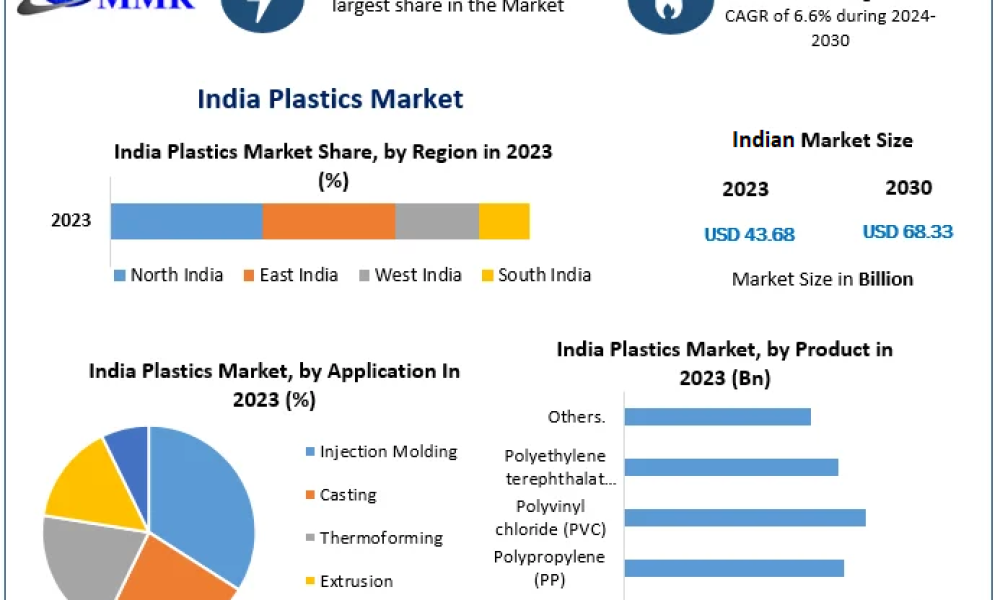
India Plastics Market Overview:
India Plastics Market valued at approximately USD 44 billion in 2024, is set for robust growth and is projected to reach around USD 77 billion by 2033, expanding at a compound annual growth rate (CAGR) of about 6.4%. The market’s expansion is underpinned by accelerating demand from packaging, automotive, construction, and consumer goods sectors. Increasing investments in advanced manufacturing technologies, supportive government initiatives, and growing emphasis on sustainable plastics further bolster the market outlook.
Key Highlights & Insights
Market Size & Growth: USD 44 billion in 2024, forecasted to grow to USD 77 billion by 2033 at a CAGR of 6.4%.
Dominating Region: Western India, primarily Gujarat and Maharashtra, accounts for approximately 47% of polymer consumption, supported by proximity to raw materials, well-developed infrastructure, and export facilities.
Leading Segment: Packaging remains the dominant end-use sector, accounting for about 42% of plastic consumption, fueled by rapid growth in e-commerce and food industries.
Key Driver: Rising demand for lightweight, durable, and cost-effective plastic products in the expanding packaging, automotive, and construction industries.
► Get a sample of the report:https://www.maximizemarketresearch.com/request-sample/120148/
Recent Developments
Significant expansions in polymer production capacity have been driven by key players including Reliance Industries Ltd, Indian Oil Corporation Ltd, GAIL (India) Ltd, Supreme Industries Ltd, and Nilkamal Ltd.
Government initiatives such as the Production Linked Incentive (PLI) scheme have stimulated investment in polymer manufacturing capacity, particularly in Gujarat.
Rising adoption of biodegradable and bio-based plastics is gaining traction amid growing environmental awareness.
Emergence of smart plastic components in automotive, electronics, and healthcare sectors driving innovation.
Expansion of recycling plants and circular economy initiatives are enhancing sustainability in plastic production.
Market Dynamics
Growth Drivers:
Growth of packaging demand powered by increasing e-commerce and food sector consumption.
Automotive industry growth fueling demand for lightweight plastic components enhancing fuel efficiency.
Infrastructure development and housing growth driving demand for plastic piping, fittings, and construction materials.
Technological adoption including injection molding, extrusion, and 3D printing improving efficiency and product range.
Challenges:
Environmental concerns and regulatory pressures on plastic use and waste management.
Raw material price volatility affecting production costs.
Competition from alternative materials and need for improving recycling infrastructure.
Regional Analysis
Western India: Largest consumption hub with 47% polymer demand, driven by strong industrial clusters and export-oriented manufacturing.
South India: Fastest-growing region with an 11.4% CAGR, supported by growing automotive, electronics, and medical device sectors.
Northern and Eastern India: Emerging consumption centers fueled by urbanization and infrastructure projects.
Product Segmentation
By Polymer Type: Polyethylene (dominant), polypropylene, polyvinyl chloride, and others (including engineering and bioplastics).
By Processing Technology: Injection molding, blow molding, extrusion, compression molding, thermoforming, and others.
By End Use: Packaging, automotive, infrastructure & construction, consumer goods, healthcare, electronics.
Key Trends
Increased demand for biodegradable and bio-based plastics growing at over 12% CAGR through 2030.
Industry-wide shift to circular economy models with a focus on recycling and sustainable manufacturing.
Use of IoT-enabled and smart plastic parts fostering innovation in automotive and electronics sectors.
Growing digitalization of distribution and supply chain enhancing market reach.
Strategic collaborations and mergers to expand product portfolios and geographic presence.
Frequently Asked Questions (FAQs)
What is the current size of the India plastics market?
Approximately USD 44 billion in 2024 with steady growth expected.Which region consumes the most plastic in India?
Western India, specifically Gujarat and Maharashtra, with 47% of total polymer consumption.What drives the market growth?
Packaging, automotive, and infrastructure sectors primarily drive demand.Who are the key players in the market?
Reliance Industries, Indian Oil Corporation, GAIL, Supreme Industries, Nilkamal.How is sustainability addressed in the market?
Adoption of biodegradable plastics and investment in recycling infrastructure are growing to tackle environmental concerns.
Conclusion
The India plastics market is set to experience significant growth through 2033 fueled by rapid urbanization, rising consumption in packaging, automotive, and infrastructure, and a shift towards sustainability. Strategic investments, advanced technology adoption, and supportive policies provide a strong foundation for continued expansion. The industry is well-positioned to meet the needs of a growing economy while addressing environmental responsibilities, making India a key player in the global plastics market landscape.
◉ Get Market Research Latest Trends
♦ Maximize Market Research is launching a subscription model for data and analysis in the MMR Statistics
Contact Maximize Market Research:
3rd Floor, Navale IT Park, Phase 2
Pune Bangalore Highway, Narhe,
Pune, Maharashtra 411041, India
[email protected]
+91 96071 95908, +91 9607365656
About Maximize Market Research:
Maximize Market Research is a multifaceted market research and consulting company with professionals from several industries. Some of the industries we cover include medical devices, pharmaceutical manufacturers, science and engineering, electronic components, industrial equipment, technology and communication, cars and automobiles, chemical products and substances, general merchandise, beverages, personal care, and automated systems. To mention a few, we provide market-verified industry estimations, technical trend analysis, crucial market research, strategic advice, competition analysis, production and demand analysis, and client impact studies.




