
India Non-Life Insurance Market Overview:
India Non-Life Insurance Market is experiencing robust expansion, propelled by surging automotive demand, rising health awareness, and increased purchasing power among the fast-growing middle class. Leveraging digital channels and policy innovation, both public and private players are accelerating coverage while tackling long-standing challenges such as under-penetration in rural geographies and operational complexities.
Key Highlights & Insights
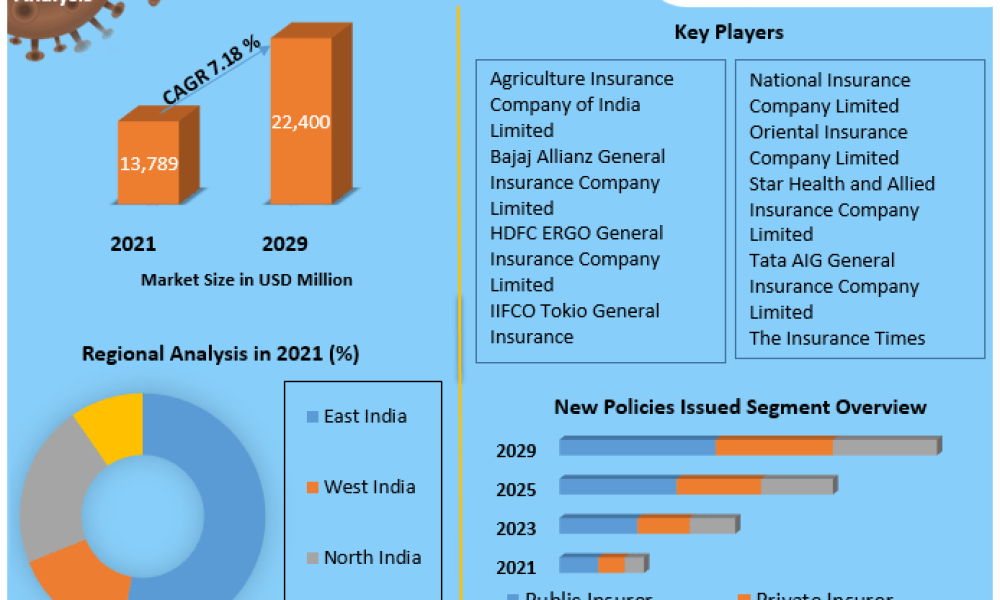
Market Size & Growth: The India non-life insurance market stood at US$ 13,789 million in 2021 and is anticipated to reach US$ 22,400 million by 2029, progressing at a CAGR of 7.18% across the forecast period.
Dominating Region: The market is India-centric, with rapid urbanization, compulsory motor insurance, and a thriving healthcare sector supporting metropolitan dominance. Urban regions surge ahead, though government schemes and digitalization are gradually increasing rural penetration.
Leading Segment: Motor insurance remains the largest segment, accounting for the highest policy volume due to the legal requirement and growing vehicle ownership. Health insurance is rapidly growing, bolstered by rising preventive healthcare awareness and post-pandemic consumer priorities.
Key Driver: Growth is steered by increased purchasing power, a young workforce, regulatory mandates, and demand from automotive and healthcare sectors. Digital transformation and regulatory support are accelerating market development.
► Get a sample of the report:https://www.maximizemarketresearch.com/request-sample/42091/
Recent Developments
2023-2024: Major insurers such as HDFC ERGO, ICICI Lombard, Bajaj Allianz, and Tata AIG ramped up digital offerings and introduced AI-enabled claims processing for faster settlement and customer engagement.
2024: The Indian Government bolstered support for health insurance adoption via expanded Ayushman Bharat and PMJAY schemes.
Leading companies invested in cyber risk assessment tools to mitigate rising data privacy and cybersecurity threats.
Public and private insurers collaborated with fintechs and e-commerce platforms to simplify online sales and premium payment options.
Market Dynamics
Drivers:
Growing automotive sales and compulsory motor insurance drive the largest market share.
Pandemic-driven health awareness boosts health insurance uptake across age groups.
The expansion of digital infrastructure and unified payment interfaces simplifies buying and managing policies.
Regulatory reforms such as IRDAI’s sandbox initiatives are enabling product innovation and faster market response.
Restraints:
Supply-side challenges including agent incentive capping and operational costs affect distribution in semi-urban and rural regions.
Data privacy risks and cyber threats increase technology investment pressure.
Lack of consumer awareness and insurance literacy in remote areas impedes deep penetration.
Opportunities:
Rural expansion and micro-insurance products to target untapped populations.
Use of AI, big data, and telematics for risk assessment, underwriting, and customer engagement.
Collaborations and partnerships with tech start-ups and e-commerce players diversify distribution channels.
Regional Analysis
Urban India: Continues to be the dominant regulator of premium inflow, aided by higher awareness, disposable income, and digital adoption.
Rural India: Presents significant potential, with improved digital penetration and government-backed awareness campaigns driving gradual growth.
Zone-Wise: Western and Southern regions lead due to higher levels of financial literacy and higher per capita income.
Product Segmentation
By Product: Motor insurance (largest), health insurance (fastest-growing), fire insurance, marine insurance, and others.
By New Policies Issued: Public insurers, private insurers, and specialized insurers.
By Distribution Channel: Individual agents, corporate agents, banks, brokers, direct business, and others.
Key Trends
Widespread adoption of digital sales and app-based customer servicing.
Growing interest in cyber risk and data breach policies.
Shift toward personalized insurance products, usage-based motor premiums, and wellness-linked health plans.
Increased focus on faster, tech-enabled claims processing and paperless documentation.
Frequently Asked Questions
1. What segments are covered in the India non-life insurance market?
Segments are based on product type, new policies issued by type of insurer, and distribution channel.
2. What is the projected market size by 2029?
The India non-life insurance market is expected to reach US$ 22,400 million by 2029.
3. Which segment dominates the market?
Motor insurance is the leading segment, followed closely by health insurance due to surging awareness.
4. Which region is dominant?
Urban regions lead, but rapid growth is projected in rural markets through digital and governmental initiatives.
Conclusion
India’s non-life insurance market is set for robust growth through 2029, anchored by strong demand in motor and health insurance, accelerating digital transformation, government support, and rising consumer awareness. Targeted innovation, rural expansion, technology adoption, and cross-industry collaboration will be key to realizing the full potential of this market and ushering in a new era of financial protection for India’s diverse population.
◉ Get Market Research Latest Trends
♦ Maximize Market Research is launching a subscription model for data and analysis in the MMR Statistics
Contact Maximize Market Research:
3rd Floor, Navale IT Park, Phase 2
Pune Bangalore Highway, Narhe,
Pune, Maharashtra 411041, India
[email protected]
+91 96071 95908, +91 9607365656
About Maximize Market Research:
Maximize Market Research is a multifaceted market research and consulting company with professionals from several industries. Some of the industries we cover include medical devices, pharmaceutical manufacturers, science and engineering, electronic components, industrial equipment, technology and communication, cars and automobiles, chemical products and substances, general merchandise, beverages, personal care, and automated systems. To mention a few, we provide market-verified industry estimations, technical trend analysis, crucial market research, strategic advice, competition analysis, production and demand analysis, and client impact studies.




