
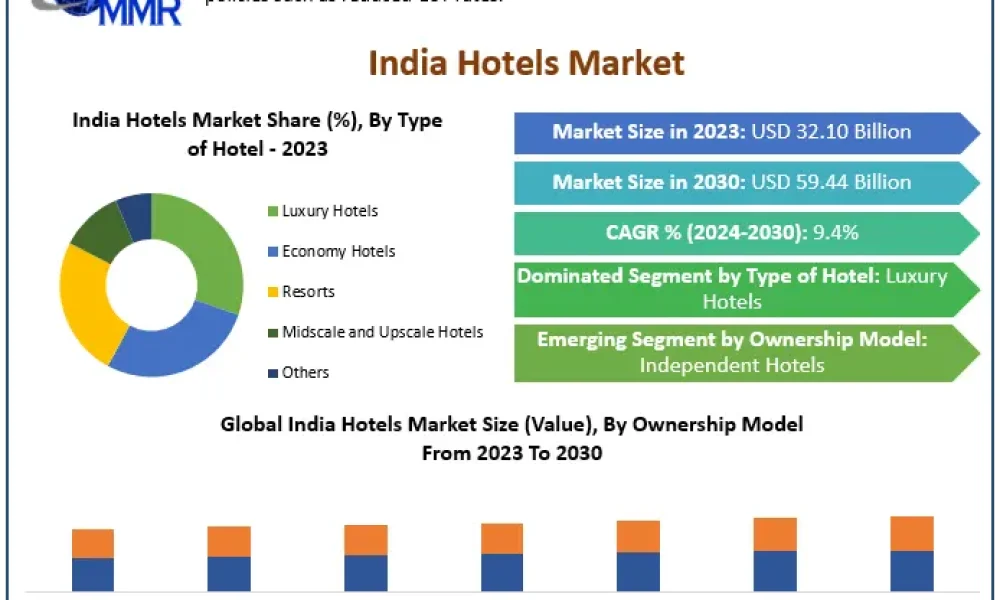
India Hotels Market Overview:
India Hotels Market is projected to grow significantly from USD 243.56 billion in 2024 to USD 798.95 billion by 2033, at a strong CAGR of 14.11%. This growth is propelled by rising domestic and international travel, expanding middle-class income, active government tourism campaigns such as Incredible India, and enhanced infrastructure development across the country.
Key Highlights & Insights
Market Size & Growth: Valued at USD 243.56 billion in 2024, expected to reach USD 798.95 billion by 2033 with a CAGR of 14.11%.
Dominating Region: Pan-India growth with prominent activity in North, West, South, Central, East, and Northeast India. North and West India lead business and leisure travel markets while South India excels in wellness tourism.
Leading Segment: Budget and mid-scale hotels capture the largest share by volume, responding to growing demand from millennials and cost-conscious domestic travelers.
Key Driver: Increased disposable incomes, improved connectivity, rise in domestic tourism, government promotional activities, and diversification in accommodation options.
► Get a sample of the report:https://www.maximizemarketresearch.com/request-sample/52799/
Recent Developments
Major hotel groups such as Taj Hotels (IHCL), Oberoi Hotels & Resorts, ITC Hotels, and Radisson have expanded portfolios with new properties targeting tier-2 and tier-3 cities.
In 2024, Suba Group of Hotels opened the Click Hotel in Madhya Pradesh, focusing on business travelers, while Radisson launched Inn by Radisson Ayodhya, tapping into pilgrimage tourism.
Digital transformation, including contactless check-ins and AI-powered guest services, is becoming standard across new properties.
Increased sustainability efforts with property certifications and eco-friendly operations are gaining prominence.
Market Dynamics
Growth Drivers:
Surge in leisure and business travel, supported by regional tourism and MICE (Meetings, Incentives, Conferences, and Exhibitions) growth.
Government initiatives such as tax incentives, tourist circuit development, and infrastructure funding.
Rising urbanization and rising middle-class contributing to greater travel frequencies.
Expanding organized retail and hospitality chains enhancing accessibility and service quality.
Challenges:
Seasonal demand fluctuations impacting occupancy rates.
Shortage of skilled hospitality labor leading to operational inefficiencies.
Regulatory hurdles and real estate constraints in prime regions.
Regional Analysis
North India: Rapid growth driven by business travel, tourism hotspots, and pilgrimage centers.
West and Central India: Expanding urban centers and business districts fueling accommodations demand.
South India: Wellness tourism and IT hubs contribute significantly to market expansion.
East and Northeast India: Emerging destinations with increasing investments in infrastructure and eco-tourism.
Product Segmentation
By Hotel Type: Independent Hotels, Chain Hotels.
By Segment: Budget and Economy, Mid and Upper Mid-scale, Luxury.
By Service Type: Service Apartments, Full-Service Hotels, Limited-Service Hotels.
Key Trends
Rising preference for budget and mid-scale accommodations among millennials.
Growth in experiential and eco-tourism driving diversified hotel offerings.
Increasing incorporation of digital and AI technologies in guest experience and operations.
Expansion of hotel loyalty programs and customized marketing strategies.
Asset-light business models and franchise expansion gaining popularity.
Conclusion
India’s hotel market is experiencing rapid expansion, supported by favorable demographic trends, government policies, and growing tourism demand. Diverse accommodation categories are proliferating across all regions, catering to a wide range of travelers. The sector’s evolution towards technology adoption, sustainability, and experiential offerings will continue to shape a booming hospitality landscape through 2033 and beyond.
FAQs
What is the projected India hotels market size by 2033?
Approximately USD 799 billion.Which regions show the fastest growth?
North and West India lead, with South and Northeast India emerging rapidly.What segments dominate the market?
Budget and mid-scale hotels dominate by volume, luxury segment grows on premium demand.What drives market growth?
Rising domestic tourism, government tourism promotion, growing disposable incomes, and improved connectivity.Who are the key players?
Taj Hotels (IHCL), Oberoi Hotels & Resorts, ITC Hotels, Radisson Hotel Group, Suba Group of Hotels.
◉ Get Market Research Latest Trends
♦ Flexible Pipe Market
♦ Liquid Vitamins Market
Contact Maximize Market Research:
3rd Floor, Navale IT Park, Phase 2
Pune Bangalore Highway, Narhe,
Pune, Maharashtra 411041, India
[email protected]
+91 96071 95908, +91 9607365656
About Maximize Market Research:
Maximize Market Research is a multifaceted market research and consulting company with professionals from several industries. Some of the industries we cover include medical devices, pharmaceutical manufacturers, science and engineering, electronic components, industrial equipment, technology and communication, cars and automobiles, chemical products and substances, general merchandise, beverages, personal care, and automated systems. To mention a few, we provide market-verified industry estimations, technical trend analysis, crucial market research, strategic advice, competition analysis, production and demand analysis, and client impact studies.




