
The global hypercalcemia treatment market is witnessing robust growth, driven by rising prevalence of cancer, metabolic disorders, and a growing demand for effective calcium-lowering therapies. Hypercalcemia, characterized by abnormally high levels of calcium in the blood, can result from conditions such as primary hyperparathyroidism, malignancy-associated metabolic dysregulation, and chronic kidney disease. Effective management of this condition is critical, as untreated hypercalcemia can lead to severe complications, including renal dysfunction, cardiac arrhythmias, and neurological impairments. The market is steadily expanding as hospitals and specialty care centers adopt advanced intravenous and oral therapies, including bisphosphonates and calcitonin, to address acute and chronic hypercalcemia cases.
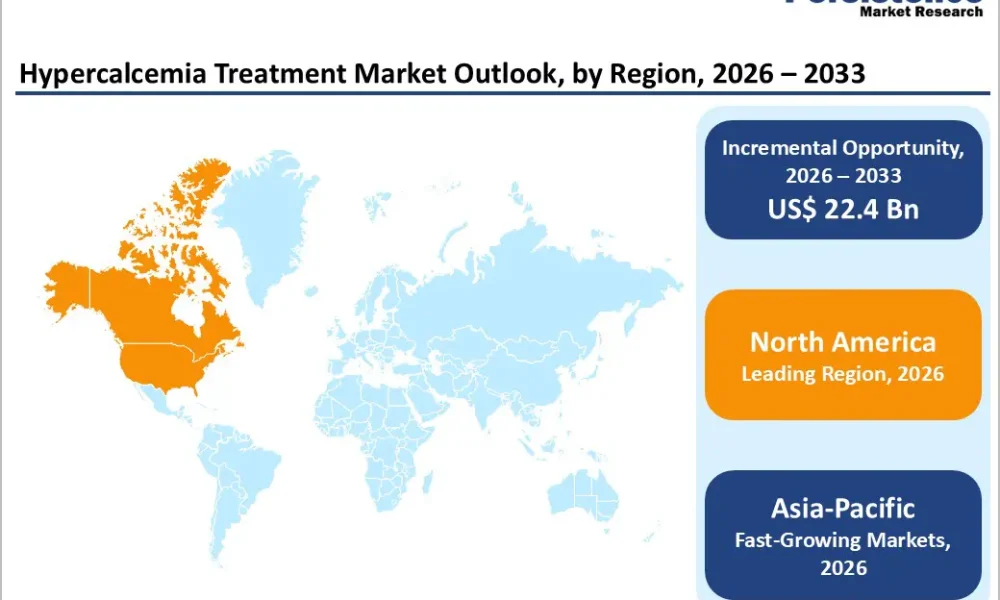
According to market estimates, the global hypercalcemia treatment market is projected to grow from US$ 24.2 billion in 2026 to US$ 46.6 billion by 2033, reflecting a CAGR of 9.8% during the forecast period. North America currently dominates the market, accounting for 40.3% of the global share, due to its advanced oncology infrastructure, high prevalence of malignancy-associated hypercalcemia, and strong reimbursement policies. Bisphosphonates represent the leading product segment, capturing 62.4% of the market in 2025, owing to their proven efficacy in reducing serum calcium levels, well-established safety profile, and widespread availability in hospital settings. Meanwhile, Asia-Pacific is emerging as the fastest-growing region, benefiting from expanding healthcare infrastructure, rising awareness of metabolic disorders, and increasing government investments in healthcare services.
Download Your Free Sample & Explore Key Insights: https://www.persistencemarketresearch.com/samples/34006
Key Highlights from the Report
• The hypercalcemia treatment market is projected to nearly double from US$ 24.2 Bn in 2026 to US$ 46.6 Bn by 2033.
• Bisphosphonates dominate the product segment with a 62.4% market share in 2025.
• North America leads the regional market due to advanced oncology care and strong reimbursement systems.
• Asia-Pacific is the fastest-growing region, driven by healthcare investments and rising diagnostic access.
• The market growth is fueled by increasing prevalence of cancer-related hypercalcemia and metabolic disorders.
• Opportunities lie in the development of targeted biologics, long-acting formulations, and outpatient therapies.
Market Segmentation
The hypercalcemia treatment market is segmented primarily by product type and end-user, reflecting both therapeutic preferences and healthcare delivery infrastructure. By product, bisphosphonates lead the market due to their ability to inhibit osteoclast-mediated bone resorption, effectively lowering serum calcium in 60–90% of treated patients. Intravenous formulations such as pamidronate and zoledronic acid are widely used in hospitals for acute management, while oral bisphosphonates provide chronic therapy options. Other therapeutic options include calcitonin, corticosteroids, denosumab, and supportive electrolyte therapies, catering to specific patient needs and comorbidities.
By end-user, hospitals dominate the hypercalcemia treatment landscape, primarily because severe or symptomatic hypercalcemia constitutes a medical emergency requiring rapid intervention and continuous monitoring. Hospital settings provide access to intravenous therapies, electrolyte management, and multidisciplinary care from endocrinology, oncology, nephrology, and critical care teams. Clinics and specialty centers also play a role in ongoing outpatient management, particularly for chronic hypercalcemia cases, but the acute treatment burden remains concentrated in hospital environments.
Regional Insights
Geographically, North America remains the largest market for hypercalcemia treatment due to its advanced healthcare infrastructure, high incidence of cancer-related hypercalcemia, strong diagnostic capabilities, and well-established reimbursement policies. The U.S. alone reports hypercalcemia of malignancy in approximately 2%–2.8% of all cancer patients, driving high demand for calcium-lowering therapies. Europe maintains a substantial market share, supported by structured healthcare systems in countries such as Germany, France, and the U.K., which provide broad access to treatment and robust patient awareness of metabolic and endocrine disorders.
In contrast, the Asia-Pacific region is emerging as the fastest-growing market due to expanding tertiary care facilities, increasing diagnosis rates, and government-led healthcare initiatives. Countries like China, India, and Japan are witnessing higher healthcare expenditures and improved access to effective therapies, contributing to strong market growth. Investments in healthcare infrastructure, along with rising prevalence of cancer and metabolic disorders, are expected to accelerate adoption of advanced hypercalcemia treatments across the region in the coming years.
Get Custom Insights Designed for Your Business: https://www.persistencemarketresearch.com/request-customization/34006
Market Drivers
The hypercalcemia treatment market is primarily driven by the growing prevalence of cancer-related hypercalcemia and metabolic disorders. Hypercalcemia often accompanies malignancies such as breast, lung, and hematologic cancers, with U.S. data showing tens of thousands of cases annually. Additionally, endocrine disorders such as primary hyperparathyroidism contribute to elevated calcium levels, increasing the overall patient population requiring treatment. Rising awareness among healthcare providers and patients about the importance of early diagnosis, coupled with advancements in intravenous and oral therapy options, further propels market growth. Moreover, the aging global population is contributing to a higher incidence of metabolic and endocrine disorders, creating sustained demand for effective hypercalcemia management solutions.
Market Restraints
Despite the promising growth outlook, high costs associated with advanced and biologic therapies pose a significant restraint on market expansion. Biologic drugs, which may be employed for refractory or malignancy-associated hypercalcemia, can range from several thousand to over USD 100,000 per patient annually due to complex research, development, and manufacturing processes. High costs limit patient access, impose stricter reimbursement requirements, and delay adoption, particularly in emerging markets. Additionally, healthcare systems face challenges in integrating expensive biologics into standard care protocols, which may temporarily slow market penetration until biosimilar alternatives or cost-effective formulations become more widely available.
Market Opportunities
The hypercalcemia treatment market presents significant opportunities in the development of novel targeted therapies and biologics, particularly for refractory or malignancy-associated cases. The increasing application of monoclonal antibodies, receptor modulators, and precision biologics offers the potential to improve patient outcomes while addressing unmet clinical needs. Expanding outpatient treatment options and long-acting formulations provide additional avenues for market growth. Furthermore, the rising healthcare infrastructure and oncology investments in emerging markets create opportunities to introduce advanced therapies at scale, increasing access and improving disease management for patients with complex hypercalcemia cases.
Checkout Now & Download Complete Market Report: https://www.persistencemarketresearch.com/checkout/34006
Company Insights
The hypercalcemia treatment market is highly competitive, with established pharmaceutical companies driving innovation and expanding global reach. Key players include:
• Amgen Inc.
• Pfizer Inc.
• Mylan N. V.
• Sunovion
• Apotex Corporation
• Novartis AG
• Bayer AG
• Hoffmann La Roche
• Atnahs Pharma
• Cipla Inc.
• Sun Pharmaceuticals Industries Ltd
• Dr. Reddy’s Laboratories
• Aurobindo Pharma Limited
Global Hypercalcemia Treatment Market Segmentation
By Product
- Bisphosphonates
- Clodronate
- Ibandronate
- Pamidronate
- Zoledronic Acid
- Calcitonin
- Glucocorticoids
- Denosumab
- Calcimimetics
By Distribution Channel
- Hospitals
- Clinics
- Independent Pharmacy & Drug Stores
By Region
- North America
- Europe
- East Asia
- South Asia & Oceania
- Latin America
- Middle East and Africa
Recent Developments
In July 2025, XTANDI® combined with leuprolide significantly improved survival outcomes in men with non-metastatic hormone-sensitive prostate cancer, delaying disease progression and reducing metastasis risk.
In May 2025, Astellas and Pfizer reported that XTANDI™ (enzalutamide) demonstrated long-term overall survival benefits for patients with metastatic hormone-sensitive prostate cancer, reinforcing its role as a first-line therapy in advanced cases.
Conclusion
The global hypercalcemia treatment market is poised for substantial growth over the coming decade, driven by rising prevalence of cancer, metabolic disorders, and increasing adoption of effective calcium-lowering therapies. North America leads the market due to advanced healthcare infrastructure, while Asia-Pacific shows the fastest growth, supported by expanding healthcare access and rising diagnostic rates. Bisphosphonates remain the dominant treatment segment, reflecting their proven efficacy, safety, and widespread use in hospital settings. Despite high costs associated with biologic therapies, emerging innovations and opportunities in targeted and long-acting treatments present a promising outlook. Strategic investments in emerging markets, coupled with advancements in outpatient and hospital-based care, are expected to sustain the market’s expansion, improving outcomes for patients worldwide.




