

Hydrogen Infrastructure Market Overview
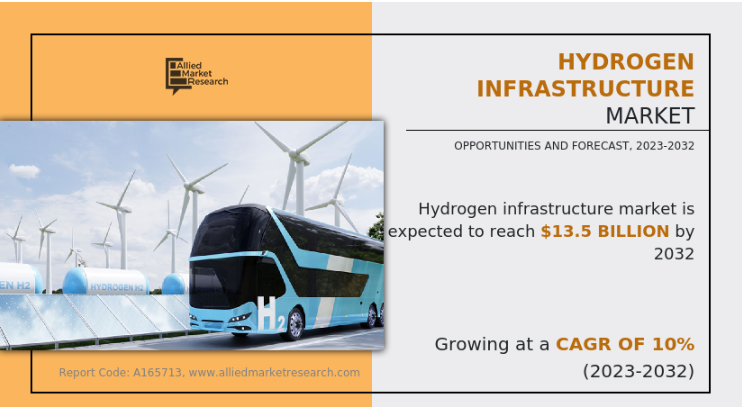
According to a new report published by Allied Market Research, The hydrogen infrastructure market size was valued at $4.9 billion in 2022, and is estimated to reach $13.5 billion by 2032, growing at a CAGR of 10% from 2023 to 2032.
Hydrogen infrastructure refers to the network of facilities, systems, and technologies required for the production, storage, distribution, and utilization of hydrogen as an energy carrier. Hydrogen has gained attention as a potential clean and versatile energy source that can contribute to decarbonization efforts and address various energy and environmental challenges. To fully integrate hydrogen into the energy landscape, a well-developed and comprehensive hydrogen infrastructure is necessary.
Download PDF Brochure: https://www.alliedmarketresearch.com/request-sample/166197
Hydrogen production involves generating hydrogen gas using various methods, such as steam methane reforming, electrolysis, and biomass gasification.
The major players operating in the hydrogen infrastructure market are Air Liquide, Linde plc, Nel Hydrogen ASA, Plug Power, Inc., Shell plc, ITM Power plc, Ballard Power Systems, McPhy Energy, Cummins, Inc., and Engie SA.
Hydrogen infrastructure refers to the interconnected network of facilities, technologies, and systems essential for the entire lifecycle of hydrogen as an energy carrier. This includes the production, storage, transportation, and utilization of hydrogen as a clean and sustainable source of energy.
Hydrogen distribution involves the network of pipelines and local distribution centers that deliver hydrogen to end-users, including industrial facilities, fueling stations, and residential applications.
Hydrogen utilization encompasses various applications, such as fuel cells, hydrogen combustion in internal combustion engines, and its use as a feedstock in industrial processes.
Hydrogen fueling stations are crucial for supplying hydrogen to fuel-cell electric vehicles and other hydrogen-powered transport and this will offer hydrogen infrastructure market opportunities.
Hydrogen transportation encompasses the means by which hydrogen is moved from production facilities to distribution points and end-users, utilizing methods like gaseous hydrogen tube trailers and liquid hydrogen tankers.
Hydrogen storage is necessary for overcoming hydrogen’s low volumetric energy density, with storage methods including compression and liquefaction.
Benefits
- Clean Energy Carrier: Hydrogen can be produced from renewable sources, providing a low-emission energy option.
- Energy Storage: Acts as a means to store excess renewable energy, balancing supply and demand.
- Versatility: Applicable in various sectors, including transportation, industry, and heating.
Hydrogen Production: Hydrogen can be produced through several methods, including:
Steam Methane Reforming (SMR): Extracts hydrogen from natural gas, with carbon dioxide as a byproduct.
Electrolysis: Uses electricity to split water into hydrogen and oxygen, especially when powered by renewable sources (“green hydrogen“).
Biomass Gasification: Converts organic materials into hydrogen and other gases.
Thermochemical Processes: Various processes that use heat to extract hydrogen from hydrocarbons or other feedstocks.
Hydrogen Storage: Hydrogen has low energy density per unit volume, so effective storage solutions are crucial. Common storage methods include:
Compressed Hydrogen: Storing hydrogen gas at high pressures in tanks.
Liquid Hydrogen: Cooling hydrogen to extremely low temperatures to store it as a liquid.
Solid-State Hydrogen Storage: Using materials that can absorb and release hydrogen gas.
Buy This Report (348 Pages PDF with Insights, Charts, Tables, and Figures): https://bit.ly/44wiXyv
Hydrogen Transportation: Hydrogen needs to be transported from production sites to consumption points. Methods include:
Pipelines: Dedicated hydrogen pipelines or repurposing existing natural gas pipelines.
Hydrogen Trucks: Transporting hydrogen in gaseous or liquid form.
Shipping: Transporting liquid hydrogen in specialized vessels.
Components of Hydrogen Infrastructure
- Production Facilities:
- Electrolysis: Uses electricity to split water into hydrogen and oxygen, often powered by renewable sources.
- Steam Methane Reforming (SMR): The most common method, converting natural gas into hydrogen, though it emits CO2 unless combined with carbon capture technology.
- Storage Solutions:
- Compressed Hydrogen: Stored in high-pressure tanks, suitable for transport and distribution.
- Liquid Hydrogen: Cooled to cryogenic temperatures for storage, allowing for higher energy density.
- Solid-State Storage: Involves materials that can absorb hydrogen, providing a safer and more compact storage method.
- Distribution Networks:
- Pipelines: Dedicated hydrogen pipelines transport hydrogen from production sites to consumers.
- Transport Vehicles: Trucks and rail systems equipped to carry compressed or liquefied hydrogen.
- Refueling Stations:
- Facilities that provide hydrogen refueling for fuel cell vehicles, similar to conventional gas stations.
- End-Use Applications:
- Fuel Cells: Used in vehicles, stationary power systems, and backup power applications.
- Industrial Uses: Employed in refining, ammonia production, and other chemical processes.
Future Trends
- Policy Support: Increasing government initiatives and funding aimed at developing hydrogen infrastructure and technology.
- Technological Advancements: Innovations in production efficiency, storage solutions, and fuel cell technology.
- Integration with Renewables: Strengthening the connection between hydrogen production and renewable energy sources to enhance sustainability.




