
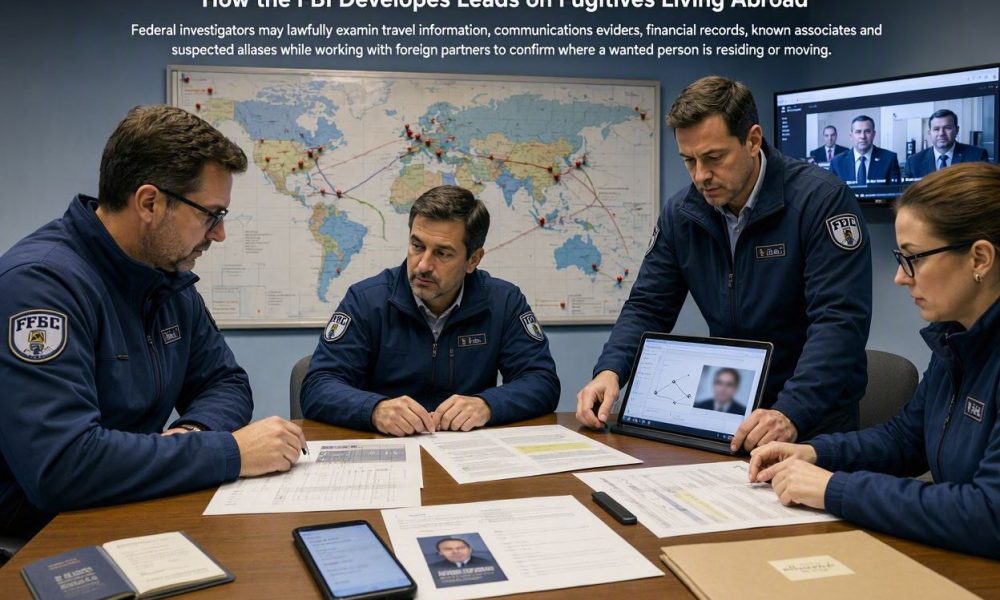
Federal investigators may lawfully review travel information, communications evidence, financial records, known associates, suspected aliases, identity documents, and public information, working through established international channels with foreign partners to confirm where a wanted person is residing, working, traveling, or moving.
WASHINGTON, DC, September 7, 2026: When a wanted person leaves the United States, the Federal Bureau of Investigation can develop overseas leads through lawful records analysis, interviews, international liaison relationships, police-to-police cooperation, diplomatic channels, public tips, and coordinated requests for evidence or provisional arrest.
The FBI’s role abroad differs fundamentally from its domestic authority because American agents generally cannot conduct unilateral searches, make independent arrests, compel foreign witnesses, or seize evidence inside another sovereign nation without permission and legal action from the appropriate local authorities.
Successful international fugitive investigations therefore depend upon two connected disciplines, with analysts and agents assembling reliable location intelligence. At the same time, prosecutors and international-affairs specialists develop the lawful documentation required for foreign cooperation, detention, Extradition, deportation, expulsion, or voluntary surrender.
Every case remains shaped by its charges, warrant, destination, treaty, evidence, citizenship issues, political conditions, and foreign law, meaning rapid identification of a likely country may still be followed by months or years of investigation and contested legal proceedings.
The Investigation Begins With a Valid Warrant and Accurate Identity
Before asking a foreign government to assist, investigators confirm that an enforceable warrant exists, determine which charges support the request, review the court record, and assemble identifying information strong enough to distinguish the defendant from people with similar names or appearances.
That identity package can include legal names, aliases, former names, photographs, fingerprints, birth information, citizenship, passports, physical characteristics, addresses, vehicles, professional records, telephone numbers, email accounts, social-media identities, relatives, employers, and known travel history.
Errors that appear minor domestically can become serious internationally because a mistranslated name, incorrect birth date, outdated photograph, or incomplete nationality record may delay foreign action, cause mistaken identification, or undermine confidence before an Extradition judge.
The FBI must also distinguish between a lawful alternate name and a deceptively used alias, since married names, transliteration differences, professional identities, and dual citizenship can create legitimate variations that do not independently prove concealment or criminal intent.
FBI International Offices Connect Investigations With Host Countries
The bureau maintains an overseas liaison presence designed to support cooperation with foreign police, security services, prosecutors, and other authorized partners, allowing domestic field offices to communicate through personnel who understand local institutions, language, law, and diplomatic sensitivities.
The FBI’s official explanation of its international operations describes cooperation with foreign counterparts, Justice Department international-affairs specialists, and the State Department in matters involving evidence collection, treaties, fugitive Extradition, and transnational criminal investigations affecting American interests.
Legal attaché personnel do not replace local investigators because the host country retains sovereignty and decides what actions its officers can take, what judicial process is necessary, and what information may lawfully be shared under domestic rules.
Their value lies in trusted communication, institutional knowledge, and coordination, helping American case agents frame requests accurately while helping foreign counterparts understand the warrant, identity, alleged conduct, public-safety concerns, and evidence sought by the United States.
Travel Information Helps Establish the First Geographic Hypothesis
Investigators commonly reconstruct the wanted person’s movement from the last confirmed location, examining lawfully available passenger information, reservations, border encounters, vehicle records, hotel activity, transportation purchases, surveillance, and witness observations to identify the most plausible route abroad.
A reservation alone does not prove travel because tickets can be abandoned, changed, purchased for another person, or created as misdirection, so boarding information, baggage activity, border records, payment details, device data, and independent sightings can corroborate it.
Agents also examine earlier travel patterns because previous residences, frequent destinations, family visits, business relationships, language skills, immigration permissions, property, and professional networks may reveal countries where the defendant possesses both motive and practical ability to remain.
The purpose is not to assume that every familiar country is a hiding place, but to prioritize jurisdictions rationally while excluding impossible routes, outdated connections, and apparent travel events produced by shared accounts or stolen identification.
Communications Evidence Can Reveal Relationships and Movement
With appropriate legal authority, investigators may examine communications records, account information, contact patterns, connection data, and preserved content to identify recent associates, geographic indicators, behavioral changes, or accounts activated after the defendant stopped appearing in court.
Domestic providers may respond to subpoenas, court orders, search warrants, or preservation requests according to American law. At the same time, records controlled abroad may require foreign legal process, voluntary cooperation, treaty assistance, or action by local prosecutors and courts.
Encrypted content may remain inaccessible, but surrounding information can still help establish that accounts communicated, devices connected through particular services, or activity occurred during periods corresponding with travel, financial transfers, and witness observations.
Investigators must remain cautious because accounts can be shared or compromised, virtual networks can distort apparent location, scheduled messages can publish automatically, and an associate may communicate on someone’s behalf without establishing the fugitive’s physical presence.
Financial Records Can Map Support and Geographic Activity
Lawfully obtained financial records may reveal airfare, accommodation, vehicle rentals, currency exchanges, insurance, utilities, remittances, international transfers, cash withdrawals, account access, and payments to people who could be providing housing, transportation, employment, or other assistance.
Financial analysis often focuses on patterns rather than individual transactions because one charge may be automated or misleading, while repeated activity tied to travel data, communications, and witnesses can support a stronger assessment of location and available resources.
Investigators also examine whether assets were liquidated or transferred before disappearance, whether offshore structures were activated, and whether new intermediaries began paying expenses after the defendant lost access to familiar domestic accounts or credit facilities.
None of those circumstances independently proves flight or criminal assistance, since families share funds, businesses operate internationally, and legitimate planning can resemble preparation, requiring prosecutors to separate lawful conduct from evidence demonstrating concealment, obstruction, laundering, or support for evasion.
Known Associates Can Confirm or Contradict Digital Leads
Relatives, friends, employees, landlords, lawyers, accountants, business partners, transportation providers, and recent acquaintances may know where the person intended to travel, which documents were used, who offered assistance, or how communications changed immediately before disappearance.
Witness information can be valuable but unreliable because loyalty, hostility, fear, memory problems, financial disputes, media attention, or personal advantage may influence what someone reports, making independent corroboration essential before the FBI asks foreign police to undertake sensitive action.
Associates are not automatically suspects just because they communicate with a wanted person. Still, anyone who destroys evidence, deceptively transfers assets, fabricates records, threatens witnesses, or makes materially false statements can create separate legal exposure through their own conduct.
Investigators compare interviews against records and other witnesses, looking for consistent timelines, unexplained contradictions, direct personal knowledge, and specific details that could only come from genuine recent contact rather than internet speculation, invention, or secondhand rumor.
Alias Analysis Connects Identities Without Collapsing Them
Fugitives living abroad may use nicknames, alternate spellings, business names, online handles, changed surnames, fraudulent documents, or genuine passports from more than one country, creating identity questions that must be resolved before foreign arrest.
Analysts compare names with photographs, fingerprints, birth records, travel history, addresses, relatives, devices, and financial activity, looking for combinations that show continuity between the federally wanted defendant and the person living under another identity overseas.
Biometric comparison can assist this work, yet facial-recognition results and automated matches require human review and corroboration because aging, image quality, appearance changes, common features, and algorithmic limitations can produce misleading candidates or false confidence.
Amicus International Consulting’s examination of technology used to identify long-term fugitives provides broader context for how older photographs and fragmented identity records can generate new leads. However, technology should support, not replace, lawful evidence and professional verification.
Public Information Can Produce Leads Without Proving Location
Investigators may review public social-media posts, business filings, property records, professional profiles, news photographs, court documents, event appearances, and online advertising that lawfully reveal connections, addresses, employment, associates, travel, or changes in appearance.
Public posts can be old, manipulated, scheduled, reposted, falsely attributed, or uploaded by another person. Hence, analysts examine metadata where lawfully available and compare the material against records before treating an apparent location as current or authentic.
The FBI may also release photographs, rewards, or public appeals when broad exposure could reach someone who recently encountered the fugitive. However, publicity can alert the defendant, compromise surveillance, or generate thousands of inaccurate tips requiring substantial screening.
A credible public tip usually begins verification rather than ending the investigation, with agents assessing source knowledge, recency, specificity, motive, and corroborating information before requesting operational assistance from a foreign partner.
Intelligence and Admissible Evidence Serve Different Purposes
Information sufficient to prioritize a city or request discreet observation may not satisfy the evidentiary rules governing a search, arrest, Extradition, or criminal trial, so it is important to distinguish investigative intelligence from material that can support formal legal action.
A confidential source may provide an accurate address that foreign police verify independently. At the same time, the eventual Extradition package relies upon certified warrants, charging documents, statutory provisions, identity evidence, affidavits, and records obtained through procedures recognized by the requested country.
Prosecutors work with agents to preserve chain of custody, authentication, translation, and disclosure because evidence collected abroad can become the subject of defense motions concerning reliability, legality, voluntariness, confrontation, privilege, or compliance with applicable treaty provisions.
This division explains why investigators may know where a fugitive probably lives yet wait before acting, since premature disclosure or an unsupported arrest request can cause the person to move and weaken future cooperation with foreign authorities.
Foreign Police Decide What Actions Are Lawful Locally
After receiving reliable location information, host-country authorities determine whether they can conduct surveillance, obtain local records, interview witnesses, search property, stop the person, seize documents, or arrest the person under their own constitutional, statutory, and procedural rules.
American agents may share intelligence, explain evidence, observe authorized activity, or assist when formally permitted. Still, they remain subject to diplomatic agreements, bureau policy, host-country consent, and legal restrictions governing foreign law-enforcement operations inside sovereign territory.
Differences in privacy law, data retention, arrest standards, evidentiary rules, corruption risks, political conditions, and institutional capacity can accelerate or obstruct the same investigative request depending upon the destination and the alleged offense.
Trust matters because foreign agencies are more likely to act on requests that are accurate, proportionate, documented, and respectful of local law. At the same time, careless or politically sensitive demands can damage cooperation far beyond one fugitive case.
INTERPOL Can Broaden International Awareness
The United States may seek an INTERPOL Red Notice, diffusion, or other police communication when appropriate, allowing member-country authorities to receive identifying and warrant information and consider action under their own law if the person appears within their jurisdiction.
A Red Notice is not an international arrest warrant, and each country decides its legal effect, whether it permits provisional detention, and what additional domestic process must occur before the wanted person can be held for Extradition.
Accurate identity details remain essential because common names, transliteration differences, multiple nationalities, outdated photographs, and uncertain documents can cause false matches or delay action when border officers and foreign police attempt to confirm the correct individual.
Amicus International Consulting’s overview of INTERPOL Red Notices and Extradition explains the distinction between international police alerts and formal surrender proceedings, which remain separate even when the same warrant and identity evidence support both processes.
Locating a Fugitive Does Not Guarantee Extradition
Once prosecutors confirm a wanted person is abroad, they evaluate treaty coverage, dual criminality, limitation periods, nationality restrictions, evidentiary requirements, political-offense exclusions, human-rights issues, specialty rules, and any assurances the requested country may require before surrender.
The Justice Department and State Department coordinate formal requests through established channels. At the same time, the foreign country’s courts and executive officials apply domestic law and treaty obligations independently before deciding whether detention and transfer may proceed.
Defendants can challenge identity, evidence, treaty interpretation, procedural compliance, prison conditions, political motivation, or other recognized issues through hearings and appeals, creating timelines that extend well beyond the FBI’s initial confirmation of residence or movement.
Alternative outcomes can include deportation, expulsion, waiver, consent, or voluntary surrender. Still, those routes depend on lawful governmental decisions and cannot automatically substitute whenever formal Extradition appears inconvenient, politically difficult, delayed, or contested.
A 2026 Cybercrime Arrest Illustrates Foreign Cooperation
In June 2026, Reuters reported an FBI-assisted arrest in Montenegro involving a dual Iranian and Turkish citizen wanted in the Southern District of New York for alleged computer intrusions, identity theft, and conspiracy connected with attacks against American universities.
According to the report, Montenegrin police and the FBI cooperated to locate and arrest the man in Kotor, after which Extradition proceedings began in Podgorica under a legal process controlled by Montenegro rather than American agents.
The allegations remain unproven unless established in court. Yet, the reported sequence illustrates how a federal warrant, verified identity, international coordination, foreign police authority, local detention, and Extradition litigation function as distinct but connected stages.
The case also shows that a successful location assessment is not the end of an international fugitive investigation because prosecutors must still secure lawful surrender, transportation, detention, evidence, and eventual proceedings before the federal court with jurisdiction.
Some Foreign Leads Develop Quickly While Others Take Years
A fugitive may be located rapidly when fresh travel records, current photographs, active communications, cooperative associates, and responsive foreign police converge upon one address, workplace, hotel, airport, or border crossing soon after the warrant becomes active.
Other investigations stall because the country is uncertain, aliases are sophisticated, documents conflict, records are unavailable, corruption interferes, witnesses fear retaliation, diplomatic relations deteriorate, or foreign law does not permit the action American authorities request.
Cases can revive when technology improves, a passport expires, immigration status changes, money diminishes, associates cooperate, public photographs appear, another arrest produces devices, or the fugitive travels into a jurisdiction offering stronger law-enforcement cooperation.
Consequently, public silence does not establish investigative abandonment because agents may continue maintaining alerts, validating identity information, evaluating tips, preserving records, and waiting for a lawful opportunity that did not exist when the person first disappeared.
Defense Rights Continue Across Borders
Fugitive status does not prove the underlying charges, and a person located abroad retains access to legal protections available under the host country’s detention and Extradition procedures as well as federal rights following any return to the United States.
Counsel may challenge mistaken identity, unreliable evidence, defective warrants, treaty interpretation, Extradition documentation, detention conditions, specialty violations, and alleged government misconduct. At the same time, prosecutors continue carrying the procedural and evidentiary burdens assigned by each jurisdiction’s governing law.
Witnesses and associates can also obtain independent counsel, protect privileged communications, preserve records, and avoid speculation, ensuring that cooperation or lawful resistance occurs through informed procedures rather than false statements, evidence destruction, threats, or improvised private arrangements.
Responsible reporting must likewise separate allegations from judicial findings because wanted posters, international alerts, foreign arrests, and Extradition orders principally concern identity, custody, and procedural authority rather than final adjudication of guilt on unresolved federal charges.
Voluntary Surrender Can Replace an Uncertain Arrest
A defendant who learns of an active warrant should communicate through qualified criminal counsel, allowing lawyers to verify the case, contact prosecutors, explore controlled surrender, prepare detention arguments, and coordinate medical, family, property, immigration, or travel concerns.
An arranged return does not guarantee release, dismissal, immunity, or favorable sentencing treatment. Still, it can reduce the danger and uncertainty associated with arrest by foreign police, prolonged Extradition detention, sudden deportation, or capture during international travel.
Direct attempts to negotiate without counsel, contact witnesses, destroy evidence, use another person’s identity, or conceal financial activity can create additional investigative material and possible criminal exposure beyond the charges that produced the original warrant.
Because two legal systems are involved, defendants abroad may require coordinated representation in both countries to address local custody and Extradition questions while preserving an effective defense before the federal court awaiting their return.
International Lead Development Combines Patience With Precision
The FBI develops leads on fugitives living abroad by combining verified identity information, lawful travel and communications records, financial analysis, witness interviews, public information, technology, international liaison relationships, and foreign police action conducted under the host country’s authority.
No single lead carries the entire case because reliable location findings usually emerge when independent sources converge, allowing investigators to distinguish genuine residence or movement from abandoned reservations, shared accounts, manipulated posts, false aliases, and deliberate misdirection.
The strongest investigations respect sovereignty and procedure from the start, ensuring useful intelligence can be converted into authenticated evidence, lawful detention, sustainable Extradition requests, secure transportation, and federal court proceedings that can withstand defense scrutiny.
For a wanted person abroad, physical distance may slow the process but rarely ends the case, since changing technology, relationships, documents, finances, immigration status, and diplomatic conditions can create new opportunities long after the original trail appeared to have disappeared.




