
Online Bidding Platform Market: Size, Trends, and the Digital Transformation of Procurement
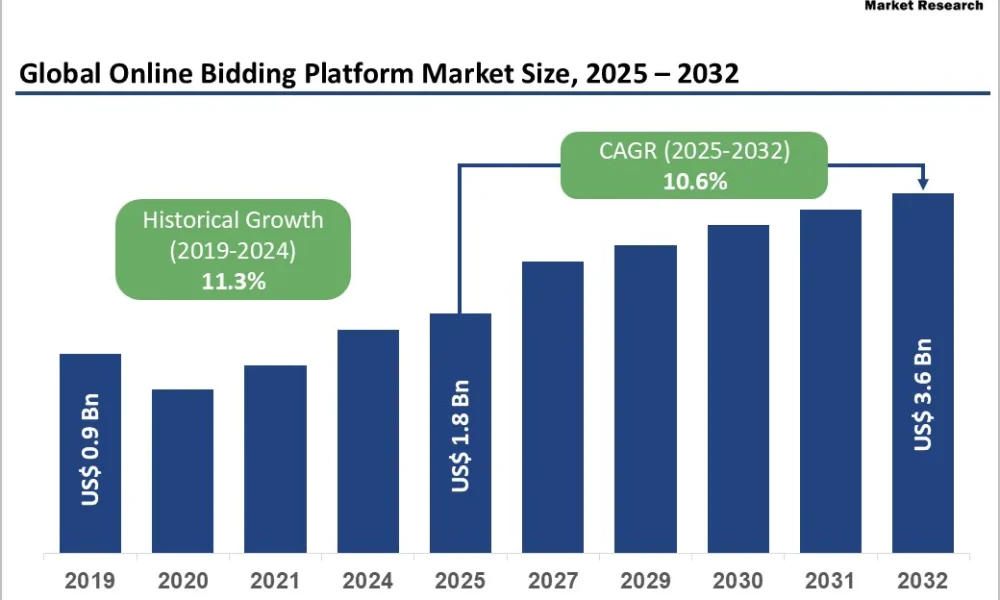
The global online bidding platform market is undergoing a profound transformation as organizations across government, corporate, and consumer sectors shift away from manual procurement and physical auctions toward fully digital, transparent, and data-driven bidding environments. Valued at US$ 1.8 billion in 2025, the market is projected to double to US$ 3.6 billion by 2032, expanding at a robust CAGR of 10.6% during the forecast period.
This growth reflects more than just technological adoption. It represents a structural shift in how goods, services, and assets are priced, procured, and transacted globally. Online bidding platforms are increasingly viewed as strategic tools that reduce costs, enhance transparency, improve compliance, and enable faster decision-making in complex procurement ecosystems.
As regulatory mandates tighten, supply chains globalize, and enterprises seek operational efficiency, online bidding platforms are becoming indispensable across industries ranging from government procurement and healthcare to real estate and industrial manufacturing.
Market Overview: Why Online Bidding Platforms Are Gaining Momentum
Online bidding platforms enable buyers and sellers to participate in structured auctions through digital interfaces. These platforms support multiple auction formats such as English auctions, reverse auctions, sealed bids, and time-based bidding, catering to diverse procurement and sales needs.
Between 2019 and 2024, the market recorded a strong historical CAGR of 11.3%, indicating sustained momentum even before the current wave of AI-driven and blockchain-enabled innovations. The continued expansion is being driven by three core forces:
- Rapid digitalization of procurement processes
- Regulatory push for transparency and accountability
- Rising demand for automated, cost-efficient sourcing mechanisms
Today, online bidding is no longer limited to surplus asset sales or consumer collectibles. It has evolved into a mission-critical procurement infrastructure supporting high-value government contracts, enterprise sourcing, healthcare supply chains, and large-scale real estate transactions.
Key Market Highlights at a Glance
North America leads the global online bidding platform market with 37% share in 2025, supported by advanced digital infrastructure, strong cybersecurity frameworks, and stringent procurement regulations. The region’s mature enterprise procurement ecosystem has enabled rapid adoption of reverse auction technologies.
Asia-Pacific is the fastest-growing region, registering a projected CAGR of 12.4% through 2032. Accelerated digitalization in China and India, government e-procurement mandates, and expanding cross-border trade are fueling adoption across the region.
From a functional perspective, English auctions dominate with nearly 40% market share, owing to their intuitive ascending-price structure and broad acceptance across asset classes such as real estate, art, and luxury goods.
On the industry front, Healthcare & Medical procurement is the fastest-growing segment, expanding at a CAGR of 13.2%, driven by cost pressures, regulatory modernization, and increasing supply chain complexity.
Market Dynamics Driving Growth
Government Procurement Digitalization and Regulatory Mandates
Government digitalization initiatives represent one of the strongest growth engines for the online bidding platform market. Public sector procurement globally is under increasing pressure to deliver transparency, efficiency, and accountability.
In the United States, evolving Federal Acquisition Regulation (FAR) requirements are encouraging federal agencies to use reverse auction platforms to promote competitive pricing. Similarly, the European Union Public Procurement Directive mandates digital-first procurement approaches across member states.
Government procurement currently accounts for 32–35% of total platform demand, and this share is expected to grow as emerging economies implement national e-procurement frameworks. Digital bidding not only reduces corruption risks but also significantly shortens procurement cycles and improves supplier participation.
Rising Adoption of Reverse Auction Technology in Corporate Procurement
Reverse auctions have emerged as a powerful cost-optimization tool for enterprises. In this format, suppliers compete by progressively lowering prices to win contracts, creating intense competitive pressure while maintaining quality standards.
Large organizations in retail, automotive, healthcare, and manufacturing report 15–25% procurement cost savings through reverse auction adoption. Asia-Pacific enterprises, particularly in China, India, and Japan, are aggressively deploying these platforms to manage supplier ecosystems more effectively.
As procurement teams increasingly rely on data-driven sourcing strategies, reverse auction platforms are transitioning from optional tools to core procurement infrastructure.
Market Restraints Limiting Adoption
High Implementation and Integration Costs
Despite strong value propositions, high implementation and integration costs remain a key barrier, especially for small and medium-sized enterprises. Enterprise-grade bidding platforms require significant investment in system customization, ERP integration, staff training, and data migration.
Implementation costs typically range from US$ 50,000 to US$ 500,000, depending on organizational complexity. Additionally, recurring expenses such as licensing fees, transaction charges, cybersecurity updates, and technical support increase long-term ownership costs.
Many organizations estimate 3–5 year payback periods, which can deter adoption in budget-constrained environments, particularly in developing economies with limited digital maturity.
Elevate your business strategy with comprehensive market data. Request a sample report now: https://www.persistencemarketresearch.com/samples/32934
Cybersecurity and Data Privacy Challenges
Cybersecurity concerns are another critical restraint. Online bidding platforms handle highly sensitive data, including pricing strategies, supplier financials, and procurement plans. Approximately 47% of organizations cite cybersecurity risks as a primary adoption barrier.
Compliance with regulations such as GDPR in Europe, CCPA in the United States, and evolving data localization laws in Asia adds further complexity. Platform providers must invest heavily in encryption, access controls, audit trails, and compliance certifications such as ISO 27001 and SOC 2.
High-profile cybersecurity incidents in 2023–2024 have heightened risk awareness, pushing buyers to favor established providers with proven security credentials, contributing to gradual market consolidation.
Emerging Opportunities Shaping the Future
Real Estate Digital Auctions and Transaction Modernization
Real estate represents a major untapped opportunity for online bidding platforms. Global property transactions exceed US$ 2 trillion annually, and a growing portion is shifting toward digital auction models.
Banks disposing of distressed assets, government land authorities, and real estate investment firms are increasingly adopting online auctions to improve price discovery and reduce sales cycles. This trend alone could unlock US$ 450–500 million in incremental market opportunity by 2032.
AI, Blockchain, and Advanced Analytics Integration
Artificial intelligence is redefining the capabilities of online bidding platforms. AI-powered features such as predictive pricing, supplier risk scoring, automated bid evaluation, and auction design optimization are transforming procurement from reactive to strategic.
Blockchain integration further enhances trust by providing immutable audit trails and transparent transaction histories. AI-enabled platforms command 25–40% higher subscription pricing and are expected to gain 12–15% additional market share in advanced procurement environments.
Category-wise Market Analysis
Auction Type Insights
English auctions remain the most widely used format, accounting for around 40% market share in 2025. Their simplicity, transparency, and regulatory compatibility make them ideal for real estate, art, collectibles, and luxury goods.
Approximately 70% of online real estate auctions globally use English auction mechanisms, reinforcing their long-term dominance.
Solution Insights
Marketplace bidding platforms dominate the solution landscape with 58% share, driven by strong network effects and multi-vendor architectures. These platforms enable simultaneous buyer-seller interactions and support diverse monetization models, including transaction fees and premium services.
Their scalability, multi-currency support, and integrated payment and logistics tools make them preferred choices for global expansion.
Industry Insights
The Government & Non-Profit segment leads with 35% market share, supported by stable procurement budgets and long-term contracts. Regulatory complexity increases development costs but also strengthens entry barriers, reinforcing dominance for compliant providers.
Regional Market Insights
North America
North America remains the largest market, driven by mature procurement regulations and enterprise adoption. The U.S. leads innovation, while Canada and Mexico are rapidly expanding digital procurement mandates.
Europe
Europe holds roughly 25% global share, emphasizing regulatory harmonization and ESG-focused procurement. GDPR compliance raises entry barriers but protects established players.
Asia-Pacific
Asia-Pacific is the fastest-growing region, led by China, Japan, and India. Initiatives like India’s Government e-Marketplace (GeM) highlight strong governmental commitment to online bidding adoption.
Competitive Landscape and Recent Developments
The market is moderately fragmented, with 15–20 major global players and numerous regional specialists. Competition increasingly centers on AI capabilities, compliance expertise, and industry-specific customization.
Notable developments include Liquidity Services’ 2025 acquisition of Auction Software and Simple Auction Site, and eBay’s expansion of live-auction commerce through eBay Live.
Conclusion: A Market Redefining Digital Commerce and Procurement
The online bidding platform market is no longer a niche digital toolset. It is rapidly becoming a foundational layer of modern procurement, asset sales, and enterprise sourcing. With strong regulatory support, accelerating AI integration, and expanding use cases across industries, the market is set for sustained growth through 2032.
Organizations that invest early in secure, intelligent, and scalable bidding platforms will gain lasting competitive advantages in cost control, transparency, and operational agility—defining the next era of digital procurement.
Related Reports:




