
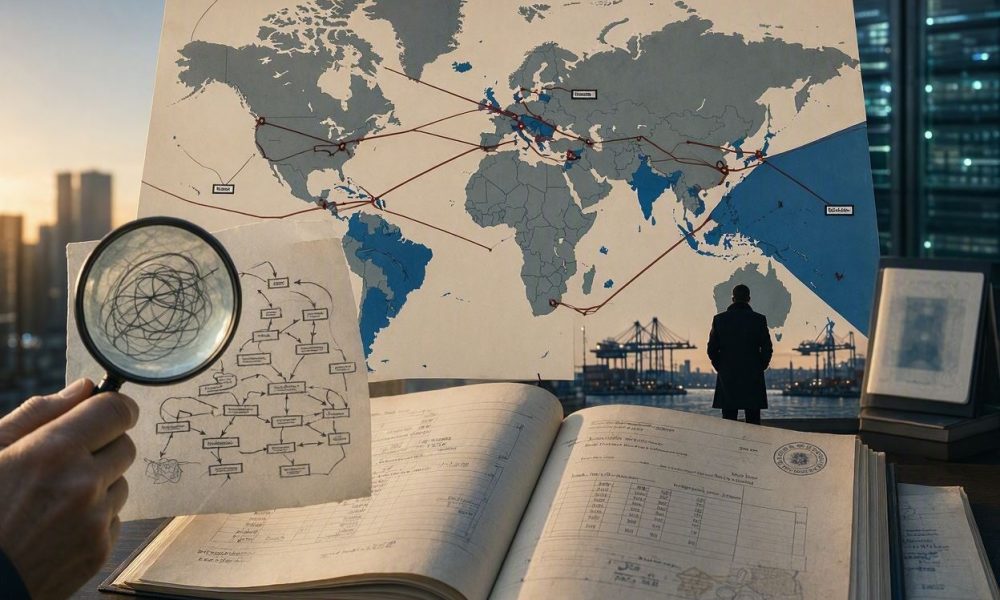
Cross-border transfers and complex ownership arrangements can make suspected criminal proceeds harder to trace, placing financial records, beneficial ownership evidence and international law-enforcement cooperation at the center of investigations involving white-collar defendants who have moved abroad.
WASHINGTON, D.C., September 17, 2026. When a defendant in a major fraud, corruption, securities or tax case leaves the United States, investigators may find that locating the person is only one part of a much larger international investigation.
The second trail can be financial.
Money may have moved through several banks, corporate entities, investment accounts, trusts, or jurisdictions before investigators begin reconstructing what happened, requiring authorities to establish who controlled the funds, where they originated, and whether particular assets can legally be connected to alleged criminal conduct.
In white-collar fugitive investigations, this financial trail can matter because a person may cross an international border within hours. In contrast, the financial records surrounding that movement can remain distributed among institutions and governments for years.
The U.S. Justice Department’s Asset Forfeiture Program describes asset forfeiture as a tool used to identify, seize, and forfeit property connected with criminal activity while promoting cooperation among American and foreign law-enforcement agencies.
The Investigation Often Begins With the Money
Unlike a conventional fugitive investigation centered primarily on physical location, white-collar cases frequently involve extensive documentary evidence that can continue generating investigative leads long after the defendant has left the jurisdiction.
Bank transfers, securities transactions, corporate records, property purchases, and account-opening documentation can help investigators reconstruct financial relationships that existed before the person became a fugitive.
The central question is rarely limited to where the money went.
Investigators may also need to determine who authorized transactions, who ultimately benefited, whether an intermediary acted independently, and whether apparently separate companies were actually controlled by the same individual or group.
This distinction becomes important when financial activity passes through corporations whose legal ownership may differ from their practical control.
A company can have directors, shareholders, managers, accountants and authorized signatories, while investigators must still determine which individual exercised ultimate authority over its assets.
Offshore Does Not Automatically Mean Illegal
Holding money, investments or corporate interests outside one’s home country is not inherently unlawful, and millions of individuals and businesses maintain legitimate international financial arrangements for investment, commercial, family and tax-planning purposes.
The investigative issue arises when prosecutors believe offshore structures were used to conceal criminal proceeds, disguise beneficial ownership, evade legally required reporting, or obstruct efforts to recover assets associated with an alleged offense.
That distinction matters because investigators cannot treat the existence of a foreign account or company as proof of criminal activity.
They must connect financial evidence to the conduct alleged in the underlying case and satisfy the legal standards governing subpoenas, warrants, forfeiture proceedings and requests for foreign assistance.
For legitimate international clients, maintaining accurate ownership, tax, banking and source-of-funds records can therefore become increasingly important as global financial institutions apply enhanced compliance standards to international relationships.
Amicus International Consulting has separately examined the compliance issues surrounding lawful international banking and financial identity planning through its Banking Passport Program overview.
One Transfer Can Produce Records in Several Countries
A single international payment can involve the sending bank, receiving bank, intermediary institutions, correspondent banks, and financial service providers in different jurisdictions.
That can create valuable evidence, but it can also complicate an investigation.
A U.S. investigator might identify a transaction almost immediately from domestic records, but still need foreign legal procedures to obtain underlying documentation held by a bank in another country.
Those procedures can involve mutual legal assistance arrangements, court orders, treaty mechanisms, financial-intelligence cooperation or direct law-enforcement coordination, depending on the jurisdiction and the nature of the information sought.
Different countries also have different rules on financial privacy, disclosure, evidentiary standards, and when assets may be restrained.
The result is a financial investigation that can progress at different speeds simultaneously.
Beneficial Ownership Becomes a Central Question
Corporate ownership can present another investigative challenge because the person whose name appears on a company registration may not necessarily be the individual who ultimately controls the assets.
Investigators examining suspected criminal proceeds may therefore compare corporate filings with banking records, signatures, emails, contracts, payment instructions and other evidence showing how an entity actually operated.
They may also examine connections among companies to determine whether apparently unrelated businesses shared addresses, officers, financial professionals, account signatories or common sources of funds.
None of those circumstances alone necessarily proves criminal ownership.
Taken together with other evidence, however, they can help authorities construct a financial picture demonstrating who exercised practical control over particular property.
This process is especially significant when investigators believe proceeds were moved repeatedly before being converted into real estate, securities, artwork or other assets.
The 1MDB Case Shows How Far the Financial Trail Can Extend.
The continuing 1MDB litigation provides one of the clearest public examples of how international financial tracing can continue long after the underlying transactions occurred.
In May 2026, the Justice Department announced another forfeiture order covering more than $6 million in assets associated with the 1MDB investigation, including a New York apartment and rental income.
The department alleged that billions of dollars belonging to Malaysia’s sovereign wealth fund were misappropriated between 2009 and 2015 through an international money-laundering and embezzlement scheme involving Low Taek Jho, commonly known as Jho Low.
Justice Department case information continues to identify Low as a fugitive in the related criminal proceedings, illustrating how asset recovery and financial litigation can continue even while the principal defendant remains outside American custody.
Reuters also reported in May 2026 that Low remained a fugitive while facing unresolved U.S. criminal charges connected with the 1MDB scandal.
The case demonstrates why international financial investigations do not necessarily end when a defendant leaves the country.
Property, bank records, and transactions can remain subject to litigation even if authorities have not obtained physical custody of the accused.
Financial Records Can Also Produce Location Evidence
Tracing assets serves another purpose in some fugitive cases: financial activity can generate information relevant to determining where a wanted defendant may be living or operating.
Investigators working with appropriate legal authority may examine transaction records alongside other evidence to determine whether particular payments correspond with travel, accommodation, professional services or property connected with a suspected location.
The key distinction is that a bank transaction does not necessarily establish the account holder’s physical location.
Accounts can be managed remotely, representatives can authorize payments, and corporations can conduct business in countries where their beneficial owners are not physically present.
Investigators therefore generally need corroborating evidence before translating financial activity into a reliable conclusion about someone’s whereabouts.
Amicus International has previously examined the broader relationship between fugitive investigations, international financial activity and cross-border enforcement in its coverage of international fugitive investigations involving Ryan Wedding.
International Cooperation Can Become the Bottleneck
The effectiveness of a cross-border financial investigation often depends on how quickly authorities in different countries can lawfully exchange information and preserve assets.
That cooperation can be highly effective, but it is rarely instantaneous.
Requests may require translation, judicial review, certification, or compliance with the requested country’s domestic evidentiary standards before authorities can release banking information or restrain property.
The Justice Department highlighted the importance of such cooperation in the Danske Bank matter when it announced a $50 million forfeited-asset sharing agreement with Estonia in January 2025, recognizing evidence and assistance Estonian authorities provided during the investigation.
The case illustrates an important feature of modern financial enforcement: investigators frequently need evidence located outside the country bringing the prosecution.
Delay Can Matter in Complex White-Collar Cases
International cooperation can also create timing difficulties.
Reuters reported in June 2026 that Switzerland’s attorney general had raised concerns about procedural delays in complex financial investigations, including disputes over evidence and the time required for international cooperation in white-collar cases.
Those delays can become significant when prosecutors face limitation periods, large volumes of digital evidence and multiple jurisdictions applying different procedural requirements.
The problem does not necessarily mean financial evidence cannot be obtained.
Instead, it means investigators may have to pursue several parallel legal processes while carefully preserving evidence and meeting deadlines in the jurisdiction where criminal charges were filed.
For that reason, financial tracing can continue for years after the original alleged conduct occurred.
Asset Recovery and Fugitive Capture Are Separate Processes
Another important distinction is that recovering suspected criminal proceeds and obtaining custody of a fugitive are legally different objectives.
A government may successfully freeze or forfeit assets located within its jurisdiction even though the defendant remains overseas.
Conversely, a defendant may be arrested abroad while investigators continue litigating ownership of bank accounts, real estate or other property in several additional countries.
The Justice Department’s continuing 1MDB asset-recovery litigation demonstrates this separation particularly clearly.
Authorities have pursued property allegedly connected with the underlying financial scheme while Low has continued to face unresolved criminal charges outside U.S. custody.
Following Ownership Can Be More Important Than Following Geography
Traditional fugitive investigations naturally focus on physical movement: airports, border crossings, residences and known associates.
Complex financial cases introduce another map.
Investigators may need to trace how money moved from one account to another, how corporate ownership changed, who signed banking instructions, and whether property purchased through one entity ultimately benefited someone associated with the alleged offense.
This financial map does not necessarily reveal where a defendant is located.
It can reveal the network surrounding the defendant, including companies, financial relationships, and assets that may remain accessible to investigators even when the person is not.
That distinction has made forensic accounting, financial intelligence and international asset tracing increasingly important components of major cross-border investigations.
The Financial System Can Complicate Flight, but It Can Also Preserve Evidence
Moving money internationally can initially complicate a financial investigation because authorities must cross legal and institutional boundaries to obtain evidence.
At the same time, international financial activity can create records at multiple institutions.
Account applications, compliance reviews, wire-transfer records, transaction histories, and corporate documentation may continue to exist even after the underlying funds have moved elsewhere.
For investigators, the challenge is assembling those separate pieces into a legally admissible record showing what happened, who controlled the transactions,s and how the activity relates to the charges being prosecuted.
That process can be slow, particularly when evidence spans numerous jurisdictions, but sophisticated financial structures do not automatically eliminate the documentary trail.
The News Trail
Modern white-collar fugitive investigations increasingly follow two trails at the same time.
One trail follows the defendant through borders, immigration systems, international police cooperation and possible Extradition proceedings.
The other follows the money through banks, corporations, investment accounts, property and financial intermediaries.
The first may reveal where a person has gone.
The second can help explain how assets were moved, who controlled them, and whether funds remain available for seizure, forfeiture, or restitution.
In major international cases, investigators may spend years connecting those trails.
That is why offshore financial networks can complicate white-collar fugitive investigations without necessarily making the underlying financial activity invisible. Each additional jurisdiction can add another legal process, another institution, and another delay. Still, it can also create another set of financial records that can become evidence.
As cross-border finance becomes increasingly integrated, the contest between financial complexity and financial transparency is becoming a defining feature of international white-collar enforcement.




