
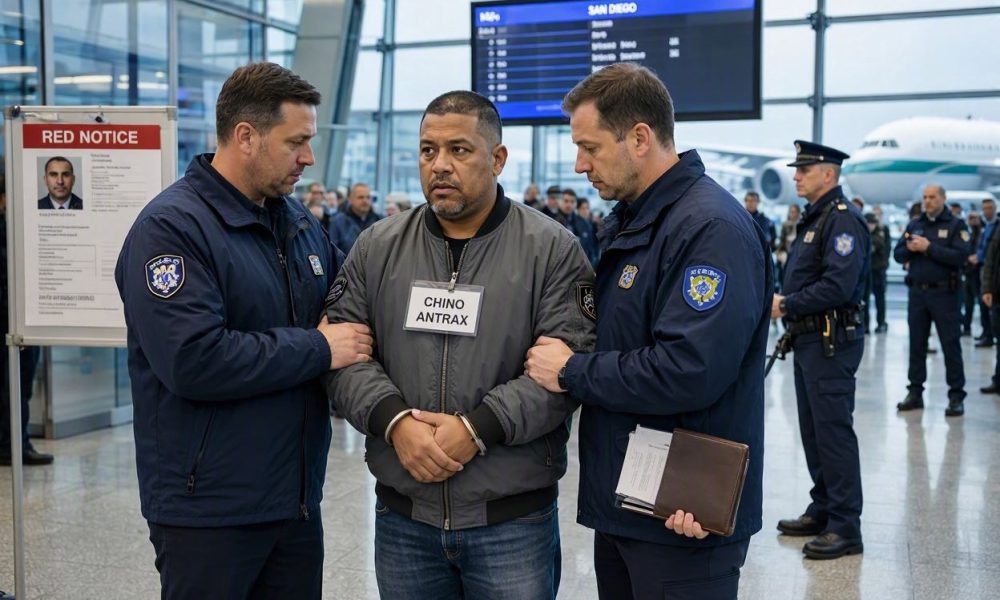
Jose Rodrigo Arechiga-Gamboa used a dead man’s identity, a fraudulent Mexican passport, plastic surgery, and altered fingerprints, but coordinated forensic work and an Interpol alert led Dutch authorities from Schiphol Airport to a heavily secured American extradition.
WASHINGTON, D.C., August 27
Jose Rodrigo Arechiga-Gamboa stepped from a flight arriving at Amsterdam’s Schiphol Airport under the name Norberto Sicairos-Garcia. Still, the identity presented in his Mexican passport could not withstand the international law-enforcement system waiting beyond the aircraft door.
Dutch authorities arrested the Mexican national on December 30, 2013, after the United States circulated both a provisional arrest request and an Interpol Red Notice connected to a sealed San Diego indictment returned only ten days earlier.
Widely known as “Chino Antrax,” Arechiga-Gamboa had been identified by American prosecutors as a senior Sinaloa Cartel figure and leader of Los Antrax, an armed enforcement organization associated with narcotics security and violent operations.
His detention became a defining example of how international airports combine passenger records, passport inspection, police databases, biometric evidence, and cross-border alerts to create a concentrated enforcement environment where even a sophisticated false identity can collapse quickly.
The Netherlands did not immediately place him on an American aircraft, because arrest under an international alert began a separate Dutch extradition process requiring judicial review before United States officers could lawfully take custody.
After a Dutch court approved surrender in May 2014, the United States Marshals Service and Drug Enforcement Administration transported Arechiga-Gamboa from Amsterdam to San Diego under heavy security on July 10, completing a closely coordinated transatlantic handover.
The Arrest Happened in 2013, While Extradition Followed in 2014
Although the case is commonly identified with 2014 because that was the year of extradition, the critical airport arrest occurred on December 30, 2013, as Arechiga-Gamboa deplaned a KLM flight originating in Mexico City.
A federal grand jury in the Southern District of California had returned a sealed indictment on December 20, charging conspiracies to distribute controlled substances intended for American importation and to import controlled substances into the United States.
The clerk issued a sealed arrest warrant that same day, giving prosecutors domestic judicial authority. At the same time, international specialists prepared the communications and legal requests needed to locate and provisionally detain him outside American territory.
United States officials asked foreign authorities for assistance through two complementary mechanisms, using a provisional arrest warrant to support immediate legal action and an Interpol Red Notice to circulate the wanted-person information through international police channels.
According to the United States Department of Justice, Dutch officers encountered Arechiga-Gamboa at Schiphol while he was traveling under the fraudulent identity Norberto Sicairos-Garcia and carrying a Mexican passport issued in that name.
The indictment was unsealed in San Diego on January 3, 2014, several days after the arrest, allowing prosecutors to announce the charges publicly without compromising the airport operation that had already secured his detention.
That sequence demonstrates why a criminal case invisible to ordinary internet searches may remain fully operational inside protected police systems, where sealed warrants, passenger information, and Interpol communications can be accessed by authorized national authorities.
A False Passport Built Around a Dead Person’s Identity
Prosecutors said the passport did not merely contain a fictional variation of Arechiga-Gamboa’s own name. Instead, they assumed the identity of a deceased person, adding identity fraud concerns to an already sophisticated effort at international concealment.
Using a real person’s biographical details can make a document appear superficially consistent with civil databases. Still, it can also create discrepancies in historical records, death information, photographs, and biometrics that expose the impersonation.
American authorities further alleged that Arechiga-Gamboa had undergone significant plastic surgery and attempted to alter his fingerprints, measures evidently intended to weaken the physical connections between his body, known images, prior records, and the name circulating internationally.
Those alterations failed because law-enforcement specialists confirmed his identity through forensic techniques, demonstrating that modern identification rarely depends upon a single photograph, one fingerprint impression, or the unverified biographical page inside a passport.
Border authorities can compare multiple interconnected information layers, including document security features, passport issuance history, flight reservations, previous travel, photographs, fingerprints, watchlist records, device information, recorded interviews, and intelligence supplied by trusted foreign partners.
Readers examining the security technology built into modern passports should recognize that document examination increasingly combines physical security with databases and biometrics, making identity verification a connected process rather than a visual inspection alone.
The case also shows why cosmetic alteration offers no reliable answer to biometric scrutiny, since changes to outward appearance may leave deeper facial geometry, fingerprints, travel patterns, associated records, and other identifying evidence largely intact.
Why Schiphol Airport Became the Decisive Location
Schiphol is one of Europe’s major international transit hubs, where passengers entering or connecting through the Netherlands may encounter sophisticated document systems and law-enforcement access to international alerts, depending upon itinerary and applicable border procedures.
An airport concentrates the information necessary to identify a wanted traveler, because airlines collect reservation details. At the same time, immigration and police agencies may assess passports, destination data, routing history, identity markers, and active notices during a narrow operational window.
Arechiga-Gamboa’s arrival from Mexico City placed him inside Dutch jurisdiction, meaning the Netherlands could apply its own provisional-arrest and extradition laws once officials connected the traveler using Norberto Sicairos-Garcia’s name to the person sought by San Diego prosecutors.
The Red Notice did not authorize American agents to arrest him inside the Netherlands, nor did it compel a Dutch court to approve extradition, because every coercive action still required authority recognized within the requested country.
Nevertheless, the alert was operationally powerful because it delivered identifying and case information to agencies positioned to act, turning a sealed California prosecution into an immediate airport detention thousands of miles from San Diego.
The arrest therefore captures the true nature of a Red Notice, which lacks independent worldwide arrest power but can trigger national police action when paired with a valid warrant, provisional request, treaty relationship, and local legal authority.
From Alleged Bodyguard to Los Antrax Leader
Extradition filings portrayed Arechiga-Gamboa as someone who began working for the Sinaloa Cartel as a bodyguard before becoming leader of Los Antrax, an enforcement group responsible for protecting narcotics shipments and conducting violent operations.
Prosecutors alleged that he eventually rose into the highest levels of the organization, connecting logistical drug-trafficking responsibilities with the coercive capacity used by cartel networks to secure routes, enforce discipline, intimidate rivals, and protect leadership.
The Sinaloa Cartel operated through flexible alliances and specialized cells rather than a single conventional corporate hierarchy, making armed groups such as Los Antrax important for protecting personnel, territory, shipments, and relationships across Mexico.
At the moment of arrest, those descriptions remained government allegations rather than adjudicated facts. Still, Arechiga-Gamboa later pleaded guilty and admitted high-level membership, narcotics activity, and participation in violence supporting the cartel’s operations.
Responsible reporting must preserve that timeline because the presumption of innocence applied when prosecutors announced the sealed indictment. At the same time, the later guilty plea changed the legal status of facts that Arechiga-Gamboa formally admitted in federal court.
Dutch Judges Controlled the Extradition Decision
Following the Schiphol airport arrest, American officials submitted the extensive legal materials required to support extradition. Still, Dutch authorities retained full responsibility for detention and independent judicial review while Arechiga-Gamboa remained inside the Netherlands.
A Dutch court considered the American request and ordered his extradition on May 28, 2014, concluding that he could be surrendered to face the narcotics conspiracy charges described in the Southern District of California case.
That order confirms the difference between provisional arrest and final surrender, because the first preserves the requested person’s availability. In contrast, the second follows a formal examination of treaty requirements and domestic extradition law.
Defense counsel may contest identity, evidentiary sufficiency, dual criminality, political motivation, prior jeopardy, limitation periods, serious human-rights concerns, or diplomatic assurances, depending upon the governing treaty and the domestic law of the requested state.
The Red Notice itself decides none of those issues, meaning the Dutch court did not function as a branch of Interpol but as an independent national institution responsible for determining whether the American request could lawfully proceed.
General public guidance concerning Interpol Red Notices and international extradition emphasizes this important separation because international police circulation, provisional detention, judicial review, executive approval, and physical custody transfer are related but legally distinct procedural events.
In Arechiga-Gamboa’s case, those stages moved from a sealed warrant and international alert through Dutch detention and court approval before culminating in an escorted flight to the jurisdiction where the indictment had been filed.
Heavy Security Accompanied the Flight to San Diego
Arechiga-Gamboa arrived at San Diego International Airport at approximately 2 p.m. on July 10, 2014, aboard a flight arranged by the Marshals Service and Drug Enforcement Administration under security reflecting his alleged cartel position and flight risk.
Contemporaneous international coverage by Reuters described the passenger as a suspected senior Sinaloa Cartel operative and reported that American federal officers transported him directly from Amsterdam to secure federal custody in Southern California.
He was booked after landing and scheduled for arraignment before United States Magistrate Judge Mitchell D. Dembin, transferring responsibility from Dutch extradition authorities to the federal court overseeing the San Diego narcotics prosecution.
The security surrounding the arrival did not prove the indictment. Still, it reflected an operational assessment involving alleged organizational rank, international travel under a fraudulent identity, altered physical identifiers, and the possibility of escape or external intervention.
The successful extradition also depended on personnel beyond the escorting officers, including Justice Department international-affairs lawyers, federal prosecutors, investigators, forensic specialists, Dutch police, judicial authorities, aviation personnel, and custodial officials who carefully coordinated the international transfer.
This extensive institutional chain is frequently compressed into a short statement that a fugitive was extradited, even though lawful surrender ordinarily requires months of evidence preparation, translation, diplomatic communication, hearings, travel planning, and custody documentation.
The Guilty Plea Changed the Case
On May 20, 2015, Arechiga-Gamboa pleaded guilty in federal court, formally admitting that he conspired to import substantial quantities of cocaine and marijuana into the United States and acknowledging his high-level operational role within the Sinaloa Cartel.
He admitted that the conspiracy operated from at least May 2005 through December 2013, connecting years of alleged trafficking activity to the federal charge that had generated the sealed warrant and international alert.
Government accounts said he acknowledged providing armed security for narcotics shipments and participating in violent cartel activities, converting important portions of the prosecution’s original allegations into admitted facts accepted through a formal federal plea proceeding.
The negotiated guilty plea avoided a lengthy public trial in which prosecutors would otherwise have needed to present admissible evidence and prove every charged criminal element beyond a reasonable doubt before a unanimous federal jury.
It also clearly demonstrated that extradition did not determine criminal guilt, because the Dutch proceeding decided whether surrender was lawful. At the same time, the American federal court separately handled the plea, conviction, custodial sentencing, and resulting supervision.
An 87-Month Sentence and Supervised Release
Federal Judge Dana M. Sabraw sentenced Arechiga-Gamboa in December 2019 to 87 months in custody followed by five years of supervised release, with his lengthy detention dating from the December 2013 arrest accounting for most of the custodial term.
He moved from custody to supervised release in San Diego in March 2020, subject to conditions that restricted his movement and required ongoing contact with federal probation officials responsible for monitoring his compliance.
In May 2020, authorities reported that he had disappeared from supervision after a probation officer could no longer locate him, creating another fugitive episode almost six years after the Netherlands had extradited him to California.
Reports soon placed him back in Sinaloa, where Mexican authorities identified his body after three people were found dead inside a vehicle near Culiacán, closing the story with violence resembling the cartel environment described throughout his prosecution.
His death did not diminish the legal significance of the original airport arrest. Still, it added a stark final chapter showing that extradition, conviction, imprisonment, and supervision did not permanently separate him from the violent network surrounding his earlier life.
False Identity Versus Forensic Identity
The enduring investigative lesson from the Schiphol arrest is that identity consists of interconnected records and physical characteristics, meaning replacing a passport name does not necessarily replace the evidentiary trail attached to the traveler presenting it.
Arechiga-Gamboa reportedly combined several sophisticated concealment methods, yet international investigators overcame the fraudulent passport, deceased person’s identity, altered appearance, and attempted fingerprint changes by evaluating a broader collection of forensic, biometric, and intelligence information.
Modern watchlist screening can connect partial matches and inconsistent records for secondary examination, where trained personnel assess whether the traveler’s document, claimed history, route, physical characteristics, and database information support the same identity.
No legitimate privacy service or lawful second-citizenship program authorizes impersonating a deceased person, unlawfully altering official documents, obstructing biometric comparison, or knowingly using a passport issued through fraud to defeat an active international arrest request.
Legal identity planning depends on authentic government records and truthful applications. In contrast, counterfeit or fraudulently obtained documents can create separate criminal liability while increasing suspicion at the very border encounter they were meant to survive.
What the Case Teaches About Red Notices
For the public, Arechiga-Gamboa’s arrest shows why a Red Notice should be described neither as a universal warrant nor as a harmless bulletin, because its practical effect depends on the national authority receiving and acting on it.
For prosecutors, the case shows how a sealed indictment can protect against premature disclosure, while a provisional arrest request and international notice enable foreign police to identify a wanted traveler outside American territory.
For experienced defense lawyers, the record highlights the need to examine the underlying warrant, passport evidence, biometric identification, provisional detention authority, treaty requirements, certified extradition filings, and permitted scope of prosecution following international surrender.
For airport security authorities, the case shows the importance of combining document expertise with forensic analysis and international police data, especially when extensive cosmetic alteration or intentionally damaged fingerprints make ordinary visual comparison far less reliable.
For travelers, the episode confirms that using another person’s passport identity can fail even when the document appears genuine, because border screening increasingly evaluates the person, database history, and journey rather than trusting the booklet alone.
The precise account is therefore that Dutch authorities arrested Arechiga-Gamboa under Dutch authority after receiving American requests transmitted through formal channels. In contrast, a Dutch court independently approved the extradition that brought him to San Diego.
A Landmark Airport Extradition Case
The Chino Antrax case remains one of the clearest examples of a Red Notice intersecting with identity fraud, cartel enforcement, biometric investigation, airport policing, European extradition law, and a major American narcotics prosecution.
It began with a sealed California indictment on December 20, 2013, accelerated at Schiphol ten days later, passed through a Dutch extradition order in May, and reached San Diego under heavy security in July 2014.
The subsequent guilty plea established criminal responsibility for drug-trafficking conduct. At the same time, the sentence, supervised release, disappearance, and death completed a trajectory far more complicated than the initial report of an airport arrest under a false name.
What endured at every stage was the verified identity behind the alias: Norberto Sicairos-Garcia appeared on the passport, “Chino Antrax” defined the public reputation. Jose Rodrigo Arechiga-Gamboa remained the person the courts recognized.
That outcome shows the strategic power of international police cooperation: a Red Notice provided global visibility, forensic work defeated physical and documentary deception, Dutch law governed surrender, and American courts ultimately determined guilt and punishment.




