
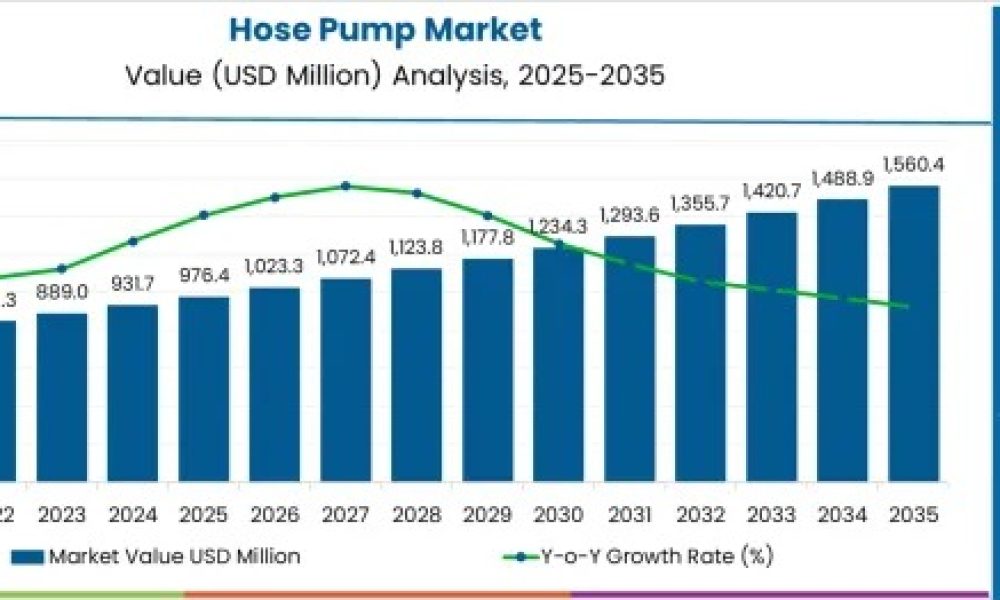
The global Hose Pump Market is moving into a decade of steady growth, expanding from an estimated USD 976.4 million in 2025 to USD 1,560.4 million by 2035. This reflects a firm CAGR of 4.8% as process-driven industries—including chemicals, wastewater, mining, and food processing—continue adopting hose pumps for their durability, leak-free operation, and capability to handle abrasive, viscous, and shear-sensitive fluids.
Subscribe for Year-Round Insights → Stay ahead with quarterly and annual data updates
https://www.futuremarketinsights.com/reports/sample/rep-gb-22682
Market Value and Forecast Trends
According to updated 2025–2035 projections, demand is being strongly influenced by expansion in chemical manufacturing, rapid industrialization across emerging markets, and increasing investments in automated pumping systems. The market’s growth pattern aligns closely with evolving regulatory pressures that require safer, enclosed fluid transfer technologies.
By 2025, hose pumps operating in the 8 to 16 bar pressure range will contribute 33.9% of global revenue, making this the largest and most influential segment. Its dominance stems from its suitability across key industries and its ability to deliver consistent flow performance with lower maintenance requirements.
In material selection, natural rubber hoses are projected to account for 28.2% share in 2025, driven by superior abrasion resistance, flexibility, and cost efficiency—factors essential for continuous-duty pumping cycles. Natural rubber’s compatibility with a wide spectrum of industrial fluids has also reinforced its leadership.
Application and End-Use Momentum
The chemical industry will represent 37.6% of total hose pump revenue in 2025, underscoring its reliance on enclosed, contamination-free pumping systems. Hose pumps are widely used in chemical dosing, slurry transfer, erosive media handling, and corrosion-prone applications, making them critical equipment in processing plants.
Wastewater treatment facilities continue to adopt hose pumps for sludge management and chemical injection, while the mining sector uses them for abrasive slurry handling. The food and pharmaceutical sectors are also accelerating adoption, given the pumps’ ability to maintain product integrity and minimize shear.
Regional Growth Insights
The hose pump market demonstrates varied but robust expansion across major economic blocs:
- China (CAGR: 6.5%) – Growth driven by large-scale mining investments, chemical plant expansions, and national focus on industrial automation. Slurry transfer units alone represented 34% of new equipment purchases by 2030.
- India (CAGR: 6.0%) – Infrastructure, cement production, and mining led adoption. Between 2025 and 2029, hose pump penetration at mining sites grew 3.8×. “Make in India” initiatives accelerated domestic supply chain growth.
- Germany (CAGR: 5.5%) – Strong demand from food & beverage and pharmaceutical industries, with pharmaceutical applications contributing nearly 38% of national hose pump sales in 2027.
- United Kingdom (CAGR: 4.6%) – Water utilities accounted for 44% of UK installations by 2028 as environmental regulations and automation advanced fluid handling upgrades.
- United States (CAGR: 4.1%) – High adoption across oil & gas downstream, wastewater treatment, and food processing. IoT-enabled dosing units captured 27% of all new orders by 2029.
These growth differentials reflect broader trends: BRICS economies exhibit capacity-driven expansion, while OECD markets show stable performance supported by regulatory compliance and technological modernization.
Key Market Drivers and Trends
Three dominant factors are shaping hose pump demand through 2035:
- Durability and operational safety:
Industries increasingly prefer hose pumps for their leak-free design and ability to manage corrosive, abrasive, and shear-sensitive fluids. - Reduced maintenance costs:
Peristaltic pump designs minimize component wear, lowering downtime—an advantage for high-throughput chemical, mining, and wastewater operations. - Advanced elastomer and IoT integration:
Market leaders are developing improved elastomer hoses and smart pump systems enabling real-time monitoring, predictive maintenance, and automated dosing.
New opportunities are emerging in bioprocessing, hygienic fluid handling, and IoT-enabled industrial dosing—segments where accuracy, contamination control, and automation are critical.
Competitive Landscape
Top manufacturers—including Watson-Marlow Fluid Technology Group, Bredel Pumps, Albin Pump AB, Flowrox, Grundfos, Verder Group, and Graco—are driving innovation through advanced hose materials, IoT capabilities, and application-specific designs. OEM partnerships are expanding rapidly, with many regional suppliers introducing customized elastomer solutions for aggressive chemical and high-pressure applications.
Get data that aligns with your strategic priorities — ask for report customization today:
https://www.futuremarketinsights.com/customization-available/rep-gb-22682
Have a specific Requirements and Need Assistant on Report Pricing or Limited Budget please contact us – [email protected]
About Future Market Insights (FMI)
Future Market Insights, Inc. (FMI) is an ESOMAR-certified, ISO 9001:2015 market research and consulting organization, trusted by Fortune 500 clients and global enterprises. With operations in the U.S., UK, India, and Dubai, FMI provides data-backed insights and strategic intelligence across 30+ industries and 1200 markets worldwide.
Contact Us:
Future Market Insights Inc.
Christiana Corporate, 200 Continental Drive,
Suite 401, Newark, Delaware – 19713, USA
T: +1-347-918-3531



