

Overview
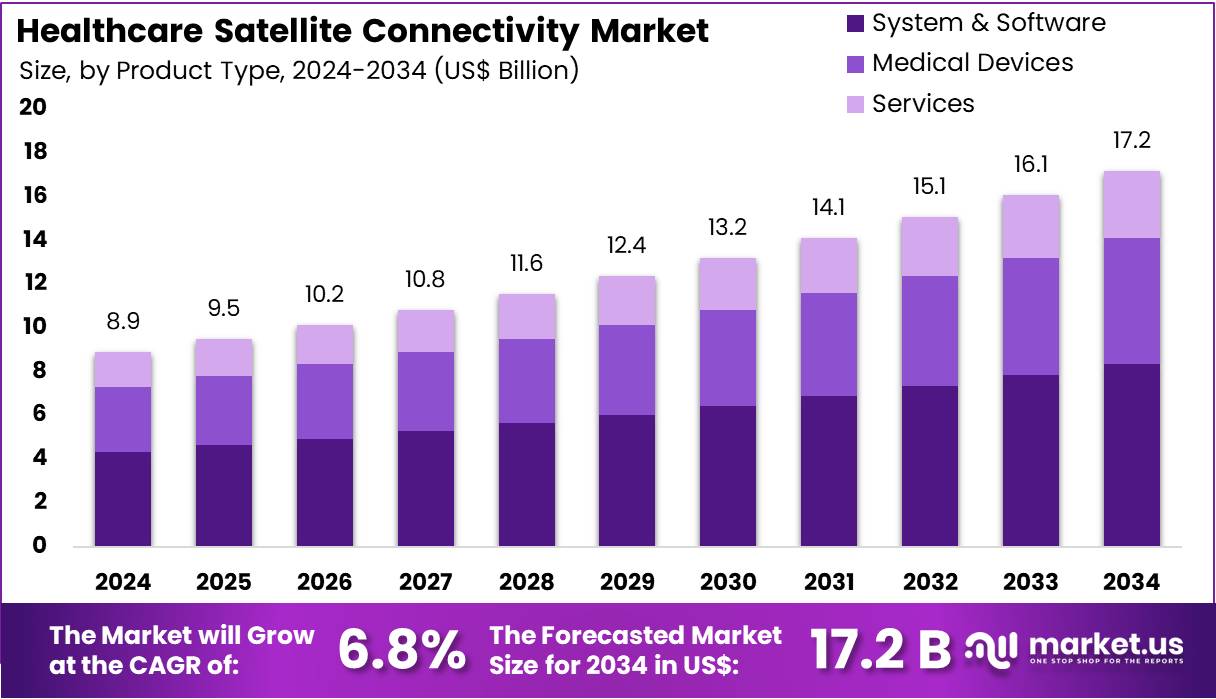
The Global Healthcare Satellite Connectivity Market is experiencing strong growth, driven by the increasing need for reliable communication in remote and underserved regions. The market is projected to reach approximately USD 17.2 billion by 2034, rising from USD 8.9 billion in 2024. This reflects a compound annual growth rate (CAGR) of 6.8% between 2025 and 2034. Satellite connectivity is playing an essential role in delivering medical services where traditional infrastructure is either weak or non-existent.
The demand for healthcare access in isolated regions is expanding. According to the International Telecommunication Union (ITU), over 2.6 billion people worldwide remain offline, many in rural or hard-to-reach areas. This digital divide has created an opportunity for satellite communication systems to support essential services such as telemedicine, emergency response, and remote patient care. Satellite networks are not limited by geography and can quickly establish connectivity in these underserved locations.
A major factor behind Healthcare Satellite Connectivity Market growth is the increasing prevalence of chronic diseases. The Centers for Disease Control and Prevention (CDC) emphasized in its February 2024 report the importance of continuous monitoring and timely medical intervention. Satellite connectivity enables real-time transmission of health data, facilitating early diagnosis and effective treatment. It supports the efficient operation of mobile clinics and allows healthcare workers to respond swiftly in critical situations.
Technological advancements further support market expansion. Innovations such as low-earth orbit (LEO) satellite constellations and high-throughput satellites have enhanced signal quality, reduced latency, and increased bandwidth. These improvements enable seamless integration with digital health tools such as electronic health records (EHRs) and wearable medical devices. As a result, patients and providers benefit from uninterrupted, high-quality telehealth services regardless of their location.
The market also benefits from increased demand during emergencies and natural disasters. Satellite networks ensure continuous healthcare communication when terrestrial systems fail. They are widely used in disaster relief operations, mobile field hospitals, and rural healthcare outreach programs. Satellite-enabled logistics and supply chain management also support the distribution of medical supplies, vaccines, and critical equipment to remote areas.
Collaboration among healthcare providers, satellite operators, and technology firms is accelerating innovation. Public and private sector partnerships are expanding satellite coverage and ensuring its integration with national health systems. These efforts are helping to bridge the healthcare access gap in both developing and developed nations. As global digital health efforts progress, satellite connectivity remains a critical enabler of equitable healthcare delivery and improved population health outcomes.
Key Takeaways
- In 2024, the Healthcare Satellite Connectivity market earned US$ 8.9 billion and is projected to reach US$ 17.2 billion by 2033.
- The market is expected to grow at a steady CAGR of 6.8% over the forecast period from 2024 to 2033.
- Among product types, the system & software segment led in 2024, accounting for 48.7% of the total market share.
- The product segmentation also includes medical devices and services, though these held comparatively smaller shares than system & software.
- Based on technology, fixed satellite services (FSS) dominated in 2024 with a substantial share of 46.8% in the global market.
- The technology segment is further categorized into mobile satellite services (MSS), specialty markers, and fixed satellite services (FSS).
- Within applications, telemedicine emerged as the leading category in 2024, representing 53.6% of total revenue in the segment.
- Other application areas include connected imaging and clinical operations, each contributing notably to the overall market performance.
- In terms of end-users, hospitals & clinics held the largest share at 58.4%, signifying their dominant role in satellite connectivity adoption.
- Additional end-users include clinical research organizations and diagnostic laboratories, playing vital roles in technology uptake.
- Geographically, North America led the market in 2024, securing a dominant regional share of 39.9% in total market revenue.
Get Sample: https://market.us/report/global-healthcare-satellite-connectivity-market/request-sample/
Segmentation Analysis
Product Type Analysis
The system and software segment dominated the market with a 48.7% share. This growth is due to the increasing need for integrated communication platforms in healthcare. Providers demand efficient data transmission, real-time monitoring, and seamless system interoperability. The adoption of telehealth and remote patient monitoring has driven this shift. Reliable systems are essential for managing high data volumes securely. In addition, advancements in AI and cloud computing enhance software capabilities. Healthcare organizations are prioritizing digital transformation, boosting system and software deployment to improve care and operational efficiency.
Technology Analysis
Fixed satellite services (FSS) held a 46.8% market share due to their ability to provide stable, high-capacity communication links. These services are essential for telemedicine, emergency response, and diagnostics in remote regions. FSS supports secure and continuous connectivity, which is critical in healthcare. Enhanced bandwidth and satellite coverage further increase service reliability. As demand for wide-area connectivity grows, healthcare providers are adopting FSS for dependable communication. This trend is expected to continue as satellite technologies improve, reinforcing the segment’s strong market position.
Application Analysis
The telemedicine segment recorded a 53.6% revenue share, highlighting its rapid adoption. Satellite connectivity enables healthcare delivery in underserved and rural areas. It supports virtual consultations, diagnostics, and follow-ups. The rising prevalence of chronic diseases increases the need for remote care and continuous patient monitoring. Real-time video and data transfer technologies have improved the quality of telemedicine services. As a result, healthcare providers are investing in satellite-enabled platforms. This segment is expected to grow steadily, driven by the need for accessible and cost-effective care solutions.
End-User Analysis
Hospitals and clinics accounted for 58.4% of the market share. These facilities depend on satellite networks for telehealth, medical record sharing, and emergency response. The push for digital transformation is driving increased adoption of satellite communication. It ensures smooth data flow and uninterrupted operations, especially in critical care settings. Satellite connectivity also allows specialized services to reach remote regions, enhancing treatment access and quality. With rising investments in healthcare IT, hospitals and clinics continue to lead in adopting satellite connectivity solutions, reinforcing this segment’s dominant market position.
By Product Type
- Medical Devices
- Implantable Medical Device
- Stationary Medical Device
- Wearable External Device
- System & Software
- Remote Device Management
- Network Security
- Network Bandwidth Management
- Data Analytics
- Application Security
- Services
- System Integration Services
- Support & Maintenance Services
- Consulting, Training & Education
By Technology
- Mobile Satellite Services (MSS)
- Specialty markers
- Fixed Satellite Services (FSS)
By Application
- Telemedicine
- Connected Imaging
- Clinical Operations
By End-user
- Hospitals & Clinics
- Clinical Research Organization
- Research & Diagnostic Laboratories
- Others
Impact of Macroeconomic and Geopolitical Factors on the Healthcare Satellite Connectivity Market
Macroeconomic conditions play a significant role in shaping the healthcare satellite connectivity market. During economic downturns, healthcare providers and governments often face budget constraints. This can delay or reduce investment in satellite infrastructure. However, government policies aimed at expanding healthcare access in remote areas may accelerate satellite adoption. These initiatives often continue regardless of broader economic slowdowns. As a result, the dual influence of economic cycles and public policy continues to define investment patterns in healthcare connectivity across diverse geographies.
Geopolitical factors further influence the development of this market. Rising tensions can disrupt international partnerships and affect the supply chain of satellite components. National security concerns may also shift funding priorities toward building more resilient and secure satellite networks. In regions with strategic importance, this can lead to faster adoption of satellite connectivity for healthcare and other critical services. Such geopolitical dynamics can redirect investments and reshape regional growth patterns, especially in areas where terrestrial infrastructure remains limited or vulnerable.
Tariffs, particularly in the United States, present a mixed impact. Higher import duties on satellite equipment may raise infrastructure costs, limiting access for smaller or rural healthcare providers. This could temporarily slow market expansion. However, tariffs may also encourage domestic innovation and production of satellite technologies. Over time, this could strengthen local supply chains and reduce dependence on foreign sources. Despite short-term cost pressures, the long-term demand for remote healthcare access is expected to sustain growth, positioning satellite connectivity as a critical enabler of health system resilience and equity.
Buy Directly: https://market.us/purchase-report/?report_id=149279
Conclusion
In conclusion, the healthcare satellite connectivity market is set to grow steadily due to the rising need for reliable communication in remote and underserved regions. The increasing use of telemedicine, digital health tools, and mobile clinics is driving this demand. Satellite technology provides a strong solution where traditional networks are unavailable or weak. Hospitals, clinics, and research labs are quickly adopting these systems to improve patient care and data sharing. Ongoing advancements in satellite technology, combined with public and private support, are expected to expand access to essential medical services. Overall, satellite connectivity is becoming a key tool in improving global healthcare delivery and bridging the digital health gap.
Get in Touch with Us:
Market.us (Powered By Prudour Pvt. Ltd.)
Address: 420 Lexington Avenue, Suite 300, New York City, NY 10170, United States.
Contact No: +1 718 874 1545 (International), +91 78878 22626 (Asia).
Email: [email protected]
View More
Healthcare Facility Management Market
Healthcare Customer Data Platform Market



