
Overview
Global Healthcare ERP Market size is expected to be worth around USD 15.7 Billion by 2033 from USD 7.5 Billion in 2023, growing at a CAGR of 7.7% during the forecast period from 2024 to 2033.
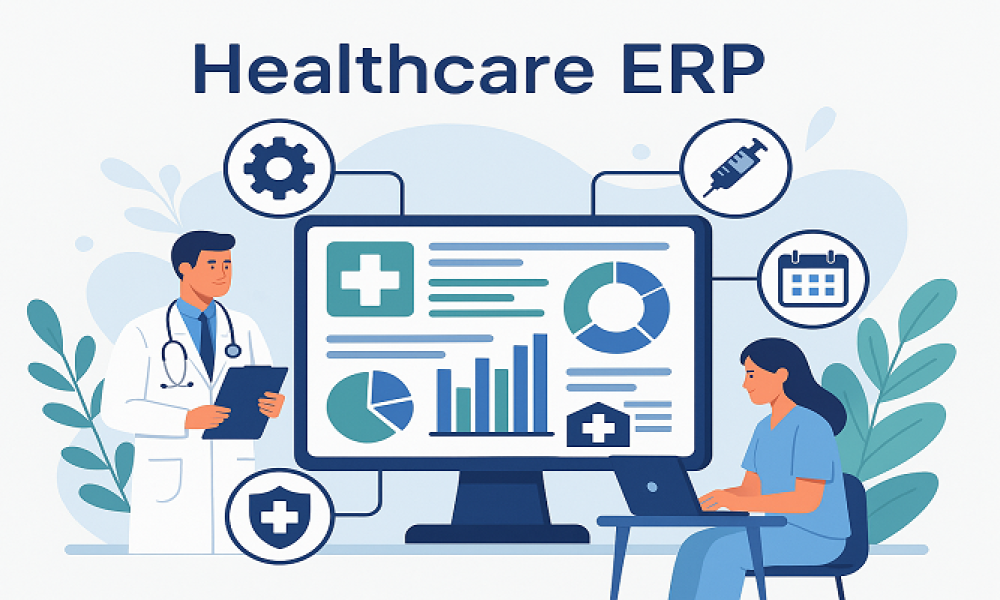
The global healthcare industry is increasingly turning to Enterprise Resource Planning (ERP) systems to enhance operational efficiency, ensure compliance, and improve patient outcomes. Healthcare ERP software integrates multiple administrative, financial, and clinical functions into a unified platform, enabling providers to streamline processes, reduce costs, and make data-driven decisions.
These solutions offer centralized access to real-time data across departments covering patient records, inventory management, billing, scheduling, and supply chain operations. As hospitals, clinics, and diagnostic centers continue to expand their digital infrastructure, ERP systems serve as a critical backbone supporting seamless interoperability and standardized workflows.
Key features of modern healthcare ERP platforms include cloud-based deployment, integration with electronic health records (EHRs), AI-enabled analytics, and automated reporting for regulatory compliance. This functionality not only ensures operational transparency but also empowers healthcare staff to focus more on patient care by minimizing manual administrative burdens.
The demand for ERP systems is further fueled by growing healthcare expenditures, the need for cost optimization, and the push for value-based care delivery models. North America leads adoption due to its advanced healthcare IT ecosystem, while Asia-Pacific is emerging rapidly with increasing investments in healthcare infrastructure.
As digital transformation accelerates across the sector, healthcare ERP systems are poised to play a vital role in driving efficiency, accountability, and sustainable growth for providers worldwide.
Click here to get a Sample report copy @ https://market.us/report/healthcare-erp-market/free-sample/

Key Takeaways
- Market Size: The global Healthcare ERP market is projected to reach approximately USD 15.7 billion by 2033, rising from USD 7.5 billion in 2023.
- Market Growth: A steady compound annual growth rate (CAGR) of 7.7% is anticipated during the forecast period from 2024 to 2033, reflecting increasing digital integration across healthcare systems.
- Function Mode Analysis: Among various functional segments, Finance and Billing emerged as the largest contributor, accounting for 30.4% of the market share in 2023.
- Deployment Analysis: On-premises deployment remains the preferred mode, representing a dominant 73.8% of the total market in 2023, driven by concerns related to data control and regulatory compliance.
- End-Use Analysis: Hospitals represent the leading end-user segment, contributing 53.8% to the overall market share, owing to the complexity and scale of operations requiring integrated ERP systems.
- Regional Analysis: North America led the global market in 2023, capturing 38.6% of the total revenue, supported by advanced healthcare infrastructure and early technology adoption.
- Innovative Leadership: The market is driven by continuous innovation from both established players and emerging startups, with a focus on delivering customized ERP solutions tailored to the evolving demands of the healthcare sector.
Segmentation Analysis
- Function Mode Analysis: The Healthcare ERP market is categorized by function mode, with Finance and Billing representing the largest segment at 30.4% in 2023. This function supports accurate financial transactions and regulatory compliance. Inventory and Material Management optimizes resource allocation, while Supply Chain and Logistics Management improves procurement and delivery efficiency. Patient Relationship Management enhances patient engagement and data handling. The “Others” category includes functions such as human resources and compliance, contributing to the system-wide operational efficiency of healthcare institutions.
- Deployment Analysis: Healthcare ERP systems are deployed through On-Premises and Cloud-Based models. In 2023, On-Premises solutions led the market with a 73.8% share, favored for their data security, control, and customizability. These systems are hosted locally and maintained by internal IT teams. Cloud-Based ERP is expanding rapidly due to its scalability, lower capital investment, and ease of access across locations. It reduces the IT management burden and supports real-time data exchange, making it increasingly attractive for cost-conscious healthcare providers.
- End-Use Analysis: Hospitals accounted for the largest share in the Healthcare ERP market, representing 53.8% in 2023. Their extensive operational needs ranging from clinical care to supply chain logistics necessitate robust ERP solutions. Clinics also benefit from ERP, particularly in managing finances and patient interactions efficiently. Additionally, the “Other” categoryincluding diagnostic labs, outpatient centers, and nursing homes utilizes ERP to support targeted functions. Each segment demonstrates the adaptability of ERP systems in streamlining healthcare delivery across diverse organizational structures.
Market Segments
Function Mode
- Inventory and Material Management
- Supply Chain and Logistics Management
- Patient Relationship Management
- Finance and Billing
- Others
Deployment
- On-Premises
- Cloud- Based
End Use
- Hospitals
- Clinics
- Others
To Purchase this Premium Report @ https://market.us/purchase-report/?report_id=131483
Regional Analysis
In 2023, North America led the global Healthcare ERP market, accounting for a notable 38.6% share. This regional dominance is primarily attributed to its advanced healthcare infrastructure, robust investment in health IT systems, and the strong presence of leading ERP solution providers.
The widespread adoption of ERP systems among North American healthcare organizations is driven by the need to improve operational efficiency, ensure regulatory compliance, and enhance patient care delivery. The growing emphasis on integrated data management and automation continues to position the region at the forefront of healthcare ERP innovation.
Key Players Analysis
The Healthcare ERP market is driven by a diverse group of key players, ranging from established global enterprises to emerging innovators. These companies play a pivotal role in advancing the market through the development of integrated ERP solutions that streamline core functions such as patient management, financial operations, and supply chain logistics ultimately enhancing the operational performance of healthcare providers.
Ongoing investment in research and development enables these players to deliver secure, scalable, and tailored ERP systems. Their strategic global reach and collaborative partnerships further strengthen their position and expand their impact within the healthcare ERP landscape.
Market Key Players
- McKesson Corporation
- Oracle
- SAP SE
- Microsoft
- Aptean
- Odoo
- Infor
- Epicor Software Corporation
- SAGE Group PLC
- QAD Inc
Market Dynamics
- Market Driver: The primary driver for the Healthcare ERP market is the increasing need for operational efficiency and data integration across healthcare facilities. Rising healthcare costs, regulatory compliance demands, and the complexity of managing administrative and clinical workflows are prompting providers to adopt ERP systems. These solutions enable streamlined processes, real-time data access, and improved resource management, which are essential for enhancing patient care, reducing errors, and maintaining financial stability in both large hospitals and smaller healthcare institutions.
- Market Trend: A prominent trend in the Healthcare ERP market is the rapid shift toward cloud-based ERP solutions. Healthcare organizations are increasingly moving away from traditional on-premises systems to cloud platforms due to their scalability, lower upfront costs, and remote accessibility. Integration with advanced technologies such as artificial intelligence, predictive analytics, and Internet of Medical Things (IoMT) is also gaining traction. These trends are transforming ERP systems into more intelligent, flexible, and patient-centric platforms across the healthcare ecosystem.
- Market Opportunity: Significant market opportunities lie in the untapped potential of emerging economies and small to mid-sized healthcare facilities. As digital healthcare infrastructure expands in regions such as Asia-Pacific and Latin America, there is growing demand for affordable, scalable ERP solutions. Additionally, customized ERP modules tailored for specialized healthcare providers including clinics, diagnostic centers, and rehabilitation facilities present a strong growth opportunity. Vendors focusing on localized solutions and cloud deployment can effectively address these evolving market needs and drive future expansion.
Conclusion
The Healthcare ERP market is poised for substantial growth, driven by the increasing need for integrated digital solutions across healthcare operations. With a projected market value of USD 15.7 billion by 2033 and a CAGR of 7.7%, ERP systems are becoming essential for enhancing efficiency, compliance, and patient care.
The shift toward cloud-based platforms, rising adoption in emerging markets, and continuous innovation by key players underscore the market’s dynamic evolution. As healthcare providers seek scalable, secure, and customized solutions, ERP systems will remain central to the sector’s digital transformation and sustainable operational success.
View More Reports:
Healthcare Claims Management Market to Reach USD 21.1 Billion by 2032
Medical Transcription Software Market to Hit USD 190.2 Billion by 2032
Healthcare Analytics Market to Reach USD 249.3 Billion by 2032



