
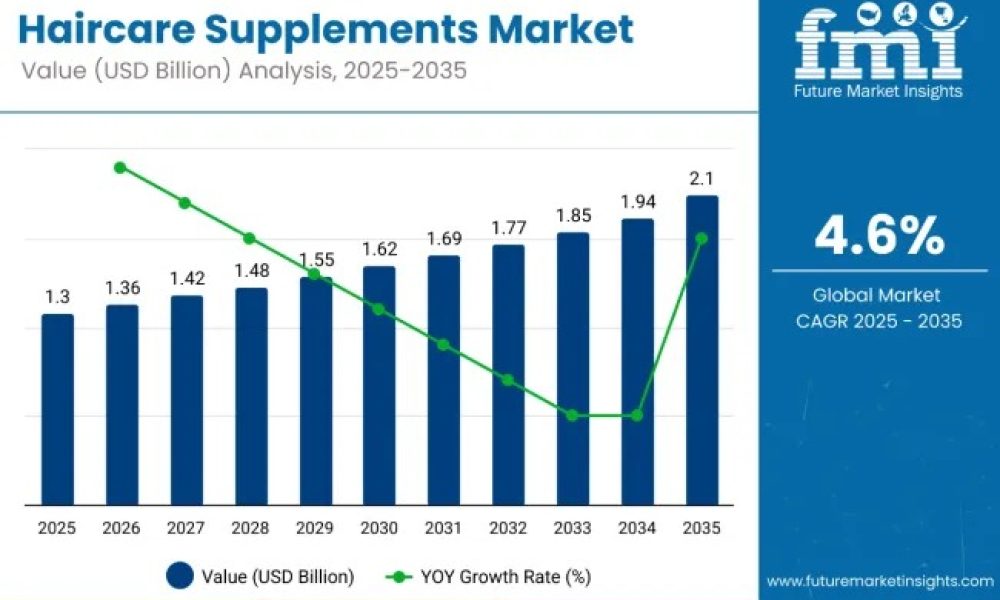
The global haircare supplement market, valued at USD 1.3 billion in 2025, is projected to reach USD 2.1 billion by 2035, registering a steady CAGR of 4.6%. Growth continues to be driven by escalating hair and scalp-related issues linked to rising pollution levels, busy lifestyles, and the increasing prevalence of nutritional deficiencies.
With consumers becoming more aware of holistic beauty routines, ingestible hair nutrition is gaining traction as a mainstream category. Demand is further strengthened by influencer-led product discovery, clinical research-backed formulations, and growing consumer preference for biotin, collagen, and multivitamin blends.
Subscribe for Year-Round Insights → Stay ahead with quarterly and annual data updates. https://www.futuremarketinsights.com/reports/sample/rep-gb-19509
Market Overview and Key Data Points
In 2025, the haircare supplement category represents a fast-expanding niche within the global beauty and nutraceutical landscape.
- Market value (2025): USD 1.3 billion
- Market value (2035): USD 2.1 billion
- CAGR (2025–2035): 4.6%
- Conventional products: 75% share in 2025
- Offline sales: 68% share in 2025
- Top growth region: East Asia, led by Japan at 5.2% CAGR
Although still contributing less than 1% to the nutraceuticals market, haircare supplements are gaining relevance as consumers integrate ingestible beauty into daily routines for improved scalp health, reduced thinning, and overall hair rejuvenation.
Country-Level Growth Outlook
Japan remains the fastest-growing market with 5.2% CAGR, supported by an ageing population increasingly relying on collagen-based beauty products. The USA is set to expand at 4.5% CAGR, driven by high spending on wellness and premium haircare gummies. In Europe, Germany (4.2% CAGR) and France (4.0% CAGR) show strong demand for clinically validated formulations, while the UK progresses at 3.9% CAGR, boosted by clean-label and vegan innovations.
Consumer Spending Trends
Per-capita spending on haircare supplements varies significantly worldwide. Developed markets—including the United States, Canada, Germany, France, Japan, and South Korea—show strong adoption driven by high disposable incomes and advanced beauty habits. Conversely, emerging markets such as India, Brazil, South Africa, and the Philippines are experiencing rapid growth due to increasing awareness, social media influence, and expanding e-commerce penetration.
Trade and Global Movement of Products
International trade in haircare supplements continues to expand as cross-border e-commerce grows.
- Key exporters: United States, Germany, Switzerland, Japan
- Major importers: China, India, Brazil, UAE, South Korea
These trade flows reflect increasing consumer demand for premium nutraceuticals and global brand diversification strategies.
Top Investment Segments
The market spans type, nature, form, functionality, sales channel, and region. Among all segments, biotin dominates with a 28% market share in 2025, followed by rising demand for collagen and vitamin-rich formulations.
Key Segment Highlights (2025):
- Nature: Conventional leads with 75% share, supported by wider availability and affordability.
- Form: Gummies and chewables hold 36% share, appealing to younger consumers and adults seeking easy daily intake.
- Functionality: Hair re-growth solutions lead with 42% share, driven by ageing demographics and higher incidence of pattern hair loss.
- Sales Channel: Offline retail dominates with 68% share, supported by supermarkets, specialty stores, and health & wellness outlets.
Market Drivers and Trends
The market’s upward trajectory is supported by rising beauty-from-within awareness, increasing cases of hair thinning, and evolving supplement formats like collagen powders and biotin gummies.
Key trends include:
- Growing demand for fruit-flavored gummy supplements
- Rising market for personalised hair nutrition
- Increasing consumer interest in collagen-based solutions
- Strong influence of digital marketing, celebrity endorsements, and social platforms
Market Challenges
Despite strong growth projections, manufacturers face regulatory complexities, high raw material costs, limited awareness in developing markets, and pricing pressures due to market competition.
Regional Insights: Top Five OECD Countries
- USA: Strong demand for biotin and collagen supplements; increasing clean-label adoption
- UK: High uptake of vegan, cruelty-free formulations and rapid online retail expansion
- Germany: Strong preference for collagen and clinically tested solutions
- France: Growingorganic and growth-focused supplement demand
- Japan: Innovation-led market with strong adoption of collagen-infused functional foods
Competitive Landscape
The market is moderately fragmented, with leading companies such as OUAI HAIRCARE (P&G), New Nordic Health Brands AB, and Nutraceutical Wellness Inc. (Unilever) driving global demand. These players focus on clinical formulations, targeted marketing strategies, and wider distribution networks across both offline and online channels.
Recent Industry Developments
- November 2024: Hum Nutrition launched its clinically tested “Hair Strong Capsule,” a formulation designed to improve hair growth, resilience, and density.
About Future Market Insights (FMI)
Future Market Insights, Inc. (FMI) is an ESOMAR-certified, ISO 9001:2015 market research and consulting organization, trusted by Fortune 500 clients and global enterprises. With operations in the U.S., UK, India, and Dubai, FMI provides data-backed insights and strategic intelligence across 30+ industries and 1200 markets worldwide.



