
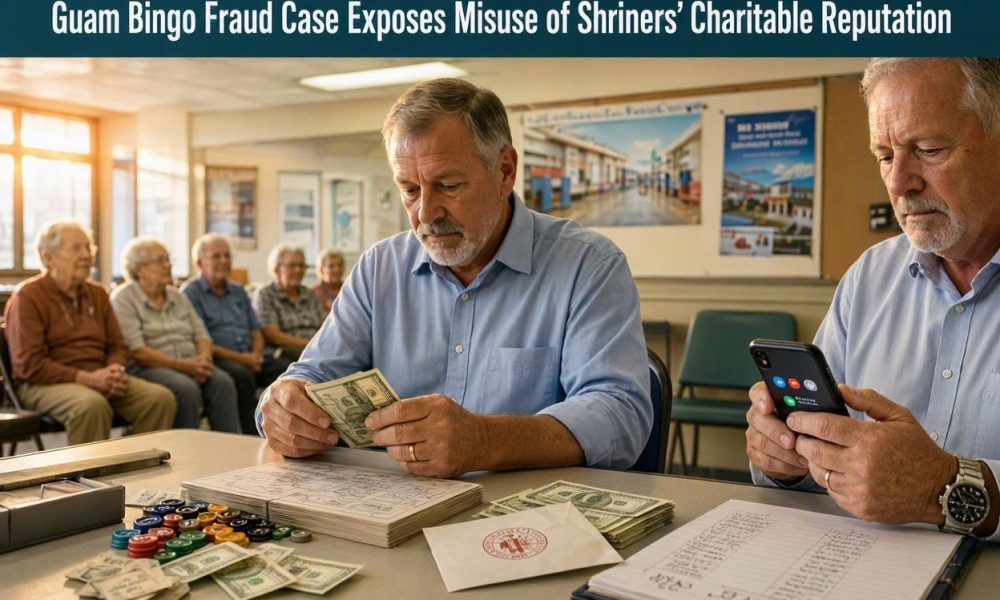
Federal prosecutors said the defendants exploited the Shriners Children’s healthcare system’s reputation, persuading patrons that bingo proceeds would support medical travel while diverting millions of dollars for their own financial gain over several years.
WASHINGTON, DC, September 14, 2026 — The Guam bingo fraud prosecution has placed the misuse of charitable reputation under scrutiny, after federal authorities described an operation that collected approximately $34 million in gross proceeds and diverted $10,750,804 for personal gain.
According to the Justice Department’s sentencing announcement, the scheme involved Hafa Adai Bingo in Tamuning between March 2015 and December 2021, with patrons falsely assured that fundraising proceeds would support the Guam Shrine Club’s charitable purpose.
After jury convictions in May 2025, Michael Marasigan received a 262-month prison sentence in absentia in May 2026, while Jose Arthur Chan received 60 months. Christine Chan received 70 months, and all three were ordered to pay joint-and-several restitution of $10,750,804.
The case invites a broader examination of how charitable fundraising should be explained, documented and supervised, particularly when the organization collecting money draws credibility from a healthcare institution whose name carries meaning far beyond the immediate fundraising venue.
The Difference Between a Charity and Those Invoking Its Name
Reporting by Hawaii News Now on the Guam bingo case included a statement from Shriners Children’s explaining that Shrine clubs are a separate organization and that the prosecution had not interrupted patient care operations for Guam patients in Guam or Hawaii.
The report also described a former parent’s recollection of promises about transportation assistance, alongside frustration over travel expenses, and a former employee’s account of reporting unauthorized patient stories and incorrect branding to the organization’s headquarters in 2017.
Those accounts introduce an essential distinction for readers: concerns about a fundraising operation and its representations should be examined separately from the treatment delivered by medical professionals, especially when the healthcare organization has explicitly addressed continuity of care.
The analytical question is how a donor or customer can establish the relationship between the name displayed at an event, the entity receiving payment and the organization expected to provide the advertised benefit to children or their families.
A Familiar Logo Is Only the Beginning of Verification
A recognizable charitable name can make a fundraising appeal feel immediately understandable. Still, practical questions remain: who organized the event, who controls its accounts, what expenses are deducted, and who confirms delivery of the promised support.
For an ordinary patron, a clear answer should be available without specialized accounting knowledge, lengthy investigation, or personal connections, because public fundraising disclosure should make an informed decision possible before money changes hands.
An event organizer could provide that clarity through a concise statement identifying the beneficiary, explaining the financial arrangement and directing participants to an independently maintained contact point where the relationship can be confirmed before participation or additional giving.
Such a statement serves a different purpose than a promotional slogan, offering information that can be checked against records rather than relying entirely on the emotional force of a familiar name, a compelling photograph, or a personal introduction.
Why Fundraising Language Deserves Close Attention
The phrase charitable proceeds can leave important questions unanswered unless organizers specify whether they mean total receipts, an amount remaining after identified expenses, a fixed payment, or a percentage calculated using a clearly disclosed and consistently applied formula.
Consider a hypothetical community event that advertises support for medical transportation while retaining money for prizes, rent and staffing; participants would need to understand those deductions before deciding whether the advertised charitable contribution matches their expectations about the fundraiser.
The concern in that example is the quality of disclosure, because a reasonable fundraising budget can include legitimate expenses while still requiring an honest explanation of how much the intended beneficiary should receive and when payment should occur.
A useful public statement would therefore describe both the calculation method and the reporting schedule, allowing the audience to compare the original promise with the eventual result rather than accept a general assurance that the event helped children.
Different Financial Figures Answer Different Questions
When evaluating a fundraising operation, readers should distinguish money collected from money available after expenses, and distinguish both from money actually transferred to a beneficiary, because those categories describe different stages in the movement of the same funds.
A large revenue figure can demonstrate the scale of an event without establishing its charitable yield. At the same time, an expense total can identify operating costs without establishing that every payment was appropriate, authorized or consistent with the representations made to participants.
Similarly, an announced obligation to repay money should not be presented as confirmation that the beneficiary has already received it, because a statement about responsibility and a statement about completed recovery communicate materially different information to the public.
For organizations publishing their own financial updates, separate lines for receipts, documented expenses, promised contributions, and completed transfers would make the report easier to understand and reduce the temptation to substitute one impressive number for a complete explanation.
Medical Travel Appeals Carry a Particular Responsibility
An appeal involving children who need to travel for treatment asks the public to imagine an immediate practical need, making precision especially valuable when explaining whether assistance covers airfare, an accompanying adult, accommodation, or changes to an existing booking.
Without those details, a family might understand a promise more broadly than the organizer intende. At the same time, a donor might assume that paying for a fundraising activity will cover expenses the advertised program does not.
A responsible program could reduce that uncertainty by publishing eligibility criteria, covered expenses, application procedures, and a contact for unresolved questions, using language families can understand before they make commitments involving travel, employment, or household finances.
Those disclosures should also distinguish available assistance from assistance still dependent on future fundraising, so that an expression of hope does not become an apparent commitment on which a parent might reasonably rely when planning a child’s journey.
Patient Stories Require Careful Stewardship
When a fundraiser uses a patient’s photograph or personal story, an appropriate review should address permission, accuracy, the context of publication and whether the presentation could imply a relationship or endorsement broader than the people involved actually authorized.
The review should consider how the material appears to someone encountering it for the first time, rather than assuming that a qualifying sentence elsewhere will correct an impression created by the prominent placement of a healthcare name or image.
Families should have a clear way to raise concerns about fundraising material tied to their experiences, and the organization using that material should identify someone responsible for reviewing the complaint and communicating the outcome within a reasonable period.
Protecting patient dignity also means avoiding unnecessary medical detail in public explanations of a financial controversy, since transparency about money can be achieved through organizational records without turning a child’s private health history into evidence for a publicity campaign.
Accountability Begins With Records That Can Be Compared
For a community fundraiser, a practical oversight model would connect the promise made to the public with the transactions recorded internally, creating a documented route from event receipts through authorized expenses to the payment received by the intended beneficiary.
That model should make discrepancies visible to someone other than the person collecting or distributing funds, because independent comparison is more useful than asking the same individual to confirm that every stage of the process was handled correctly.
Supporting records could include event summaries, invoices, payment approvals, bank statements and beneficiary acknowledgments, with enough detail to explain significant differences without forcing reviewers to reconstruct the entire operation from informal messages or incomplete personal recollections months later.
The aim should be a system that can answer ordinary questions promptly, including why a transfer was delayed, why an expense increased and whether the amount delivered corresponds to the formula that participants were originally told would apply.
Oversight Should Follow the Money Beyond the Event
A successful evening can produce attendance figures, photographs and enthusiastic feedback. Still, an oversight committee should continue its review until it reconciles the financial promises and the beneficiary confirms receipt of the amount due under the arrangement.
If a contribution remains unpaid, the internal report should identify the amount, the reason, and the person responsible for resolving it, creating a clear follow-up obligation instead of letting an unfinished transfer disappear into the next fundraising cycle.
Organizations should also consider how board members receive financial information, ensuring that reviewers can examine underlying documents and ask questions without depending entirely on a summary prepared by someone whose own decisions or payments are being reviewed.
A record of that review would help distinguish questions answered with evidence from those that remained unresolved, making it possible for later decision-makers to understand what was known and what action was taken at the time.
Complaints Can Be Treated as Information Worth Checking
A complaint about inconsistent fundraising claims should prompt a specific review of the representation and the relevant records, even when the person raising it cannot provide a complete explanation of the finances or identify the precise cause of concern.
Someone may notice that an advertised benefit differs from the assistance described to a family, or that a public appeal unexpectedly uses material, without access to the accounts needed to understand the discrepancy fully.
An accessible reporting process would allow that observation to reach an appropriate reviewer, establish whether supporting material exists and preserve the original concern accurately, while avoiding promises about findings before the relevant information has actually been examined.
Fairness requires the same discipline when communicating results, because a question may reveal misconduct, a misunderstanding or a correctable administrative problem, and each outcome calls for an explanation grounded in what the review established rather than assumptions about motives.
Independent Confirmation Strengthens Public Answers
When a controversy involves an asserted charitable relationship, confirmation from the named beneficiary can provide information the organizer’s own statement cannot, particularly about whether an event was authorized and whether a promised payment was actually received.
That confirmation should be specific enough to answer the issue under review, since acknowledging an organization’s existence or a past relationship does not necessarily establish approval of every later event, fundraising message, expense arrangement, or use of branding.
If an organization commissions an outside review, its public description should explain the scope and limitations in plain language, allowing readers to understand which questions were examined and which matters remain outside the evidence available to the reviewer.
An independent assessment becomes more useful when the organization explains how it responded to the findings, connecting recommendations with completed changes and remaining work instead of treating the existence of a report as sufficient proof that every concern has ended.
Reputation Management Must Be Supported by Verifiable Action
Amicus International Consulting describes services addressing organizational communications through its crisis public relations management offering, a field relevant to institutions explaining a public controvers. However,h the firm asserts no involvement in the Guam prosecution.
For any organization considering communications assistance, the substantive task should begin with verified facts, a clear account of responsibility and a practical explanation of remedial work, giving affected people information they can use rather than assurances they cannot test.
A useful initial statement would identify what is established, explain what remains under review and give a realistic schedule for further information, while avoiding language that suggests the organization has answered questions its own records have not yet resolved.
Where several organizations share related names or historical connections, communications should explain their actual roles with particular care, helping readers understand who raised the money, who was supposed to receive it, and who delivered the underlying service.
Rebuilding Confidence Requires More Than Improved Messaging
Thefirm’ss separate reputation-rebuilding service addresses public image after a crisis. Still, any assessment of organizational recovery should examine demonstrable conduct, including whether financial disclosures are clearer, responsibilities are defined, and previously identified problems have been corrected.
For a charity or fundraising partner, a credible recovery plan could include routine publication of completed transfers, updated agreements governing name usage and a publicly identified route for questions, with progress measured against commitments made at the outset.
Communication professionals can help make that information understandable. Still, the underlying organization must supply reliable records and accurate explanations, because carefully written language cannot establish that an unpaid contribution was delivered or that an unexamined concern was resolved.
A stronger public narrative would emerge from a sequence of documented actions that affected people can evaluate over time, allowing confidence to develop from observable performance instead of asking audiences to accept a single declaration that trust has been restored.
What Responsible Fundraising Should Make Visible
For future community events, an informative announcement should identify the legal organizer, the intended beneficiary, the basis for calculating the contribution and the expected payment date, giving patrons a concrete framework for understanding the promise attached to their participation.
Afterward, a corresponding report should show what was collected, what was deducted, and what reached the beneficiary, explaining material differences from the original expectation in language accessible to people who supported the event without reviewing its internal financial records.
This approach would also benefit legitimate organizers by giving them a consistent way to demonstrate performance, answer reasonable questions and distinguish their work from unsupported fundraising claims without relying exclusively on personal reputation or the familiarity of a charitable brand.
The lasting public-interest question is whether an appeal can withstand that straightforward comparison between promise and performance, because confidence in charitable fundraising deserves a foundation that remains visible after the banners come down and the final payment is counted.




