
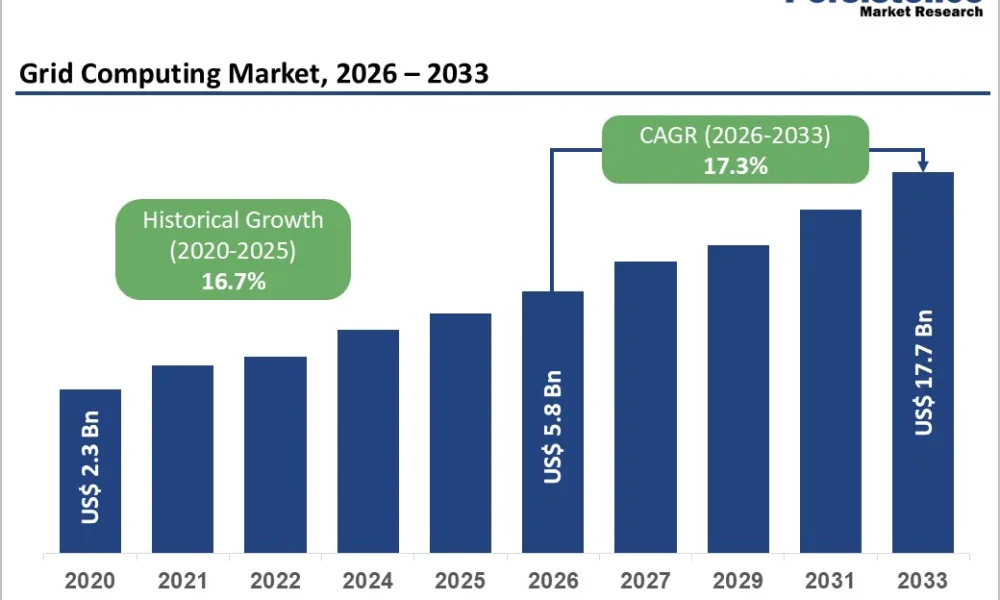
The global grid computing market is entering a transformative phase, driven by the increasing need for distributed computing frameworks capable of handling complex, large-scale computational workloads. The market is projected to be valued at US$ 5.8 billion in 2026 and is estimated to reach US$ 17.7 billion by 2033, expanding at a robust CAGR of 17.3% during the forecast period 2026–2033. Historically, the market recorded a CAGR of 16.7% between 2020 and 2025, reflecting sustained momentum.
Grid computing has become a critical enabler for organizations seeking scalable, high-performance computing (HPC) architectures. The convergence of big data analytics, artificial intelligence (AI), machine learning (ML), and hybrid cloud infrastructures is reshaping how enterprises manage distributed computing resources. Governments and enterprises alike are investing heavily in digital infrastructure modernization, further accelerating adoption.
Understanding Grid Computing
Grid computing is a distributed architecture that connects multiple computer systems across different locations to work together as a unified computing resource. Unlike traditional centralized systems, grid computing leverages geographically dispersed nodes to solve complex problems more efficiently.
The architecture allows organizations to pool computing power, storage, and data resources across networks. It is widely adopted in sectors requiring heavy computational workloads, including research institutions, financial services, healthcare, energy exploration, and manufacturing.
Grid computing differs from cloud computing in its structural focus. While cloud computing centralizes resources in data centers, grid computing distributes workloads across multiple interconnected systems, often across organizations. This makes it particularly suitable for collaborative research and compute-intensive simulations.
Market Size and Growth Outlook
The market’s anticipated growth from US$ 5.8 billion in 2026 to US$ 17.7 billion by 2033 reflects strong demand for distributed computing frameworks. A 17.3% CAGR signals sustained investments in HPC clusters, middleware solutions, orchestration tools, and managed services.
Key growth indicators include:
- Increasing deployment of AI and ML workloads requiring high computational power
- Growing enterprise reliance on real-time data analytics
- Rising demand for hybrid cloud and multi-cloud integration
- Expansion of high-performance computing environments
Digital transformation initiatives across industries are compelling enterprises to adopt scalable architectures that can manage data-intensive tasks efficiently.
Key Market Drivers
- Proliferation of Big Data Analytics
Organizations are generating massive volumes of structured and unstructured data. Grid computing enables parallel processing across distributed nodes, significantly reducing processing time for big data analytics. Industries such as banking, healthcare, retail, and telecommunications are leveraging distributed frameworks to extract actionable insights from large datasets.
- Growing Adoption of AI and Machine Learning
AI and ML workloads require immense computational resources. Training advanced neural networks and running predictive analytics models demand distributed processing environments. Grid computing provides scalable compute capacity without the need for centralized infrastructure upgrades.
- Rising Demand for High-Performance Computing
Scientific simulations, genomic research, financial risk modeling, and climate forecasting rely on HPC systems. Grid computing enhances HPC performance by integrating multiple clusters and servers into a cohesive network.
- Expansion of Hybrid Cloud Deployments
The shift toward hybrid cloud architectures is enabling enterprises to combine on-premise resources with cloud-based services. Grid computing platforms integrate seamlessly with hybrid environments, optimizing resource allocation and workload balancing.
- Regulatory Support for Digital Infrastructure
Governments in North America and Asia Pacific are investing in digital infrastructure modernization. Public-sector initiatives promoting compute resource sharing and collaborative research are accelerating grid computing adoption.
Market Segmentation Analysis
By Component
Software Segment – 52% Revenue Share in 2026
The software segment is projected to hold 52% of total market revenue in 2026. Middleware platforms, workload schedulers, orchestration systems, and monitoring tools form the backbone of distributed computing frameworks.
These solutions streamline resource management, enable job scheduling, and ensure efficient task execution across nodes. Advanced grid software enhances security, fault tolerance, and interoperability across heterogeneous systems.
Services Segment – Fastest Growing
The services segment is anticipated to witness the fastest growth between 2026 and 2033. Deployment complexity, integration challenges, and the need for customized architectures are driving demand for consulting, integration, and managed services.
Enterprises increasingly rely on specialized service providers for deployment optimization, performance tuning, and ongoing system maintenance.
Elevate your business strategy with comprehensive market data. Request a sample report now: https://www.persistencemarketresearch.com/samples/18496
Regional Insights
North America – Dominant Market in 2026
North America is expected to lead the global grid computing market in 2026, accounting for approximately 42% of total market share. The region benefits from advanced data center infrastructure, widespread HPC adoption, and strong research collaborations.
The presence of major technology firms and research institutions contributes significantly to regional growth. Organizations such as NASA and National Science Foundation actively utilize distributed computing frameworks for scientific research and innovation.
The United States, in particular, drives regional growth through sustained investments in AI research, quantum computing initiatives, and defense applications.
Asia Pacific – Fastest Growing Region
Asia Pacific is projected to be the fastest-growing regional market through 2033. Rapid digital infrastructure expansion, increasing enterprise analytics adoption, and strong government initiatives in countries like China, India, Japan, and South Korea are key growth catalysts.
The rise of smart cities, fintech platforms, and large-scale research projects is fostering demand for scalable distributed computing frameworks. Growing investments in 5G networks and cloud infrastructure further strengthen the region’s growth trajectory.
Europe
Europe also holds a significant market share, driven by collaborative research projects and digital transformation policies. Initiatives such as European Grid Infrastructure support cross-border compute resource sharing among research institutions.
Industry Applications
Healthcare and Life Sciences
Grid computing supports genomic sequencing, drug discovery simulations, and epidemiological modeling. Distributed frameworks reduce processing time for complex molecular analyses.
Financial Services
Banks and financial institutions use grid computing for risk analysis, fraud detection, algorithmic trading simulations, and regulatory compliance analytics.
Energy and Utilities
Oil and gas companies rely on distributed computing for seismic data processing and reservoir simulation. Grid computing enables rapid data interpretation from multiple exploration sites.
Manufacturing
Advanced manufacturing leverages grid computing for predictive maintenance, digital twins, and supply chain optimization.
Research and Academia
Collaborative scientific projects frequently depend on grid infrastructures to process large datasets and conduct simulations.
Technological Advancements
Integration with Cloud Computing
Leading cloud providers such as Amazon Web Services and Microsoft Azure are integrating distributed computing capabilities into their platforms. This convergence enhances scalability and cost efficiency.
Edge Computing Integration
The rise of edge computing is complementing grid architectures. By processing data closer to the source, organizations can reduce latency while leveraging centralized grid resources for complex analytics.
AI-Driven Resource Management
AI-based workload optimization tools are improving resource allocation efficiency across distributed systems. Automated scheduling and predictive scaling reduce downtime and improve system utilization.
Competitive Landscape
The grid computing market features a mix of established technology vendors and specialized solution providers. Strategic partnerships, mergers, and acquisitions are common as companies seek to expand their distributed computing capabilities.
Technology providers are focusing on:
- Enhancing interoperability across heterogeneous systems
- Strengthening cybersecurity measures
- Offering flexible subscription-based pricing models
- Expanding managed services portfolios
Public-private collaborations are also emerging as a growth strategy, particularly in research-intensive industries.
Challenges and Restraints
Despite strong growth prospects, the market faces certain challenges:
Security Concerns
Distributed architectures increase potential vulnerability points. Ensuring secure data transmission across multiple nodes is critical.
Infrastructure Complexity
Deploying and managing grid computing frameworks requires specialized expertise and significant upfront investment.
Interoperability Issues
Integrating diverse hardware and software components can be complex, particularly across cross-organizational networks.
Opportunities Ahead
The future of grid computing is closely tied to advancements in AI, IoT, and next-generation networking technologies. Key opportunities include:
- Adoption in smart city infrastructure
- Integration with quantum computing research
- Expansion in emerging markets
- Increased deployment in climate modeling and sustainability research
As enterprises seek cost-efficient ways to scale computing power, grid computing offers a compelling solution.
Future Outlook
Between 2026 and 2033, the grid computing market is expected to witness accelerated innovation and adoption. North America will maintain leadership, while Asia Pacific will drive incremental growth.
The software segment will continue to dominate revenue share, but services will expand rapidly due to deployment complexity. Strategic partnerships, government initiatives, and cloud-grid convergence will shape the competitive landscape.
With a projected market value of US$ 17.7 billion by 2033, grid computing is set to become a foundational pillar in global digital infrastructure.
Conclusion
The global grid computing market is poised for substantial expansion, driven by increasing demand for scalable, distributed computing frameworks capable of handling complex workloads. The convergence of AI, big data, hybrid cloud, and HPC technologies is reinforcing long-term growth.
As enterprises prioritize performance optimization, cost efficiency, and collaborative computing models, grid computing will remain central to digital transformation strategies. With robust investments in infrastructure modernization and growing cross-sector adoption, the market’s upward trajectory appears firmly established through 2033.
Related Reports:




