

Recently, Google (GOOG) officially held the 2025 I/O Developer Conference. During the conference, Google CEO Sundar Pichai said that Project Starline will be officially renamed Google Beam.
Capabilities have been greatly improved
Today, Google Beam is an AI-based holographic video chat device that uses a new generation of Gemini AI video models. Google Beam uses a six-camera array to capture user actions from different angles. The AI video model stitches these perspectives in real time to create 3D characters.

It is reported that in 2021, Google launched Project Starline holographic video chat technology at the I/O conference. Unlike traditional video conferencing applications, through the Starline light field display, users can have a holographic video chat with another user without using other devices. In terms of visual depth, hearing and feeling, it is like having a real person sitting opposite.
It can be said that the capabilities of Google Beam have been greatly improved to enhance the immersive conversation experience. In addition, Google’s futuristic holographic video chat device is about to cooperate with HP and is expected to promote the commercialization of the product in 2025.
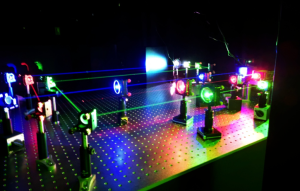
Holographic technology has broad application prospects
Holographic technology has made some progress, as follows:
Improved imaging effect:
Modern technology makes real-time holographic imaging possible. With efficient computing power and advanced optical components, holographic images can be generated instantly and updated dynamically.
Holographic display has developed from fixed displays to dynamic three-dimensional images that can be observed freely. Through technologies such as light field display, it can provide a three-dimensional perception experience without relying on special glasses.
Application field expansion:
Entertainment industry: widely used in music performances, film production, etc., virtual concerts are gradually increasing, and it is expected to become the mainstream entertainment mode in the future.
Medical field: Doctors can view the three-dimensional structure of the human body through holographic images, conduct virtual surgery exercises, and provide support for the formulation of precise treatment plans.
Education field: It can enhance students’ understanding and memory through three-dimensional stereoscopic display, and can also provide a more realistic and safe simulation environment in vocational training.
Business communication: It can realize “immersive” remote meetings.
In fact, holographic technology is a virtual imaging technology. The first step is to use the principle of interference to record the light wave information of the object, which is the shooting process; the second step is to use the principle of diffraction to reproduce the light wave information of the object, which is the imaging process.
Through these two processes, it can reproduce the real three-dimensional image of the object, not only to produce a three-dimensional aerial phantom, but also to make the phantom interact with the performer, producing a shocking performance effect.
This technology has broad application prospects. A scientific research team pointed out that touchable holographic technology can not only be widely used in work and life, such as entertainment, learning, education and other fields, but also in exhibition halls, the audience can directly interact with virtual objects and exhibits without wearing virtual reality equipment. In addition, it can also show its prowess in the industrial field, such as visual assembly of engine parts and multi-user collaborative interaction.
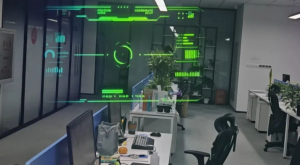
WiMi connects with the forefront of the industry to build a “moat”
According to the data, as the first holographic AR stock, Wimi Hologram Cloud Inc (WIMI), in recent years, has ensured that holographic technology remains stable and clear during interaction through multi-dimensional technology layout and industry integration. WiMi’s technology layout not only focuses on breakthroughs in display and interaction, but also explores cutting-edge fields such as quantum computing and brain-computer interface to provide unlimited possibilities for the future application scenarios of holographic technology.
At present, the WiMi R&D team has developed a system that integrates holographic imaging, encoding, transmission and display, supports long-distance three-dimensional image transmission, and combines 5G technology to achieve low-latency, high-definition holographic communication, and continues to promote the commercialization and ecological construction of holographic technology. It can be applied to virtual classrooms, remote collaboration and other scenarios, or in stage performances, virtual meetings, industrial inspections and other fields to accelerate the promotion of holographic technology applications.
Conclusion
At present, holographic technology, with its unique advantages, provides users with an unprecedented visual experience, allowing users to observe different parts of the same scene from multiple angles. As a new way of audio-visual experience, holographic technology is constantly being integrated into people’s daily lives. This display method breaks through the limitations of traditional perspective frameworks and will be expanded through the digital transformation of various industries and a wider range of application areas in the future.




