
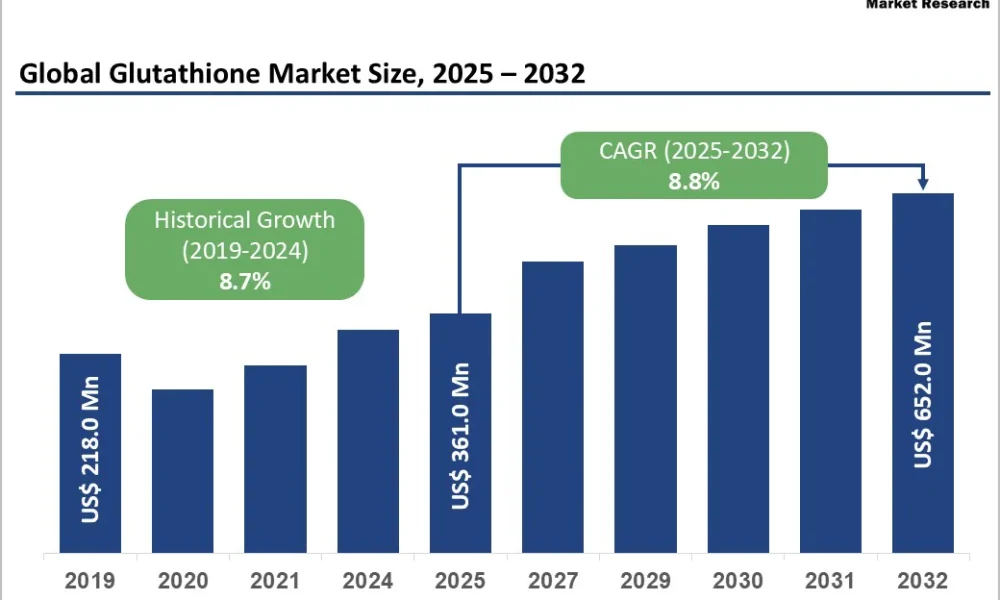
The global glutathione market is witnessing robust growth, driven by the rising awareness of health, wellness, and preventive healthcare solutions. Glutathione, a powerful antioxidant naturally present in the body, plays a pivotal role in neutralizing free radicals, supporting cellular health, and maintaining metabolic balance. Its growing application across pharmaceuticals, nutraceuticals, and cosmetics has positioned it as one of the most dynamically evolving segments in the antioxidant market. The market is projected to reach a valuation of US$ 652.0 million by 2032, up from an estimated US$ 361.0 million in 2025, registering a compound annual growth rate (CAGR) of 8.8% during the forecast period. The expansion is bolstered by advancements in biotechnology, innovative production methods, and increasing consumer preference for natural and ethically sourced ingredients.
Reduced glutathione is the leading product segment, capturing approximately 62% of market share due to its high biological activity and consumer acceptance. Naturally extracted glutathione dominates the market with a 57% revenue share, favored by environmentally conscious consumers and manufacturers prioritizing traceability and sustainability. Regionally, North America is expected to command the largest market share, accounting for nearly 30% of total revenue in 2025, due to its advanced healthcare infrastructure, high preventive healthcare awareness, and adoption of innovative delivery formats like liposomal and nano-encapsulated glutathione. Meanwhile, Asia Pacific is projected to be the fastest-growing market, fueled by rising health and beauty consciousness, cost-effective production capabilities in China and India, and increasing demand from younger and aging populations seeking preventive and cosmetic applications.
Download Your Free Sample & Explore Key Insights: https://www.persistencemarketresearch.com/samples/17779
Key Highlights from the Report
• The global glutathione market is projected to grow at a CAGR of 8.8% from 2025 to 2032.
• North America is set to hold approximately 30% of the market share in 2025.
• Reduced glutathione leads the product segment with 62% market share.
• Naturally extracted glutathione dominates with 57% revenue share in 2025.
• Asia Pacific is the fastest-growing regional market through 2032.
• Rising health awareness and an aging population are major drivers of market growth.
Market Segmentation
The glutathione market is primarily segmented based on product type, source, and application. By product type, the market is divided into reduced glutathione and oxidized glutathione. Reduced glutathione holds the dominant position due to its effectiveness in neutralizing free radicals and supporting cellular health, while oxidized glutathione is witnessing faster growth owing to its increasing use in metabolic research and redox balance studies. By source, naturally extracted glutathione dominates because of consumer preference for plant-derived, ethical, and sustainable ingredients, whereas microbial fermentation-based glutathione is the fastest-growing source, offering scalability, purity, and cost-effective production solutions.
Application-based segmentation shows pharmaceuticals leading with around 42% market share, driven by clinical recognition of glutathione’s benefits in liver support, immune enhancement, and oxidative stress management. The cosmetics and personal care segment is poised for rapid growth, supported by the demand for skin-brightening, anti-aging, and wellness products. Nutraceuticals and food additive applications are also expanding steadily, driven by health-conscious consumers and the rising popularity of functional foods enriched with antioxidants.
Regional Insights
North America remains the largest market for glutathione due to its well-established healthcare system, advanced biotechnology capabilities, and strong consumer awareness of preventive health measures. High disposable incomes and willingness to invest in premium supplements and functional foods have reinforced North America’s leadership. Europe follows closely, accounting for approximately 22% of the market, with Germany, the United Kingdom, and France leading growth. Europe benefits from a mature pharmaceutical and cosmetic industry, stringent quality standards, and regulatory harmonization that facilitates cross-border market access.
Asia Pacific is emerging as the fastest-growing regional market, driven by increasing health consciousness, urbanization, and rising demand for anti-aging and immune-support supplements. Key markets include China, India, Japan, and South Korea, where cost-effective production capabilities and established manufacturing infrastructure support both domestic and international supply. Multi-generational demand, including adoption by younger millennials for beauty and wellness and older populations for preventive healthcare, is strengthening market growth prospects. Other regions, including Latin America and the Middle East & Africa, are witnessing moderate growth, fueled by rising awareness and expanding healthcare access.
Get Custom Insights Designed for Your Businecss: https://www.persistencemarketresearch.com/request-customization/17779
Market Drivers
The glutathione market is primarily driven by rising health awareness and an aging global population. Consumers are increasingly informed about oxidative stress and its impact on cellular health, which has positioned glutathione as a vital antioxidant supplement. Its role in supporting mitochondrial function, detoxification, and immune resilience makes it highly sought after across both therapeutic and preventive applications. The growing prevalence of lifestyle-induced diseases and environmental stressors further amplifies demand, particularly in regions with high urbanization rates. Additionally, the rapid expansion of the cosmetics and personal care industry, combined with the popularity of beauty-from-within solutions, has significantly propelled market growth.
Market Restraints
High production costs and strict regulatory frameworks pose notable challenges for market growth. Raw material procurement, particularly for reduced and oxidized glutathione, constitutes a major portion of manufacturing expenses, while stringent quality assurance, labeling, and compliance requirements add further financial and operational pressures. These factors often limit market entry for smaller players and can slow down product launches. Furthermore, safety concerns related to certain formulations, such as intravenous glutathione for skin lightening, have prompted regulatory scrutiny, which can restrict market expansion and influence consumer adoption patterns.
Market Opportunities
The glutathione market offers significant opportunities driven by technological advancements and evolving consumer preferences. Innovations in microbial fermentation and biotechnological processes allow manufacturers to produce glutathione at higher yields, lower costs, and with improved purity and sustainability credentials. Expanding applications in cosmeceuticals, functional foods, and preventive healthcare products present avenues for revenue growth. Additionally, increasing research highlighting glutathione’s therapeutic potential in brain health, metabolic regulation, and immune support opens new markets in pharmaceutical and clinical applications. Rising interest in personalized nutrition and wellness supplements further enhances opportunities for product differentiation and market penetration.
Checkout Now & Download Complete Market Report: https://www.persistencemarketresearch.com/checkout/17779
Company Insights
Key players operating in the global glutathione market include:
• Kyowa Hakko Bio Co., Ltd.
• Ajinomoto Co., Inc.
• Gnosis S.p.A.
• Shandong Jincheng Pharmaceutical Group
• Sigma-Aldrich
• Mitushi Biopharma
• Herbal Creations
• Cayman Chemical
• Chemkart
• Yipin Biotechnology
• BioNutrients Solutions
Recent developments in the glutathione market include:
In August 2025, Rockefeller University identified mitochondrial glutathione as a critical metabolite facilitating breast cancer metastasis, revealing therapeutic targeting potential.
In June 2025, a meta-analysis in Psychopharmacology demonstrated significantly lower glutathione levels in individuals with major depressive disorder, highlighting its protective role in brain health and opening avenues for new therapeutic interventions.
Conclusion
The global glutathione market is on a trajectory of sustained growth, driven by increasing health awareness, an aging population, and expanding applications in pharmaceuticals, nutraceuticals, and cosmetics. Reduced glutathione and naturally extracted forms dominate the market, while innovative microbial fermentation techniques and emerging cosmetic applications are creating new growth opportunities. North America leads in market share due to advanced healthcare infrastructure and high preventive health adoption, while Asia Pacific is set to grow rapidly, driven by urbanization, health consciousness, and cost-effective production capabilities. Despite challenges related to high production costs and stringent regulatory requirements, the market offers robust potential for both established and emerging players. Ongoing research and technological advancements continue to expand glutathione’s applications, positioning it as a key component in preventive healthcare, wellness, and beauty industries worldwide.




