
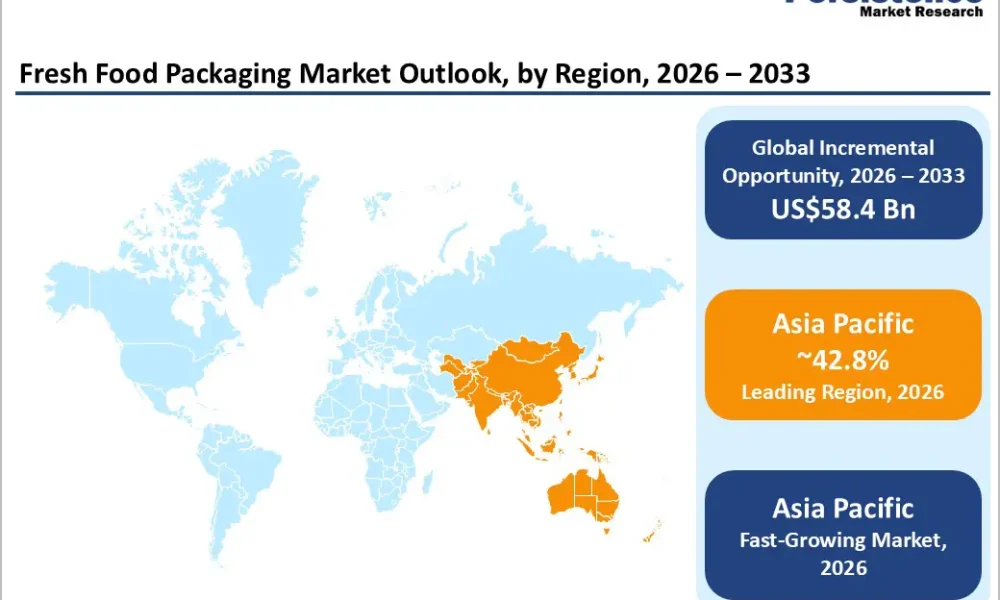
The fresh food packaging market is witnessing substantial growth as consumer demand for safe, high-quality, and convenient food products continues to rise. Fresh food packaging includes a wide range of solutions such as modified atmosphere packaging (MAP), vacuum packaging, active packaging, and intelligent packaging, designed to extend shelf life, preserve nutritional quality, and reduce spoilage. According to market estimates, the global fresh food packaging market is expected to reach US$ 134.2 billion in 2026 and is projected to expand to US$ 192.6 billion by 2033, growing at a CAGR of 5.3% during the forecast period from 2026 to 2033. This growth is primarily driven by structural changes in global food distribution systems, including the increasing commercialization of fresh produce and ready-to-eat meals through modern retail outlets and e-commerce platforms.
The market’s expansion is closely tied to technological advancements and the adoption of active and intelligent packaging solutions. Active packaging incorporates features such as oxygen scavengers, moisture absorbers, and antimicrobial layers to preserve food quality, while intelligent packaging uses sensors and indicators to provide real-time information on freshness and safety. Among packaging formats, plastic-based packaging dominates the market due to its versatility, cost-effectiveness, and ability to support various preservation technologies. Geographically, North America currently leads the market, owing to advanced cold-chain infrastructure, stringent food safety regulations, and high consumer awareness regarding freshness and food quality. Emerging markets in Asia Pacific are expected to witness the fastest growth due to rising disposable incomes, expanding retail chains, and increasing adoption of modern food packaging solutions.
𝐆𝐞𝐭 𝐚 𝐒𝐧𝐞𝐚𝐤 𝐏𝐞𝐞𝐤, 𝐒𝐚𝐦𝐩𝐥𝐞 𝐏𝐃𝐅 𝐈𝐧𝐬𝐢𝐝𝐞: https://www.persistencemarketresearch.com/samples/36083
Key Highlights from the Report
• The fresh food packaging market is projected to reach US$ 192.6 billion by 2033.
• Rising adoption of modern retail and e-commerce channels is driving packaging demand.
• Active and intelligent packaging solutions are increasingly used to extend shelf life and monitor freshness.
• Plastic-based packaging dominates due to its versatility and cost-effectiveness.
• Expanding cold-chain infrastructure in emerging markets supports market growth.
• North America currently leads, while Asia Pacific shows the fastest growth trajectory.
Market Segmentation
The fresh food packaging market can be segmented based on packaging type, material, application, and end-use industry. In terms of packaging type, the market includes modified atmosphere packaging (MAP), vacuum packaging, active packaging, intelligent packaging, and other solutions. Modified atmosphere packaging is widely used in perishable foods such as fruits, vegetables, meat, and seafood to reduce oxygen exposure and slow microbial growth. Vacuum packaging is common for meat, poultry, and processed foods, providing airtight protection against spoilage. Active and intelligent packaging segments are growing rapidly due to the increasing adoption of sensors, freshness indicators, and antimicrobial technologies that enhance product quality and safety.
Based on material type, fresh food packaging is primarily produced from plastic, paper & paperboard, glass, metal, and biodegradable polymers. Plastic remains dominant due to its lightweight, durability, and compatibility with advanced preservation technologies. Paper-based and biodegradable packaging are increasingly adopted as sustainable alternatives, especially in Europe and North America, due to rising environmental concerns. Glass and metal packaging are also used in niche applications requiring extended shelf life and premium product presentation.
Applications include packaged fresh produce, dairy products, meat & poultry, seafood, bakery items, ready-to-eat meals, and beverages. Packaged fresh produce represents the largest segment, driven by growing consumer preference for convenient, ready-to-use fruits and vegetables. Dairy, meat, and seafood applications are also significant contributors due to high spoilage risk and regulatory requirements for food safety. The end-user industries include food retail, foodservice, and online grocery platforms, with retail and e-commerce channels driving consistent demand for safe, visually appealing, and convenient packaging formats.
𝐆𝐞𝐭 𝐚 𝐂𝐮𝐬𝐭𝐨𝐦𝐢𝐳𝐞𝐝 𝐌𝐚𝐫𝐤𝐞𝐭 𝐕𝐢𝐞𝐰 𝐢𝐧 𝐎𝐧𝐞 𝐂𝐥𝐢𝐜𝐤 : https://www.persistencemarketresearch.com/request-customization/36083
Regional Insights
North America dominates the fresh food packaging market, led by the United States, where modern retail infrastructure, stringent food safety regulations, and high consumer awareness are driving adoption. Advanced cold-chain logistics systems and widespread use of active and intelligent packaging solutions further reinforce the region’s leadership position.
Europe holds a strong market share, supported by strict environmental and food safety regulations. Countries such as Germany, France, and the United Kingdom are investing heavily in sustainable packaging alternatives, including recyclable plastics, biodegradable films, and paper-based packaging. Additionally, European consumers prioritize quality, freshness, and sustainability, which drives packaging innovation.
The Asia Pacific region is expected to witness the fastest growth due to urbanization, rising disposable incomes, and increasing demand for packaged and convenience foods. Countries such as China, India, Japan, and South Korea are rapidly expanding retail chains and e-commerce platforms, fueling the adoption of fresh food packaging solutions. The growth of cold-chain infrastructure in emerging economies further supports this market expansion.
Latin America and the Middle East & Africa are gradually adopting advanced packaging solutions as modern retail, food service, and cold-chain infrastructure develop. Rising investments in logistics and storage facilities are improving the shelf life and safety of perishable foods in these regions.
Market Drivers
A key driver of the fresh food packaging market is the increasing commercialization of fresh produce and perishable food items through modern retail and online platforms. Consumers demand convenient, ready-to-eat, and visually appealing products, which encourages the adoption of advanced packaging solutions that maintain freshness and extend shelf life.
Another significant driver is the expansion of cold-chain logistics infrastructure, particularly in emerging markets. Efficient temperature-controlled supply chains allow food to remain fresh over longer distances, which, in turn, increases the need for packaging solutions such as MAP, vacuum packaging, and active packaging. Additionally, regulatory pressure for food safety and waste reduction mandates encourages the use of technologies that monitor product quality and reduce spoilage.
The adoption of active and intelligent packaging solutions is also accelerating market growth. Active packaging systems with oxygen scavengers, moisture absorbers, and antimicrobial layers prevent microbial growth and preserve nutritional quality, while intelligent packaging with sensors and freshness indicators provides real-time information about product conditions. These technologies help manufacturers, distributors, and retailers optimize inventory management and minimize financial losses due to spoilage.
Market Restraints
Despite strong growth, the market faces challenges. High costs associated with advanced packaging solutions, including active and intelligent technologies, may limit adoption among small and medium-sized enterprises. These solutions require additional investment in manufacturing processes, supply chain integration, and quality monitoring systems.
Another restraint is environmental concerns related to plastic packaging, which dominates the market. Although plastic is lightweight and versatile, increasing regulations and consumer awareness regarding sustainability are driving demand for recyclable and biodegradable alternatives. Manufacturers must balance cost, performance, and sustainability considerations, which can slow market penetration in certain regions.
Market Opportunities
The fresh food packaging market presents significant growth opportunities in sustainable and eco-friendly packaging. Biodegradable polymers, recyclable plastics, and paper-based solutions are increasingly adopted to reduce environmental impact. Innovations in sustainable materials are expected to gain momentum, especially in Europe and North America, where regulatory frameworks support eco-friendly packaging solutions.
Another opportunity lies in technological advancements such as smart and intelligent packaging systems. Integration of IoT-enabled sensors, freshness indicators, and blockchain tracking offers improved product visibility and supply chain efficiency. These solutions are particularly relevant for high-value perishable foods and ready-to-eat meals, where maintaining freshness is critical to consumer satisfaction and regulatory compliance.
The rapid expansion of online grocery and e-commerce platforms also offers opportunities for fresh food packaging manufacturers. With growing consumer reliance on home delivery services, packaging solutions that ensure food safety, freshness, and convenience during transit are increasingly critical.
𝐁𝐮𝐲 𝐍𝐨𝐰 𝐭𝐡𝐞 𝐃𝐞𝐭𝐚𝐢𝐥𝐞𝐝 𝐑𝐞𝐩𝐨𝐫𝐭: https://www.persistencemarketresearch.com/checkout/36083
Company Insights
Key players operating in the fresh food packaging market include:
• Amcor plc
• Sealed Air Corporation
• Tetra Pak International S.A.
• Mondi Group
• Berry Global Inc.
• Huhtamaki Oyj
• Coveris Holdings S.A.
• Winpak Ltd.
• Constantia Flexibles Group GmbH
• Sonoco Products Company
Recent developments include the launch of biodegradable and recyclable packaging solutions for perishable foods by several global manufacturers. Additionally, companies are increasingly investing in smart packaging technologies such as freshness indicators, sensors, and IoT-enabled monitoring systems to improve supply chain visibility and reduce food waste.
Conclusion
The fresh food packaging market is poised for robust growth over the coming years, driven by increasing commercialization of fresh produce, expansion of cold-chain logistics, and rising adoption of active and intelligent packaging solutions. Modern retail, e-commerce platforms, and changing consumer preferences for convenience, safety, and quality are key factors supporting market expansion. While challenges such as high costs and environmental concerns exist, innovations in sustainable and smart packaging technologies are expected to unlock significant opportunities. With rapid growth in emerging markets and ongoing technological advancements, fresh food packaging will continue to play a critical role in preserving product quality, enhancing consumer satisfaction, and reducing food waste globally.




