
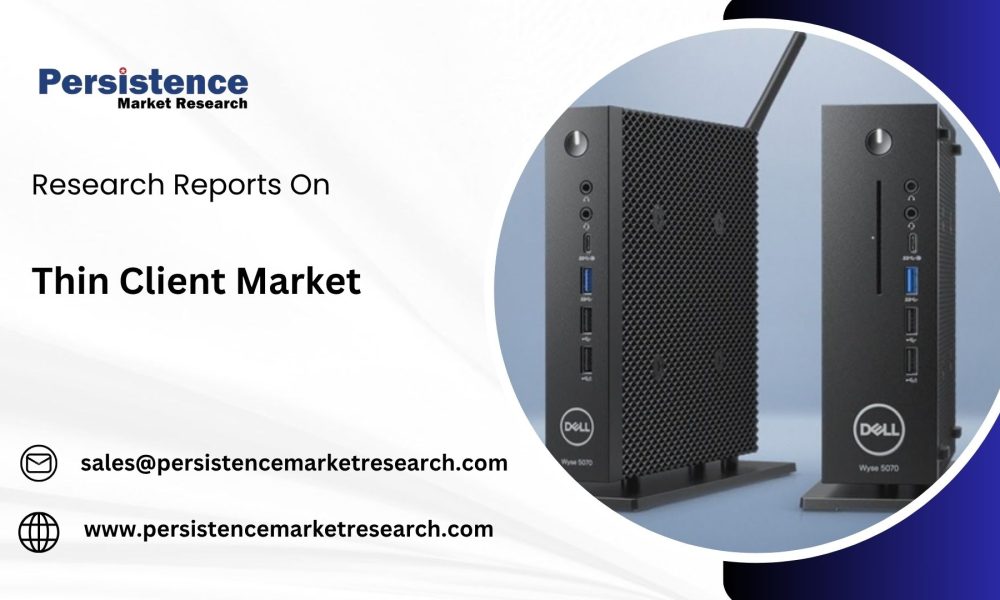
The global computing landscape is undergoing a rapid transformation, driven by trends in virtualization, cloud adoption, and remote work. According to Persistence Market Research (PMR), the global thin client market is expected to reach US$ 1.2 billion in 2023 and grow at a CAGR of 5.8%, reaching US$ 2.2 billion by 2033. This steady growth highlights the increasing preference for lightweight, secure, and energy-efficient computing solutions across industries such as healthcare, banking, education, and government.
Thin clients—computing devices that rely primarily on a central server or cloud for processing—are emerging as a compelling alternative to traditional desktop PCs. They are designed to deliver greater security, easier manageability, and lower total cost of ownership, making them ideal for organizations seeking to optimize IT operations in a hybrid or cloud-based environment.
Understanding Thin Clients: The Future of Simplified Computing
A thin client is a compact, cost-effective computing endpoint that connects to a server or cloud infrastructure where most of the data processing occurs. Unlike traditional PCs, thin clients have limited onboard hardware and storage, as their primary function is to provide users access to centralized resources.
This architecture offers several advantages:
- Centralized management of applications and data
- Enhanced security through restricted local storage
- Energy efficiency due to reduced hardware requirements
- Longer device lifespan, as thin clients experience less hardware strain
As enterprises increasingly migrate toward cloud computing and desktop virtualization (VDI) platforms such as VMware Horizon, Citrix Virtual Apps and Desktops, and Microsoft Azure Virtual Desktop, thin clients are becoming an integral part of modern IT infrastructure.
Elevate your business strategy with comprehensive market data. Request a sample report now: https://www.persistencemarketresearch.com/samples/33520
Market Drivers: Why Organizations Are Adopting Thin Clients
- Cost Efficiency and Lower Total Cost of Ownership (TCO)
Traditional PCs are costly—not only to purchase but also to maintain and upgrade. Thin clients, on the other hand, offer a lower upfront investment and reduced operational expenses. Since most processing is handled by a central server, the hardware requirements of each endpoint are minimal.
Additionally, thin clients typically have longer lifespans and lower failure rates, reducing the frequency and cost of replacements. Businesses also save on software licensing, as virtualized environments often allow for centralized license management. This combination of affordability and durability makes thin clients particularly attractive to sectors with large workforces, such as education, government, and call centers.
- Superior Data Security
In a world where data breaches can cost millions, security is a primary concern for enterprises. Thin clients inherently reduce risk because data is stored and managed centrally rather than locally on each device. This means that even if a thin client is lost or stolen, sensitive information remains secure on the server or cloud.
Organizations can implement multi-factor authentication (MFA), data encryption, and secure access controls more efficiently across a centralized system. This makes thin clients an ideal choice for industries that handle confidential data, such as banking, finance, and healthcare.
- Simplified IT Management and Maintenance
Thin clients significantly ease IT workloads by allowing administrators to manage and update systems centrally. Software updates, patches, and configuration changes can be deployed across all endpoints from a single console, reducing maintenance time and human error.
For large organizations managing hundreds or thousands of devices, this centralized control translates into massive time and cost savings. It also minimizes downtime and ensures all systems remain up to date with the latest security protocols.
- Sustainability and Energy Efficiency
Energy efficiency is another major advantage of thin clients. They typically consume 50% to 80% less power than traditional PCs, which contributes to reduced electricity costs and a smaller carbon footprint. Lower power usage also means less heat generation, creating cooler, quieter, and more comfortable work environments.
As global corporations prioritize sustainability and green IT initiatives, the adoption of energy-efficient thin client solutions aligns perfectly with their environmental goals.
- Support for Remote and Hybrid Work Environments
The shift toward remote and hybrid work models has accelerated the demand for secure and easily manageable virtual desktop infrastructure (VDI). Thin clients provide a seamless way to access corporate systems remotely without compromising data security. Since applications and data reside in the cloud, users can access their work environment from virtually any location.
This flexibility is particularly beneficial for organizations that employ a mobile or geographically distributed workforce, as it allows IT departments to maintain centralized control while ensuring consistent user experiences across devices.
Technological Advancements Enhancing Thin Client Capabilities
Thin client technology has evolved significantly from its early days of basic terminal access. Modern thin clients now support high-definition multimedia, multi-monitor setups, USB redirection, and advanced peripheral support. These enhancements make them viable for a broader range of use cases beyond traditional office environments.
Key technological developments include:
- Cloud-optimized thin clients: Devices purpose-built to connect seamlessly with cloud platforms such as AWS WorkSpaces and Microsoft Azure.
- Enhanced security protocols: Integration with Zero Trust Network Access (ZTNA) and advanced encryption standards.
- AI-based management tools: Predictive analytics for device performance, automated updates, and proactive troubleshooting.
- Edge computing integration: Some modern thin clients are designed to handle limited edge processing, balancing performance and efficiency.
As enterprises increasingly invest in digital transformation, these advancements ensure that thin clients remain competitive and capable of supporting modern workloads.
Key Market Segments
The global thin client market can be analyzed across multiple dimensions—form factor, deployment type, end-user industry, and region.
- By Form Factor
- Standalone thin clients – The most common type, connected directly to displays and peripherals.
- Mobile thin clients – Laptops or tablets configured as thin clients for remote work.
- All-in-one thin clients – Integrated monitors and computing units that save space and streamline setup.
- By Deployment Type
- Cloud-based thin clients – Rapidly growing due to increasing cloud adoption.
- On-premise thin clients – Preferred by organizations with stringent data control or compliance requirements.
- By End-User Industry
- Healthcare: Secure patient data access and centralized management.
- BFSI: Enhanced security for financial transactions and customer data.
- Education: Affordable computing for classrooms and computer labs.
- Government: Centralized IT control for large-scale administrative operations.
- IT & Telecom: Efficient infrastructure for call centers and development teams.
Regional Insights
The thin client market demonstrates diverse growth patterns across regions:
- North America remains a dominant market, driven by strong adoption of cloud and VDI solutions across enterprises. The U.S. leads in implementation due to its mature IT infrastructure and focus on cybersecurity.
- Europe follows closely, particularly in sectors such as banking, government, and education, where data privacy regulations like GDPR emphasize centralized data management.
- Asia-Pacific (APAC) is expected to experience the fastest growth through 2033, propelled by digital transformation in developing economies such as India and China. The region’s expanding IT and BPO sectors are major consumers of cost-effective thin client solutions.
- Latin America and the Middle East & Africa are emerging markets, where government modernization initiatives and increasing cloud adoption are driving gradual but steady demand.
Challenges in the Thin Client Market
Despite their many advantages, thin clients face certain challenges that could slow market expansion:
- Dependence on network connectivity: Performance is heavily reliant on stable and high-speed internet connections. Any network disruption can affect user productivity.
- Initial server infrastructure costs: Although thin clients reduce device costs, the central server or cloud infrastructure setup may require significant investment.
- Limited offline functionality: Thin clients are not ideal for environments that require frequent offline work.
- Compatibility issues: Certain legacy or graphics-intensive applications may not perform optimally in virtualized environments.
However, ongoing technological innovations and improved cloud infrastructure are gradually mitigating these limitations.
Future Outlook: The Rise of Cloud-Connected Computing
The future of the thin client market is closely intertwined with the growth of cloud computing, virtualization, and edge technologies. As enterprises continue to migrate workloads to the cloud, thin clients will play a central role in supporting secure, scalable, and efficient access to digital workspaces.
Emerging trends shaping the future of this market include:
- Increased adoption of DaaS (Desktop-as-a-Service) models.
- AI-driven device management to predict and resolve system issues automatically.
- Integration with zero-trust security frameworks for enhanced data protection.
- 5G connectivity, enabling faster and more reliable thin client performance for remote users.
With organizations emphasizing agility, cost optimization, and sustainability, thin clients are poised to become a cornerstone of modern IT ecosystems.
Conclusion
The global thin client market’s projected growth—from US$ 1.2 billion in 2023 to US$ 2.2 billion by 2033—underscores its increasing relevance in today’s evolving digital landscape. Offering a balance of security, efficiency, and affordability, thin clients represent a smart investment for businesses navigating the challenges of hybrid work, data protection, and energy management.
As technology continues to advance, thin clients will not only complement but also enhance the broader move toward cloud-centric, sustainable, and secure enterprise computing. In essence, thin clients are not just simplifying IT—they are redefining the future of business productivity.
Related Reports:




