
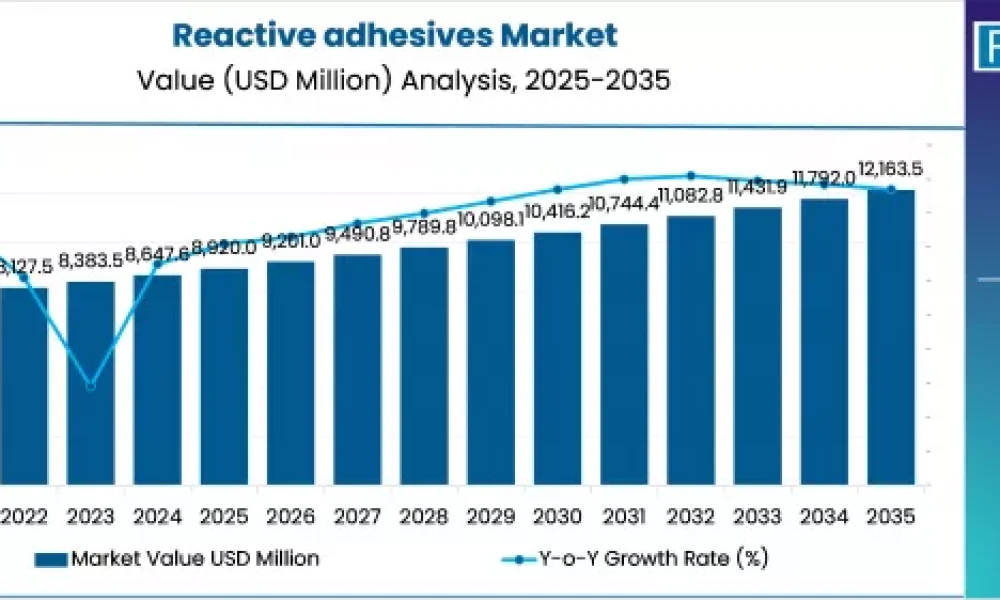
The global reactive adhesives market is projected to grow from USD 8.9 billion in 2025 to USD 12.1 billion by 2035, expanding at a CAGR of 3.2%, according to a new report by Fact.MR. Demand is being propelled by rising adoption in automotive, construction, and electronics sectors, where the need for lightweight, durable, and high-performance bonding solutions is growing rapidly.
Reactive adhesives such as epoxy, polyurethane, cyanoacrylate, and silicone formulations are gaining traction due to their superior mechanical strength, heat resistance, and chemical durability. The shift toward multi-material assemblies and sustainable lightweight engineering continues to expand their industrial relevance.
To access the complete data tables and in-depth insights, request a Discount On The Report here: https://www.factmr.com/connectus/sample?flag=S&rep_id=3908
Lightweight Design and Performance Efficiency Driving Adoption
Reactive adhesives create permanent molecular bonds between substrates, providing resilience to moisture, heat, and vibration — characteristics that have made them indispensable in automotive structural assembly, composite bonding, and electronics encapsulation.
The automotive industry remains a key growth driver. With the rapid transition toward electric and hybrid vehicles, manufacturers are increasingly using reactive adhesives to bond dissimilar materials such as aluminum, steel, and composites, improving structural integrity while reducing vehicle weight. According to the International Organization of Motor Vehicle Manufacturers (OICA), global vehicle production grew from 72.1 million units in 2016 to 73.4 million units in 2017 — a trend that has since accelerated, underpinning adhesive consumption.
In the construction sector, the ongoing boom in infrastructure and residential projects has further strengthened market momentum. As per the Institution of Civil Engineers (UK), the global construction market is expected to reach USD 8 trillion by 2030, amplifying opportunities for reactive adhesive suppliers focused on energy-efficient and moisture-resistant materials.
Innovation and Acquisitions Reinforce Market Expansion
The reactive adhesives market has witnessed notable strategic activity from leading manufacturers aiming to enhance product performance and expand their global reach.
H.B. Fuller’s acquisition of Royal Adhesives & Sealants enabled expansion into specialty applications and broadened its reactive adhesive portfolio.
SIKA AG launched SikaMelt-9677, a reactive polyurethane hot-melt adhesive ideal for polar plastics, foams, textiles, and wood — illustrating the industry’s move toward customized, high-bonding formulations.
These innovations have broadened the adoption base for reactive adhesives across demanding industrial applications while supporting faster curing and improved sustainability.
Purchase Full Report for Detailed Insights
For access to full forecasts, regional breakouts, company share analysis, and emerging trend assessments, you can purchase the complete report here: https://www.factmr.com/checkout/3908
Epoxy and Polyurethane Formulations Lead
Among resin types, epoxy-based reactive adhesives dominate due to their excellent mechanical strength, chemical resistance, and thermal stability, making them suitable for aerospace, automotive, and industrial machinery.
Polyurethane reactive adhesives (PUR) follow closely, benefiting from their flexibility, elasticity, and strong adhesion to both porous and non-porous materials. These characteristics make PUR a preferred choice in furniture lamination, composite bonding, and automotive interiors.
Cyanoacrylates continue to find niche use in medical devices and electronics assembly, while modified acrylics are increasingly integrated into applications requiring rapid curing and enhanced impact resistance.
Regional Outlook: Asia Pacific Commands Dominance
The Asia Pacific region (East Asia and South Asia & Oceania) remains the largest and fastest-growing regional market, led by China, India, Japan, and South Korea. Rising industrialization, coupled with expanding automotive and electronics manufacturing bases, continues to strengthen adhesive demand. China’s leadership in EV manufacturing and infrastructure development reinforces its position as a critical production and consumption hub.
Europe maintains steady growth, with Germany and the UK driving demand through advancements in automotive engineering, wind energy, and construction chemicals. Germany’s 6.6% CAGR underscores its commitment to precision assembly and material innovation.
North America, particularly the United States and Canada, exhibits consistent demand from transportation, aerospace, and power equipment sectors, supported by strong R&D investments and stringent performance standards.
Meanwhile, the Middle East & Africa (MEA) and Latin America are witnessing gradual adoption due to growth in industrial infrastructure and renewable energy projects.
Market Restraints and Challenges
Despite favorable growth conditions, the reactive adhesives market faces notable challenges:
Health and environmental risks associated with acrylic and epoxy formulations can cause skin irritation, requiring advanced handling protocols and eco-friendly reformulations.
Raw material volatility, especially in petroleum-derived chemicals, impacts pricing consistency.
Longer curing times for certain reactive systems may limit adoption in fast-cycle manufacturing environments.
To address these, key producers are developing low-VOC, non-toxic, and bio-based alternatives, aligning with stricter environmental standards and corporate sustainability goals.
Competitive Landscape
The reactive adhesives industry is characterized by a mix of global giants and regional specialists focused on performance differentiation and application-specific innovation.
Key players include:
H.B. Fuller Co., 3M, Arkema SA, Henkel AG & Co. KGaA, Huntsman Corporation, Pidilite Industries Ltd., and SIKA AG.
These companies emphasize strategic mergers, portfolio diversification, and R&D investment to enhance adhesive performance in energy, automotive, and construction applications. The introduction of reactive hot-melts, hybrid systems, and low-temperature curing adhesives has reshaped the competitive landscape, ensuring improved productivity and environmental compliance.
Segmentation Overview
By Resin Type:
Epoxy
Silicone
Cyanoacrylates
Polyurethane
Modified Acrylics
Others
By End-Use Industry:
Building & Construction
Automotive & Transportation
Power
Electrical & Electronics
Others
By Region:
North America (U.S., Canada)
Latin America (Mexico, Brazil, Argentina, Chile, Peru)
Europe (Germany, UK, France, Italy, Spain, BENELUX, RoE)
East Asia (China, Japan, South Korea)
South Asia & Oceania (India, ASEAN, ANZ)
Middle East & Africa (GCC, South Africa, Turkey, Rest of MEA)
Fact.MR Analyst Viewpoint
“As industries evolve toward lightweight design and multi-material engineering, reactive adhesives are becoming the backbone of structural bonding solutions. Continuous innovation in epoxy and polyurethane chemistries will be pivotal to addressing sustainability, efficiency, and automation demands.”
— Fact.MR Lead Analyst
To View Related Report :
About Fact.MR
Fact.MR is a leading market research and consulting agency specializing in chemicals, materials, and industrial innovation. Leveraging deep sectoral insights and data-driven analysis, Fact.MR empowers companies with strategic foresight to accelerate growth and optimize performance across global markets.



