
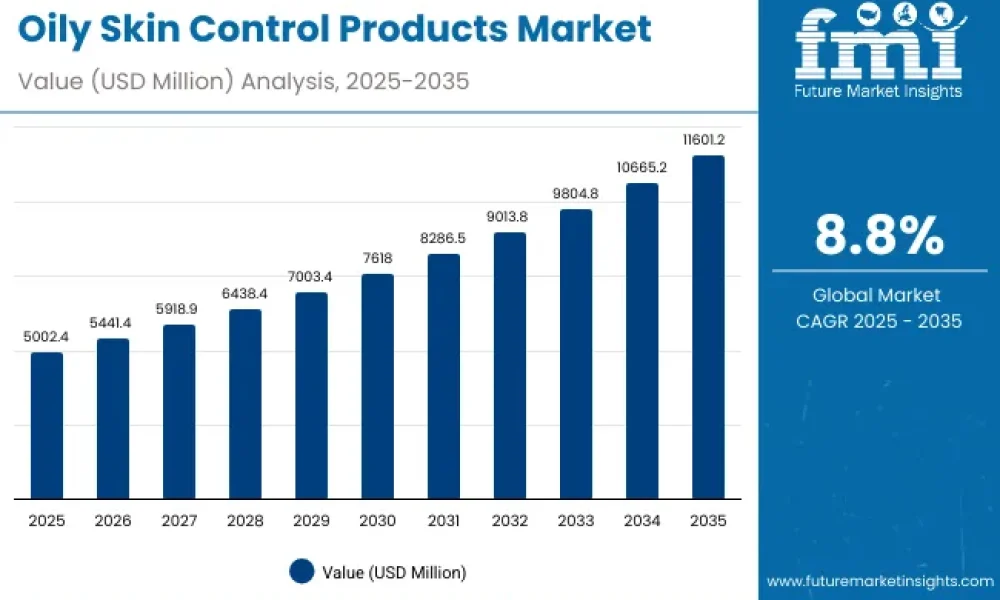
The global Oily Skin Control Products Market is entering a transformative decade, with strong growth momentum supported by dermatology-led innovation, digital-first retail strategies, and expanding adoption among younger consumers. Valued at USD 5,002.4 million in 2025, the market is forecast to reach USD 11,601.2 million by 2035, registering a robust CAGR of 8.8%. This USD 6.6 billion expansion reflects the steady mainstreaming of oil-regulating, pore-minimizing, and matte-finish skincare solutions across both developed and emerging economies.
Unlock the full market insights and exclusive data breakdowns – Request Your Sample Report Now
Market Growth Outlook: A Decade of Opportunity
Between 2025 and 2030, the market is expected to grow from USD 5.0 billion to USD 7.6 billion, contributing nearly 40% of total incremental growth. This early-phase acceleration is largely attributed to rising skincare awareness among teenagers and young adults, coupled with the rapid penetration of e-commerce platforms. Daily-use products, particularly cleansers, which account for 46.5% of market share in 2025, continue to dominate consumer routines.
From 2030 to 2035, growth is forecast to accelerate further, adding USD 3.98 billion, or nearly 60% of total expansion. Asia-Pacific will act as the primary growth engine, with India (20.2% CAGR) and China (17.6% CAGR) leading global demand. Oil-free claims, already commanding 51.5% market share, are expected to remain the most trusted positioning worldwide.
Why the Oily Skin Control Products Market Is Growing
The market’s growth is being fueled by a convergence of lifestyle, climatic, and technological factors:
- Rising awareness of skin health and barrier protection
- Increased prevalence of oily and acne-prone skin among youth
- Strong preference for oil-free, non-comedogenic, and dermatologist-tested formulations
- Expanding access through e-commerce and social commerce
- Innovation in active ingredients such as niacinamide, salicylic acid, zinc PCA, and clay minerals
Urbanization, pollution, and humid climates are further amplifying oil-related skin concerns, especially in Asia-Pacific, reinforcing long-term demand.
Competitive Landscape: Established Leaders and Emerging Innovators
The oily skin control products market remains moderately fragmented. La Roche-Posay leads with an estimated 8.5% global market share in 2025, benefiting from strong dermatologist credibility and science-backed formulations. Other established players such as Neutrogena, Cetaphil, Clinique, The Ordinary, Paula’s Choice, Kiehl’s, Murad, Bioderma, and Olay collectively account for the remaining 91.5% of market value.
At the same time, digital-native and emerging manufacturers are actively entering the market, focusing on:
- Direct-to-consumer (DTC) models
- AI-driven skin diagnostics
- Microbiome-friendly and probiotic-based solutions
- Sustainable packaging and clean-label claims
These innovations are reshaping competition and creating new expansion pathways for brands seeking to scale globally.
Key Segments of the Oily Skin Control Products Market
By Function
- Oil absorption
- Pore minimization
- Matte finish
By Active Ingredient
- Niacinamide
- Salicylic acid
- Clay and minerals
- Zinc PCA
- Tea tree oil
By Product Type
- Cleansers
- Moisturizers
- Toners
- Masks
By Channel
- E-commerce
- Pharmacies and drugstores
- Mass retail
- Specialty beauty retail
By Claim
- Oil-free
- Non-comedogenic
- Dermatologist-tested
- Fragrance-free
By End User
- Teenagers and young adults
- Adults
- Men
By Region
- North America
- Europe
- East Asia
- South Asia & Pacific
- Latin America
- Middle East & Africa
Regional Highlights
- India is projected to be the fastest-growing market, driven by urbanization, youth demographics, and e-commerce accessibility.
- China is witnessing rapid digital adoption through social commerce and livestreaming sales.
- Japan is showing strong premiumization trends focused on clinically validated skincare.
- Europe maintains steady growth supported by dermatologist trust and sustainability preferences.
- United States remains a mature but stable market, with oil-free claims continuing to lead demand.
Technology, Trust, and the Road Ahead
Clinical validation is emerging as a decisive competitive advantage, with consumers increasingly favoring products backed by dermatological studies. At the same time, the convergence of skincare and digital ecosystems—through AI-powered assessments, virtual consultations, and subscription models—is redefining how consumers discover and engage with oily skin solutions.
Looking ahead to 2035, the oily skin control products market is expected to reward companies that combine science-backed efficacy, transparent claims, omnichannel distribution, and personalized consumer engagement. Established brands will continue to leverage trust and scale, while new manufacturers and technology-driven players will play a crucial role in shaping the next generation of oily skin care innovations.
Have a specific Requirements and Need Assistant on Report Pricing or Limited Budget please contact us – [email protected]
About Future Market Insights (FMI)
Future Market Insights, Inc. (FMI) is an ESOMAR-certified, ISO 9001:2015 market research and consulting organization, trusted by Fortune 500 clients and global enterprises. With operations in the U.S., UK, India, and Dubai, FMI provides data-backed insights and strategic intelligence across 30+ industries and 1200 markets worldwide.



