
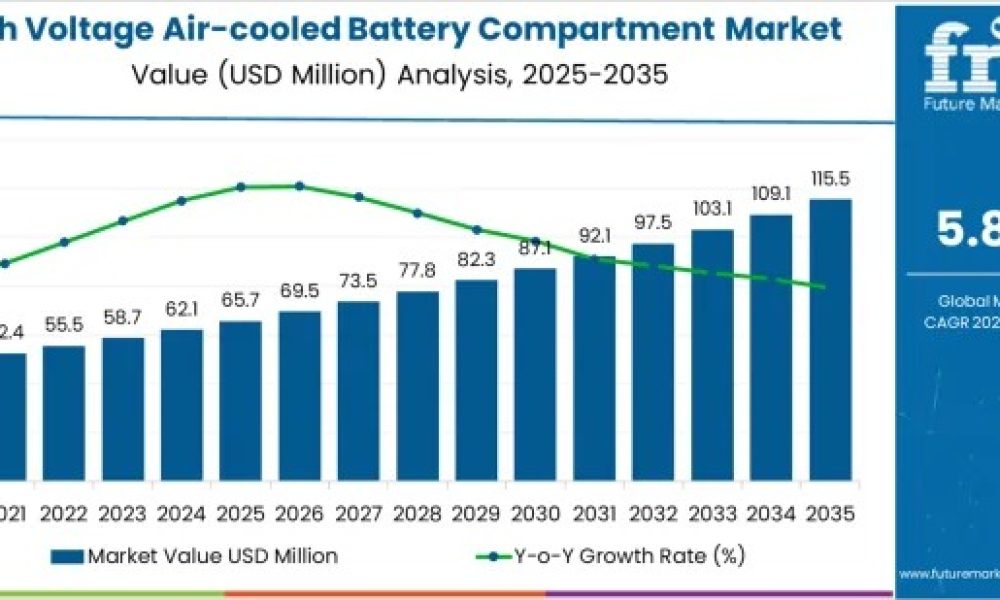
The global High Voltage Air-cooled Battery Compartment Market is entering an important growth phase as electric vehicle manufacturers, renewable energy operators, and large-scale industrial storage facilities upgrade thermal management systems to meet next-generation performance requirements. The market is projected to expand from USD 65.7 million in 2025 to USD 115.4 million by 2035, marking a CAGR of 5.8% and delivering 1.8X growth over the decade.
With battery systems becoming increasingly energy-dense and thermally sensitive, air-cooled compartments have emerged as a strategic technology offering 40–55% better thermal stability, reduced maintenance requirements, and simplified integration compared to liquid-cooled alternatives.
Subscribe for Year-Round Insights → Stay ahead with quarterly and annual data updates
https://www.futuremarketinsights.com/reports/sample/rep-gb-28307
Drivers Shaping Market Growth Through 2035
Several structural trends are pushing the industry toward advanced air-cooling designs:
- Rapid EV Manufacturing Scale-Up
Global EV output is projected to surpass 10 million units annually, requiring consistent thermal performance across lithium-ion battery platforms. Air-cooled designs reduce energy consumption while maintaining temperature uniformity under demanding load profiles.
- Renewable Energy Storage Expansion
Grid-scale renewable projects increasingly depend on high-capacity battery arrays where thermal consistency is essential for lifecycle performance. Air-cooled systems provide up to 55% improved cooling efficiency, making them ideal for large installations demanding predictable performance.
- Shift Toward High-Density Battery Architectures
As lithium-ion and upcoming solid-state chemistries evolve, battery compartments must manage complex heat distribution requirements. Natural air-cooling, which accounts for 62% of total share, remains the preferred solution for its reliability, minimal operational cost, and architecture compatibility.
Decade Outlook: Two-Phase Growth Pattern
Phase 1: 2025–2030
Market value will rise from USD 65.7 million to USD 87.1 million, driven by:
- EV production acceleration
- Grid-scale storage deployment
- Convection-based airflow system innovation
- Integration of air-cooled designs within automated battery assembly lines
This period will contribute 43.1% of total decade growth.
Phase 2: 2030–2035
The market will expand from USD 87.1 million to USD 115.4 million, adding USD 28.3 million or 56.9% of the total decade increase. Advancements will include:
- AI-assisted thermal monitoring
- Multi-functional modular cooling units
- Integrated safety diagnostics
- Deep collaboration between battery OEMs and cooling technology firms
Key manufacturers—such as Qingan Energy Storage Technology, Yangtze River Delta Energy Storage Group, and Anhui Ruineng Technology—are leading the shift toward automated airflow control and high-precision cooling infrastructure.
Regional Performance: Asia Pacific Continues to Lead
China (7.8% CAGR)
The global leader, backed by the world’s largest EV and energy storage manufacturing ecosystem. Subsidy programs supporting thermal management upgrades further accelerate demand.
India (7.3% CAGR)
A rapidly emerging hub powered by electrification initiatives and renewable energy investments. Major clusters like Pune and Bangalore are adopting advanced cooling solutions to meet rising performance standards.
Germany (6.7% CAGR)
Known for engineering precision, Germany integrates high-efficiency thermal solutions within EV production centers and renewable storage projects, achieving 40–50% thermal improvement in validated deployments.
Brazil (6.1% CAGR)
EV manufacturing capacity expansion and renewable infrastructure growth are pulling in advanced cooling technologies through OEM partnerships and technology transfer initiatives.
United States (5.5% CAGR)
A mature energy storage market focused on thermal consistency, battery safety, and integration of digital monitoring systems.
Market Segmentation Highlights
By Cooling Method
- Natural Air Cooling – 62% share
- Energy-efficient
- Low maintenance
- High reliability
- Forced Air Cooling – 38% share
- Active ventilation
- Suitable for high-load environments
By Application
- Lithium-ion Compartments – 68% share
- Dominant across EV, grid storage, and portable energy
- NiMH Compartments – 32% share
- Used in select hybrid and backup power applications
Barriers and Opportunities
Despite strong momentum, high initial investment and technical expertise requirements pose challenges in cost-sensitive markets. However, rising awareness of thermal consistency, safety compliance norms, and battery productivity benefits will continue to offset adoption barriers.
Get data that aligns with your strategic priorities — ask for report customization today:
https://www.futuremarketinsights.com/customization-available/rep-gb-28307
Have a specific Requirements and Need Assistant on Report Pricing or Limited Budget please contact us – [email protected]
About Future Market Insights (FMI)
Future Market Insights, Inc. (FMI) is an ESOMAR-certified, ISO 9001:2015 market research and consulting organization, trusted by Fortune 500 clients and global enterprises. With operations in the U.S., UK, India, and Dubai, FMI provides data-backed insights and strategic intelligence across 30+ industries and 1200 markets worldwide.
Contact Us:
Future Market Insights Inc.
Christiana Corporate, 200 Continental Drive,
Suite 401, Newark, Delaware – 19713, USA
T: +1-347-918-3531



