
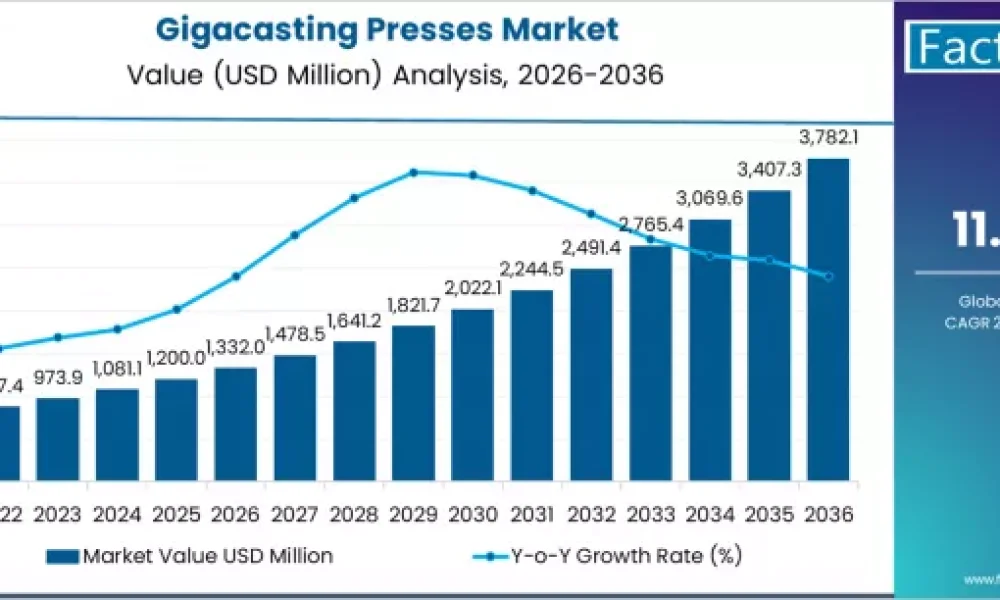
The global gigacasting presses market is witnessing transformative growth, driven by accelerating electrification in the automotive industry, rapid advancements in high-pressure die-casting technologies, and shifting regional manufacturing dynamics. The gigacasting presses market is forecast to expand from USD 1,332.0 million in 2026 to USD 3,782.1 million by 2036, registering a CAGR of 11.0% over the decade.
Market Overview & Value Chain Dynamics
Gigacasting presses are ultra-large high-pressure die-casting machines capable of producing vehicle structural components—such as underbodies, front and rear frames, and battery trays—as integrated single pieces. This approach reduces assembly complexity, enhances structural integrity, and significantly cuts production time and cost compared to traditional multi-part welding and machining processes.
Key applications remain dominated by the automotive sector, particularly original equipment manufacturers (OEMs), which command over 76% of market share in 2026. OEM adoption continues to accelerate as automakers increasingly prioritize lightweighting, production efficiency, and sustainable manufacturing.
To access the complete data tables and in-depth insights, request a Discount On The Report here: https://www.factmr.com/connectus/sample?flag=S&rep_id=12696
Technology Evolution & Innovation Trends
The evolution of gigacasting presses is closely tied to advancements in high-pressure die-casting (HPDC) and automation technology. Emerging trends include:
Expansion of Clamp Force Capabilities: Mid-range clamp force systems (31–45 MN) hold the largest segment share (~36%), balancing production efficiency and structural performance for a broad range of vehicle components.
Shift Toward Integrated Automation: Manufacturers are increasingly embedding smart sensors, digital controls, and predictive maintenance technologies into gigacasting systems. These innovations improve precision, reduce waste, and optimize uptime—key for high-throughput automotive production lines.
Modular and Flexible Casting Platforms: Newer presses are designed for multi-component casting capabilities, enabling facilities to switch between parts without extensive retooling.
Material Advances: While aluminum alloys remain the primary feedstock due to their favorable strength-to-weight ratios, emerging research into magnesium and advanced composite alloys promises further weight reduction and performance improvements in structural components.
Despite strong momentum, technical complexity and high upfront capital expenditures remain challenges for widespread adoption, especially among smaller manufacturers.
Regional Market Demand & Growth Drivers
The gigacasting presses market reflects distinct regional dynamics shaped by industrial policy, automotive manufacturing trends, and regional EV adoption curves.
Asia-Pacific: Manufacturing Powerhouse
Asia-Pacific emerges as the dominant regional market, underpinned by its central role in global automotive manufacturing and rapid electrification initiatives:
China leads investment in gigacasting presses with expansive EV production capacity and supportive policies for advanced manufacturing adoption. Growth projections indicate China’s presses market will outpace many developed regions through 2036.
Japan and South Korea continue to invest heavily in high-precision casting and automation technologies to support domestic OEM competitiveness.
India—while currently at an earlier stage—offers significant upside potential driven by government incentives for EV supply-chain localization and a growing automotive production base.
The broader Asia-Pacific gigacasting ecosystem also benefits from established supply chains for aluminum and die-casting components, lowering overall manufacturing costs.
North America: Innovation and Scale
North America holds a leading position in technology innovation and adoption, propelled by:
A concentration of advanced automotive OEMs, including traditional manufacturers and EV startups.
Investments in smart manufacturing and automation platforms.
Economic incentives supporting EV production and sustainability goals.
The U.S. gigacasting press market alone is projected to sustain a strong CAGR through 2036, supported by continuous upgrades to manufacturing infrastructure. While gigacasting adoption has faced real-world challenges—including the need for highly specialized integration and engineering expertise—leading OEMs continue to optimize casting strategies for cost and performance gains.
Europe: Sustainability-Focused Growth
Europe’s gigacasting market is growing steadily, driven by:
Stringent emissions and sustainability regulations.
A strong automotive engineering tradition that prioritizes lightweight materials and production efficiency.
Manufacturers in Germany, the UK, and other core European markets are increasingly adopting gigacasting solutions to align with environmental targets and enhance production agility.
Emerging Regions: Latin America & MEA
Latin America and the Middle East & Africa represent emerging markets with moderate growth potential. Brazil, for instance, is expected to expand gigacasting press deployment in alignment with rising automotive production activity.
Forecast Scenarios Through 2036
Three potential scenarios outline market growth:
Likely Scenario: The baseline projection of market growth (%11 CAGR) reflects steady expansion as gigacasting presses become standard in automotive OEM lines.
Optimistic Scenario: Accelerated EV adoption and broader tech integration (e.g., AI + Industry 4.0) may push beyond baseline growth, with gigacasting presses becoming ubiquitous across passenger and commercial vehicle platforms.
Conservative Scenario: If adoption is slowed by capital cost barriers or supply chain bottlenecks, growth may moderate—but still remain strong relative to traditional casting technologies, given the long-term value proposition of integrated cast components.
Across scenarios, the market is forecast to more than double in value by 2036, validating the strategic importance of gigacasting presses in future automotive manufacturing ecosystems.
Competitive Landscape
The market features a combination of established industrial equipment manufacturers and specialized casting technology providers. Leading players include:
IDRA Group – Advanced gigacasting automation solutions.
Bühler Carat – High-performance casting presses.
LK Machinery, Toshiba Die Casting, UBE Machinery – Regional market strength and broad product portfolios.
These players are focusing on product innovation, expanded service networks, and technology partnerships to strengthen their competitive positions.
Conclusion
The gigacasting presses market is entering a period of sustained growth and strategic importance, driven by the automotive industry’s demands for cost-effective, lightweight, and high-quality structural components. With strong regional demand—particularly in Asia-Pacific and North America—and ongoing technological innovation, gigacasting presses are poised to reshape manufacturing landscapes through 2036 and beyond.
Have a specific Requirements and Need Assistant on Report Pricing or Limited Budget please contact us – [email protected]
To View Related Report :
Freight Transport Market https://www.factmr.com/report/freight-transport-market
Electric Power Transmission Distribution Equipment Market https://www.factmr.com/report/electric-power-transmission-distribution-equipment-market
Low-Creep High-Modulus Yarns Market https://www.factmr.com/report/low-creep-high-modulus-yarns-market
Demand for Stick Packaging in UK https://www.factmr.com/report/united-kingdom-stick-packaging-market



