
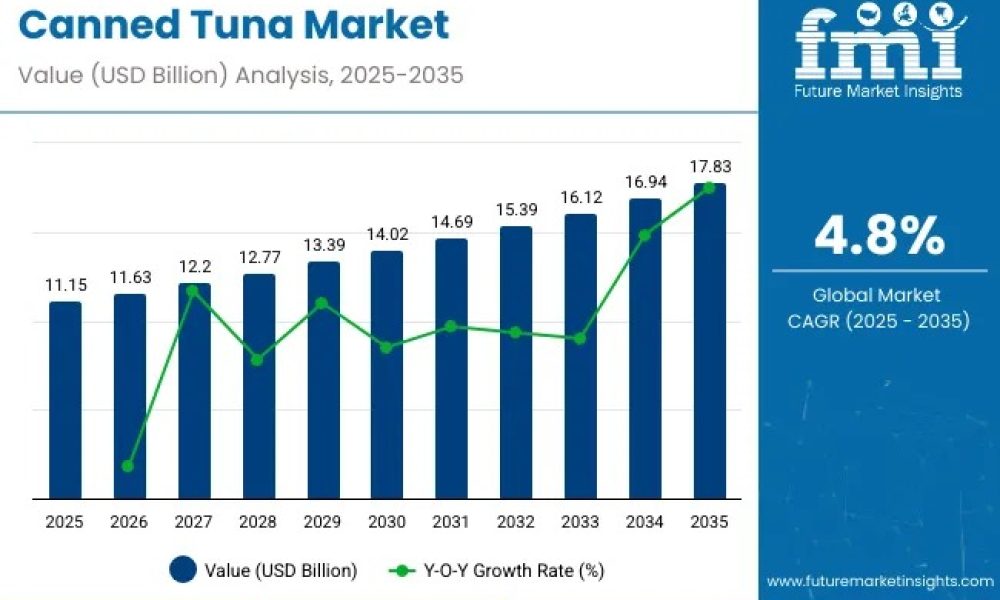
The global canned tuna market is set to expand from an estimated USD 11.15 billion in 2025 to USD 17.83 billion by 2035, reflecting a robust compound annual growth rate (CAGR) of 4.8% over the forecast period. Rising demand for convenient, protein-rich, and shelf-stable seafood is driving the growth of canned tuna across global markets.
The market’s growth is fueled by several factors, including the increasing preference for ready-to-eat meals, affordability compared to fresh or frozen seafood, and diversified product offerings. Consumers are embracing canned tuna for its versatility in salads, sandwiches, pasta dishes, and meal kits, while manufacturers are innovating with flavored pouches, gourmet fillets, and protein-rich snack packs.
Get Exclusive Access To Data Tables, Market Sizing Dashboards, And Analyst Insights. Request Sample Report!
Economic conditions such as inflation and cost-conscious consumer behavior are also contributing to the rise of canned tuna as an economical protein option. Meanwhile, manufacturers are investing in sustainable practices, including BPA-free and recyclable packaging, traceable sourcing via blockchain technology, and partnerships with eco-conscious fisheries. Companies like Thai Union Group, Bolton Group, Starkist, Dongwon Industries, and Bumble Bee Foods are leading the market with a focus on product differentiation, technological innovation, and sustainability.
Consumers increasingly demand low-mercury, high-omega-3, and clean-label products. As a result, premium tuna fillets, pole-and-line-caught tuna, and organic-certified options are gaining traction, particularly in markets such as Japan, the United States, and Europe. Retailers’ private-label brands also intensify competition, driving established manufacturers to enhance branding, transparency, and certification standards.
Per Capita Consumption and Regional Insights
Per capita consumption varies significantly:
- Developed Markets: Countries like the United States, Japan, Italy, Spain, and France report higher consumption due to established seafood diets, convenience, and accessibility.
- Emerging Markets: Nations such as Brazil, India, China, and South Africa show rising consumption driven by urbanization, exposure to Western diets, and growing middle-class incomes.
Asia-Pacific remains the largest production hub due to robust fishing infrastructure and cost advantages, while North America and Europe dominate premium and value-added segments. Rising demand for nutritious and sustainable seafood is also opening new markets, solidifying canned tuna as a resilient global protein product.
Certification and Compliance
Global canned tuna producers must comply with multiple certifications to ensure food safety and sustainability:
- Food Safety: HACCP, ISO 22000, BRC standards
- Sustainability: MSC, Friends of the Sea
- Religious Dietary: Halal and Kosher
- Regulatory Compliance: U.S. FDA and EU guidelines on labeling, mercury limits, and traceability
Tightening regulations, especially concerning illegal, unreported, and unregulated (IUU) fishing, are prompting companies to invest in traceability solutions, ethical sourcing, and real-time monitoring.
Semi-Annual Market Dynamics
The CAGR of the canned tuna market shows incremental growth:
- H1 2025–2035: 4.7%
- H2 2025–2035: 5.2%
This reflects strong momentum in the second half of the year, driven by product innovation, digital retail adoption, and premiumization trends.
Segment Analysis
- By Product Type: Canned light tuna dominates with a 50% market share in 2025 due to its affordability, versatility, and lower mercury content.
- By Product Form: Chunk tuna leads with a 40% share, favored for its convenience in meal preparation and diverse culinary applications.
- By Flavor: Flavored tuna is projected to grow at 5.7% CAGR, driven by consumer demand for spicy, herb-infused, and Mediterranean-style options.
- By Sales Channel: Online retail will register the fastest CAGR at 6.2%, fueled by e-commerce adoption, subscription models, and demand for ready-to-eat meals.
Key Industry Drivers
- Supply Chain Resilience: Manufacturers mitigate raw material volatility through fleet modernization, diverse sourcing, and long-term agreements.
- Health & Nutrition Trends: High-protein, low-carb diets, and fitness-oriented consumers are boosting demand for ready-to-eat tuna snacks and pouches.
- Premiumization: Gourmet offerings, artisanal fillets, and sustainable sourcing elevate brand positioning and consumer appeal.
Country-Wise Insights
- United States: Expansion of tuna-based meal kits and ready-to-eat innovations with ethnic flavors and clean-label products.
- Japan: Luxury tuna and high-end retail branding through artisanal fillets and specialty sauces.
- Italy: Mediterranean-style infused tuna fillets are driving premium consumption and gourmet applications.
Competition Outlook
The market exhibits moderate-to-high concentration with global leaders including Thai Union Group, Bolton Group, Starkist, Dongwon Industries, and Bumble Bee Foods. Strategies include sustainability certifications, digital traceability, premium product launches, and online retail partnerships. Local and private-label brands compete on affordability and bulk packaging, especially in Southeast Asia, Latin America, and Africa.
Buy Report Now – Click Here to Purchase the Report:
The canned tuna market’s evolution reflects a blend of convenience, sustainability, innovation, and health-conscious trends. With manufacturers responding to shifting consumer preferences and regulatory landscapes, canned tuna continues to demonstrate resilience and adaptability in the global seafood industry.
About Future Market Insights (FMI)
Future Market Insights, Inc. (FMI) is an ESOMAR-certified, ISO 9001:2015 market research and consulting organization, trusted by Fortune 500 clients and global enterprises. With operations in the U.S., UK, India, and Dubai, FMI provides data-backed insights and strategic intelligence across 30+ industries and 1200 markets worldwide.



