
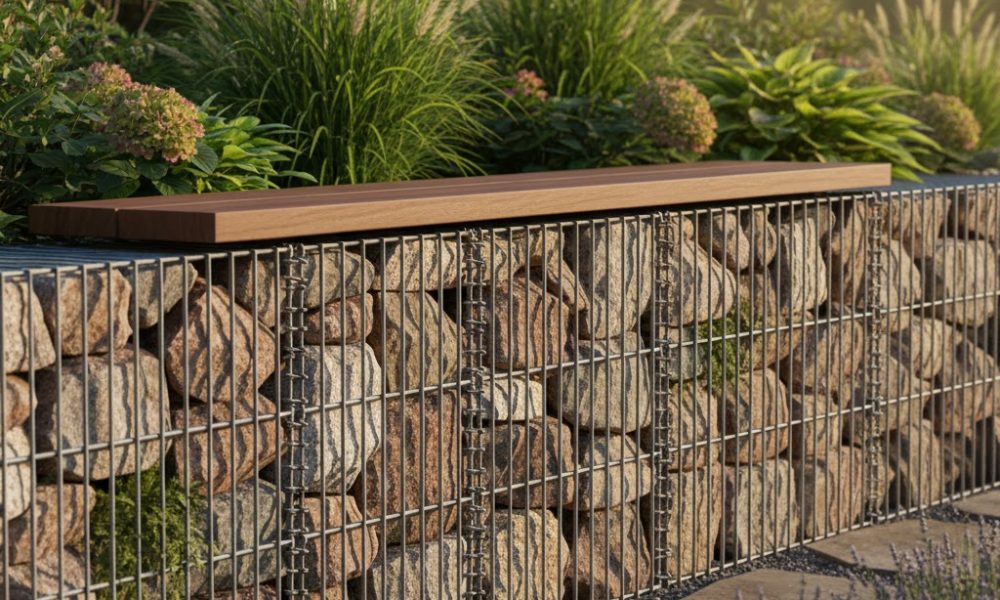
HTF MI just released the Global Gabion Wall Market Study, a comprehensive analysis of the market that spans more than 143+ pages and describes the product and industry scope as well as the market prognosis and status for 2025–2033. The marketization process is being accelerated by the market study’s segmentation by important regions. The market is currently expanding its reach.
𝐌𝐚𝐣𝐨𝐫 𝐜𝐨𝐦𝐩𝐚𝐧𝐢𝐞𝐬 in Gabion Wall Market are: Maccaferri (Italy), Tensar International Corporation (United States), Huesker Synthetic GmbH (Germany), Gabion Technologies India Pvt. Ltd. (India), TechFab India Industries Ltd (India), Terram Geosynthetics Pvt. Ltd.( India), TenCate Geosynthetics (United States), Propex Operating Company, LLC (United States), Geofabrics Australasia Pty Ltd ( Australia), NAUE GmbH & Co. KG (Germany)
𝐆𝐞𝐭 𝐂𝐮𝐬𝐭𝐨𝐦𝐢𝐳𝐞𝐝 𝐒𝐚𝐦𝐩𝐥𝐞 𝐍𝐨𝐰 👉 https://www.htfmarketintelligence.com/sample-report/global-gabion-wall-market?utm_source=Krati_NewsTrail&utm_id=Krati
According to HTF Market Intelligence, the global Gabion Wall Market size was valued at USD 3.2 Billion in 2024 and estimated to reach revenue of USD 5.4Billion by 2033, with a CAGR of ~6.5% from 2025 to 2033.
The Gabion Wall Market is Segmented by Application (Erosion control, Retaining walls, Architectural features, Road construction) by Material (Galvanized steel, PVC-coated steel, Galfan wire baskets) by Installation Method (Factory-assembled, Site-assembled)
Definition:
A gabion wall is an engineered retaining or protection structure made of wire mesh containers (gabions) — typically rectangular baskets, mattresses or cylindrical cages — filled with durable stone, rock or recycled masonry. Functioning by mass and permeability, gabion walls resist earth pressure via the weight of the filled units while permitting water to drain through, reducing hydrostatic forces behind the structure. Used widely for slope stabilization, riverbank protection, scour control, and as aesthetic retaining walls in landscape architecture, gabion systems are valued for adaptability to variable foundations, the ability to accommodate differential settlement, and relatively simple construction methods compared with cast-in-place concrete. Modern gabion solutions utilize welded or woven mesh with corrosion-resistant coatings, geotextile filter layers where needed, and modular prefabricated units to speed installation. Because gabions can be filled with locally available materials, including recycled stone, they are often presented as environmentally preferable options for certain civil and landscape engineering applications. Proper engineering design addresses bearing capacity, internal stability, hydraulic filtration and mesh corrosion performance to ensure long service life in the chosen environment.
Market Trends:
The gabion market is moving from purely functional use to integrated landscape and architectural applications. There is rising adoption of engineered gabion mattresses and prefabricated modules for faster installation, and suppliers increasingly include geotextile liners and corrosion-resistant coatings to extend service life. Design digitization (CAD/BIM) for earthworks and integrated contracting packages (supply + design + install) are becoming common. Sustainable preferences are encouraging use of locally sourced or recycled fills and visible stone facades, increasing gabion use in parks, noise barriers and urban design.
Market Drivers
Increasing infrastructure investment, climate resilience programs and the need for low-cost erosion and slope control are primary drivers. Governments and utilities are funding river stabilization, coastal protection and road/rail embankment projects that favor gabion systems because of their flexibility, permeability and ability to use local fill. Urban development and landscaping demand also contribute — architects and municipal planners select gabions for both functional retaining and aesthetic uses. The relatively low capital and maintenance requirement compared with concrete retaining solutions and the growing interest in green, permeable infrastructure further spur demand across municipal, transport and coastal sectors.
Market Opportunities:
Opportunities include product innovation (polymer-coated meshes, prefab modular gabion units), bundled design-install services, and targeting climate resilience projects (river restoration, flood defense and coastal stabilization). Landscape and architectural markets provide higher-margin visible applications. Retrofitting aging infrastructure and offering turnkey erosion-control packages to municipalities and utilities creates repeatable revenue. Exporting engineered gabion systems and training local installers in emerging markets opens new markets, while collaborations with environmental restoration specialists position gabions as both functional and ecological solutions.
Market Challenges:
Key challenges include perception and specification obstacles — gabions can be viewed as low-tech or temporary if not engineered properly. Proper performance depends on correct design, appropriate stone fill and skilled installation; poor practice leads to settlement, bulging or corrosion issues. Availability and quality control of mesh and fill materials can vary by region. In harsh marine or highly acidic soils, corrosion and service-life concerns require higher-cost coatings. Standards and certification variability across markets complicate cross-border product strategies, and competition from alternative retaining systems (concrete, reinforced earth, gabion alternatives) can constrain premium project uptake.
Dominating Region:
Europe
Fastest-Growing Region:
Asia-Pacific
Have a query? Market an enquiry before purchase 👉 https://www.htfmarketintelligence.com/enquiry-before-buy/global-gabion-wall-market?utm_source=Krati_NewsTrail&utm_id=Krati
The titled segments and sub-section of the market are illuminated below:
In-depth analysis of Gabion Wall market segments by Types: Galvanized steel, PVC-coated steel, Galfan wire baskets
Detailed analysis of Gabion Wall market segments by Applications: Erosion control, Retaining walls, Architectural features, Road construction
Global Gabion Wall Market –𝐑𝐞𝐠𝐢𝐨𝐧𝐚𝐥 𝐀𝐧𝐚𝐥𝐲𝐬𝐢𝐬
- North America: United States of America (US), Canada, and Mexico.
• South & Central America: Argentina, Chile, Colombia, and Brazil.
• Middle East & Africa: Kingdom of Saudi Arabia, United Arab Emirates, Turkey, Israel, Egypt, and South Africa.
• Europe: the UK, France, Italy, Germany, Spain, Nordics, BALTIC Countries, Russia, Austria, and the Rest of Europe.
• Asia: India, China, Japan, South Korea, Taiwan, Southeast Asia (Singapore, Thailand, Malaysia, Indonesia, Philippines & Vietnam, etc) & Rest
• Oceania: Australia & New Zealand
Gabion Wall Market Research Objectives:
– Focuses on the key manufacturers, to define, pronounce and examine the value, sales volume, market share, market competition landscape, SWOT analysis, and development plans in the next few years.
– To share comprehensive information about the key factors influencing the growth of the market (opportunities, drivers, growth potential, industry-specific challenges and risks).
– To analyze the with respect to individual future prospects, growth trends and their involvement to the total market.
– To analyze reasonable developments such as agreements, expansions new product launches, and acquisitions in the market.
– To deliberately profile the key players and systematically examine their growth strategies.
FIVE FORCES & PESTLE ANALYSIS:
In order to better understand market conditions five forces analysis is conducted that includes the Bargaining power of buyers, Bargaining power of suppliers, Threat of new entrants, Threat of substitutes, and Threat of rivalry.
• Political (Political policy and stability as well as trade, fiscal, and taxation policies)
• Economical (Interest rates, employment or unemployment rates, raw material costs, and foreign exchange rates)
• Social (Changing family demographics, education levels, cultural trends, attitude changes, and changes in lifestyles)
• Technological (Changes in digital or mobile technology, automation, research, and development)
• Legal (Employment legislation, consumer law, health, and safety, international as well as trade regulation and restrictions)
• Environmental (Climate, recycling procedures, carbon footprint, waste disposal, and sustainability)
Buy Now Latest Edition of Global Gabion Wall Market Report 👉 https://www.htfmarketintelligence.com/buy-now?format=1&report=7407?utm_source=Krati_NewsTrail&utm_id=Krati
Points Covered in Table of Content of Global Gabion Wall Market:
Chapter 01 – Gabion Wall Executive Summary
Chapter 02 – Market Overview
Chapter 03 – Key Success Factors
Chapter 04 – Global Gabion Wall Market – Pricing Analysis
Chapter 05 – Global Gabion Wall Market Background or History
Chapter 06 — Global Gabion Wall Market Segmentation (e.g. Type, Application)
Chapter 07 – Key and Emerging Countries Analysis Worldwide Gabion Wall Market
Chapter 08 – Global Gabion Wall Market Structure & worth Analysis
Chapter 09 – Global Gabion Wall Market Competitive Analysis & Challenges
Chapter 10 – Assumptions and Acronyms
Chapter 11 – Gabion Wall Market Research Method
Thanks for reading this article; you can also get individual chapter-wise sections or region-wise report versions like North America, LATAM, Europe, Japan, Australia or Southeast Asia.
About Author:
HTF Market Intelligence Consulting is uniquely positioned to empower and inspire with research and consulting services to empower businesses with growth strategies, by offering services with extraordinary depth and breadth of thought leadership, research, tools, events, and experience that assist in decision-making.
Contact Us:
Krati Bhawsar (PR & Marketing Manager)
HTF Market Intelligence Consulting Private Limited
[email protected]
Phone: +15075562445




