

Fuel Ethanol Market Overview
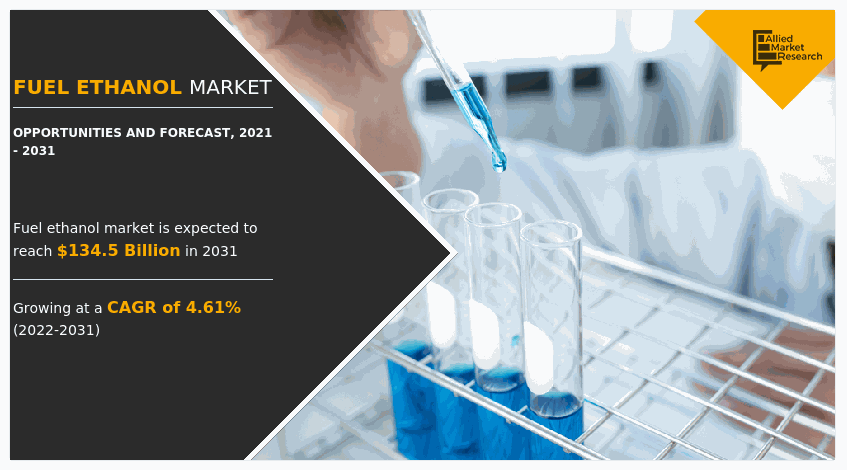
According to a new report published by Allied Market Research, the global fuel ethanol market size was valued at $86.0 billion in 2021 and is projected to reach $134.5 billion by 2031, growing at a CAGR of 4.61% from 2022 to 2031. Rising demand for cleaner transportation fuels, stringent emission regulations, and increasing adoption of renewable energy sources are major factors driving the fuel ethanol market worldwide. 🌍🚗
Introduction
Fuel ethanol is a renewable biofuel produced from plant-based materials collectively known as biomass, including agricultural crops and waste residues. It is commonly blended with gasoline to increase octane levels, improve engine performance, and reduce harmful emissions. One of the key advantages of fuel ethanol is that it can be used in conventional internal combustion engines without significant modifications.
The fuel ethanol market has gained momentum as governments and industries seek sustainable alternatives to fossil fuels. Transportation remains one of the largest contributors to global carbon dioxide emissions, and biofuels such as ethanol play a critical role in reducing environmental impact.
Download PDF Brochure: https://www.alliedmarketresearch.com/request-sample/A16349
Environmental Benefits and Rising Demand
Increasing levels of atmospheric CO₂ have intensified concerns about climate change and global warming. Since road transport accounts for a significant portion of greenhouse gas emissions, many countries are promoting ethanol blending mandates to curb pollution.
Fuel ethanol burns cleaner than gasoline, producing lower levels of carbon monoxide, particulate matter, and unburned hydrocarbons. This makes it an effective solution for improving air quality, particularly in densely populated urban areas.
Rapid urbanization and expansion of transportation infrastructure worldwide have further accelerated demand in the fuel ethanol market, as nations attempt to balance mobility needs with environmental sustainability. 🌱
Technological Advancements in Biofuel Production
Advancements in biofuel extraction technologies have significantly improved the efficiency and cost-effectiveness of ethanol production. Modern techniques enable the conversion of both food crops and non-food biomass into usable fuel, expanding the raw material base.
Cellulosic ethanol, produced from agricultural waste such as corn stover, rice straw, and sugarcane bagasse, is gaining attention as a sustainable alternative that does not compete with food supply. This innovation not only reduces waste but also provides additional income opportunities for farmers.
Government initiatives supporting green industries and renewable fuels further strengthen the growth prospects of the fuel ethanol market.
Strategic Investments and Industry Collaboration
Major oil and energy companies are increasingly investing in biofuels to comply with environmental regulations and diversify their energy portfolios. Partnerships between petroleum firms and biofuel producers are becoming more common, enabling large-scale commercialization of ethanol-based fuels.
Companies such as Shell plc and Hindustan Petroleum Corporation Limited have entered collaborations with biofuel firms to secure ethanol supplies and develop advanced production technologies.
Fuel ethanol is also being explored as an alternative fuel for power generation, particularly in diesel-fired power plants that can operate using ethanol blends. This additional application area supports expansion of the fuel ethanol market beyond transportation.
Market Restraints and Challenges
Despite its advantages, the fuel ethanol market faces several challenges. Limited availability of raw materials in certain regions can restrict production capacity and blending levels. Additionally, the presence of relatively few large-scale ethanol refineries creates supply bottlenecks.
Stringent regulatory requirements for production, storage, and transportation of biofuels often require substantial capital investment, which may deter new entrants. Moreover, fluctuations in agricultural output due to climate conditions can affect feedstock availability and pricing.
Rapid innovation by new players developing alternative processing methods may also intensify competition, creating uncertainties in market dynamics.
Market Segmentation
The fuel ethanol market is segmented by source, product type, application, end-use industry, and region.
By source, the market is divided into natural and synthetic ethanol, with natural sources dominating due to widespread biomass availability.
By product, the market includes starch-based, sugar-based, and cellulosic ethanol. Starch-based ethanol currently holds a significant share, particularly in countries with large corn production.
By application, ethanol is used in conventional vehicles and flexible fuel vehicles (FFVs). Conventional vehicles accounted for the largest share in 2021 because ethanol blends such as E10 and E20 can be used without engine modifications.
By end-use industry, the automotive sector dominates, followed by oil & gas and other industries.
Regional Outlook
North America currently holds the largest share of the fuel ethanol market, supported by strong government policies, established production infrastructure, and widespread ethanol blending programs. The region is expected to maintain robust growth during the forecast period.
Europe and Asia-Pacific also represent significant markets, driven by emission reduction targets and rising adoption of renewable fuels. Emerging economies are gradually increasing ethanol blending mandates to reduce dependence on imported crude oil.
LAMEA (Latin America, Middle East, and Africa) shows promising growth potential due to expanding agricultural production and increasing energy demand. 🌎
Competitive Landscape
The fuel ethanol market includes numerous global chemical, energy, and agribusiness companies. Key players include Braskem, BP plc, Cargill, INEOS, Mitsubishi Chemical Corporation, SABIC, Sasol, and Solvay.
These companies are adopting strategies such as capacity expansion, acquisitions, joint ventures, and technological innovation to strengthen their market position.
Impact of COVID-19
The COVID-19 pandemic significantly disrupted the fuel ethanol market due to reduced transportation activity and economic slowdown. Lockdowns imposed worldwide led to decreased vehicle usage, which directly lowered fuel consumption and ethanol demand.
Manufacturing shutdowns and trade restrictions further affected supply chains, causing temporary declines in production and sales. As economies reopen and travel resumes, demand for transportation fuels is recovering, supporting market growth.
Get a Customized Research Report: https://www.alliedmarketresearch.com/request-for-customization/A16349
Future Outlook
Long-term prospects for the fuel ethanol market remain positive as countries transition toward low-carbon energy systems. Increasing adoption of flexible fuel vehicles, expansion of biofuel infrastructure, and development of advanced ethanol technologies will continue to drive demand.
Government policies promoting renewable energy, energy security, and rural development are expected to play a crucial role in shaping the market’s future.
Conclusion
In conclusion, the fuel ethanol market is poised for steady growth as the world seeks cleaner and more sustainable transportation fuels. Ethanol’s ability to reduce emissions, enhance fuel performance, and utilize renewable resources makes it a vital component of the global energy transition.
Although challenges such as feedstock availability and regulatory compliance persist, ongoing technological advancements and supportive government initiatives are expected to drive widespread adoption. As nations strive to balance economic development with environmental responsibility, the fuel ethanol market will continue to play a crucial role in shaping the future of sustainable mobility. 🌿🚙
Other Trending Reports:-
About Us
Allied Market Research (AMR) is a full-service market research and business-consulting wing of Allied Analytics LLP based in Portland, Oregon. Allied Market Research provides global enterprises as well as medium and small businesses with unmatched quality of “Market Research Reports” and “Business Intelligence Solutions.” AMR has a targeted view to provide business insights and consulting to assist its clients to make strategic business decisions and achieve sustainable growth in their respective market domain.
Pawan Kumar, the CEO of Allied Market Research, is leading the organization toward providing high-quality data and insights. We are in professional corporate relations with various companies and this helps us in digging out market data that helps us generate accurate research data tables and confirms utmost accuracy in our market forecasting. Each and every data presented in the reports published by us is extracted through primary interviews with top officials from leading companies of domain concerned. Our secondary data procurement methodology includes deep online and offline research and discussion with knowledgeable professionals and analysts in the industry.




