
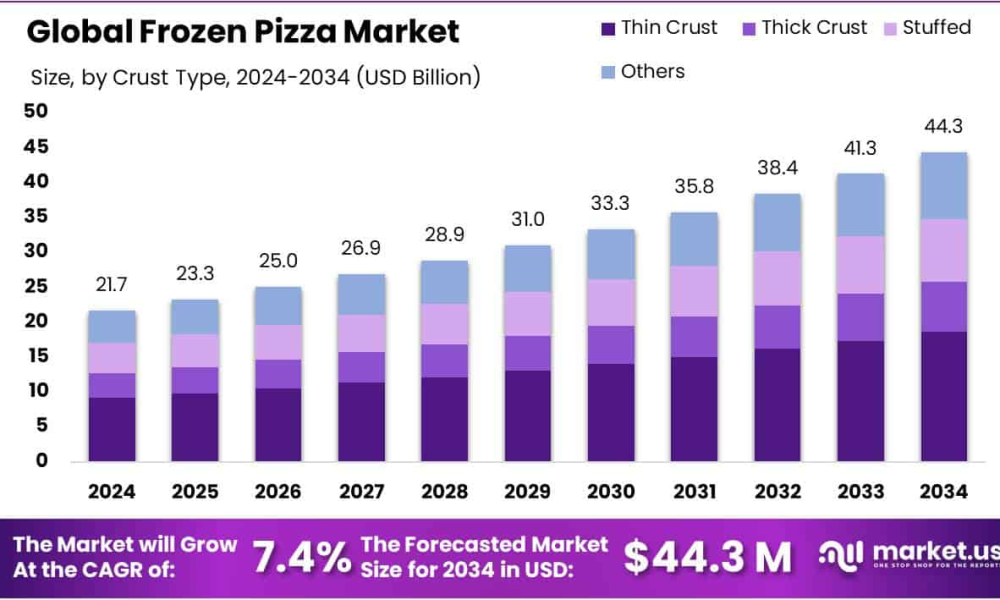
New York, NY – July 14, 2025 – The Global Frozen Pizza Market is experiencing strong growth, driven by increasing consumer demand for convenient, ready-to-eat meals. In 2024, the market was valued at USD 21.7 billion and is projected to reach USD 44.3 billion by 2034, growing at a steady CAGR of 7.4% from 2025 to 2034.
This expansion is fueled by busy lifestyles, rising disposable incomes, and the growing preference for quick meal solutions. Frozen pizza has gained popularity due to its affordability, longer shelf life, and improving quality, with many brands now offering gourmet and healthier options.
Key growth factors include innovation in flavors, crust types, and plant-based alternatives, catering to diverse dietary preferences. The market also benefits from expanding retail distribution, including supermarkets, hypermarkets, and online grocery platforms, making frozen pizza more accessible worldwide. Emerging markets present significant opportunities as urbanization and Western food trends influence consumer habits.
Additionally, the rise of private-label brands and strategic partnerships among key players is driving competition and market expansion. With increasing demand for convenience foods, the frozen pizza market is set to grow steadily, offering lucrative opportunities for manufacturers and retailers alike.
Important Revelation
- The global frozen pizza market will be valued at USD 21.7 billion in 2024.
- The global frozen pizza market is projected to reach USD 44.3 billion by 2034.
- Among crust types, thin-crust type frozen pizza accounted for the majority of the market share with 42.1%.
- Among types, non-vegetarian frozen pizza accounted for the largest market share of 61.6%.
- Based on toppings, meat-based toppings are expected to account for the largest market share in 2024, with 56.4%.
- Among frozen pizza sizes, the large-sized frozen pizza is more popular among consumers, and thus, it holds a 53.3% revenue share.
- Based on the distribution channel, the supermarkets/hypermarkets segment is anticipated to account market share of 53.5%.
- 2 out of every 3 households in America eat frozen pizza regularly.
➤ Download Exclusive Sample Of This Premium Report (Including Full TOC, Table & Figures): https://market.us/report/frozen-pizza-market/request-sample/
Report Segmentation
Crust Type Analysis
- Thin crust frozen pizzas emerged as the most preferred choice among consumers, capturing a leading market share of 42.1% in 2024. The rising preference for thin crust can be attributed to its crisp texture and lower calorie content compared to thick or stuffed crust alternatives. As health-conscious consumers increasingly seek lighter meal options, thin-crust pizzas offer an appealing balance between indulgence and wellness.
- Their lower dough content and enhanced crispiness, especially when baked or reheated, provide a satisfying mouthfeel that complements cheese and toppings effectively. This combination of texture and health positioning continues to reinforce the thin crust’s dominance in the market.
Type Analysis
- Non-vegetarian frozen pizzas accounted for the highest share in the global market, representing 61.6% of total revenue in 2024. This segment’s dominance is largely driven by the widespread popularity of meat-based pizzas, particularly in Western markets where meat consumption is deeply embedded in dietary habits.
- Toppings such as pepperoni, sausage, and chicken contribute to the traditional appeal and flavor richness that many consumers associate with frozen pizza. The availability of a wide variety of meat combinations also enhances product diversity, enabling manufacturers to cater to broad consumer preferences and maintain steady demand.
Toppings Analysis
- Meat toppings led the global frozen pizza market in 2024, securing a significant market share of 56.4%. This dominance is supported by the strong consumer demand for hearty, flavorful toppings such as pepperoni, sausage, ham, and chicken. Meat toppings are often viewed as premium ingredients, associated with a richer taste experience and higher product value.
- Additionally, the broad variety, from everyday options to gourmet selections like prosciutto and chorizo, allows consumers to explore different flavor profiles. This versatility in offerings contributes to the strong market position of meat toppings, appealing to a wide segment of taste-conscious buyers.
Size Analysis
- Large-size frozen pizzas held the largest market share in 2024, accounting for 53.3% of total sales. This preference is primarily driven by their ability to accommodate a greater number and variety of toppings, making them ideal for shared consumption among families or groups.
- The convenience of purchasing a larger pizza, minimizing the need for multiple smaller portions, fits well with busy consumer lifestyles. Furthermore, larger pizzas reduce the use of multiple packaging materials and ease storage management, making them a practical and cost-effective solution for regular frozen pizza buyers.
Distribution Channel Analysis
- Supermarkets and hypermarkets dominated the frozen pizza distribution landscape in 2024, contributing 53.5% of total revenue. Their leadership stems from the extensive variety of frozen pizza brands and formats available in these retail environments. Consumers benefit from a comprehensive product assortment that ranges from budget-friendly to premium offerings, all under one roof.
- The competitive pricing structure, frequent promotional campaigns, and loyalty incentives provided by these large-format stores further enhance their attractiveness. Their widespread availability and consumer trust continue to make supermarkets and hypermarkets the primary channel for frozen pizza purchases.
Market Key Segmentation
By Type
- Non-vegetarian Frozen Pizza
- Vegetarian Frozen Pizza
By Crust Type
- Thin Crust
- Thick Crust
- Stuffed
- Other Crust Types
By Toppings
- Meat
- Vegetables
- Cheese
- Other Toppings
By Size
- Regular
- Large
- Extra-large
By Distribution Channel
- Supermarkets/Hypermarkets
- Convenience Stores
- Specialty Stores
- Online Retail
- Others
Geopolitical Impact Analysis
Geopolitical uncertainties have significantly disrupted supply chain operations, posing a potential threat to the growth trajectory of the frozen pizza market. Shifts in trade policies, such as the imposition of tariffs on essential ingredients like cheese, meat, or wheat, can raise input costs for manufacturers. This may lead to higher retail prices and reduced price competitiveness in international markets.
Moreover, geopolitical conflicts can interrupt the availability of key raw materials, thereby impacting both production efficiency and distribution networks. Currency volatility, often triggered by global political instability, further complicates market dynamics. For multinational companies, fluctuating exchange rates may inflate import costs or reduce export profitability, prompting adjustments in pricing strategies.
Additionally, geopolitical developments may lead to revisions in food safety regulations, labeling requirements, and quality standards across different regions. Adapting to these evolving regulations can result in increased compliance costs and necessitate product reformulations or packaging alterations.
Climate policy measures, particularly those focused on sustainability and emission controls, are also influencing the frozen pizza market. Regulatory pressures to adopt eco-friendly packaging and production practices are expected to intensify, adding another layer of operational complexity for manufacturers.
Regional Analysis
North America is projected to remain the most lucrative regional market for frozen pizza, accounting for 39.1% of the global market share in 2024. This dominance is primarily driven by the deep-rooted popularity of frozen pizza in the United States, where it is considered a dietary staple. The preference for ready-to-eat and time-saving meal options among North American consumers, especially working professionals and busy households, continues to stimulate consistent demand.
The region’s well-established retail infrastructure, including supermarkets, hypermarkets, and convenience stores, ensures widespread availability and ease of access to frozen pizza products. In response to evolving consumer preferences, particularly among health-conscious buyers, manufacturers have diversified their offerings.
This includes the introduction of organic ingredients, vegetable-rich toppings, gluten-free or low-carb crusts, and plant-based cheese alternatives. These innovations have not only expanded the consumer base but also reinforced North America’s leadership position in the global frozen pizza industry.
Competitive Landscape
- August Oetker AG
- Conagra Brands
- Bellisio Foods, Inc.
- Freiberger Lebensmittel GmbH
- Newman’s Own
- Nestlé S.A.
- Simply Good Foods Co.
- Monte Pizza International B.V.
- McCain Foods Limited
- Hansen Foods, LLC
- Other Manufacturers
Get in Touch with Us:
Market.us (Powered By Prudour Pvt. Ltd.)
Address: 420 Lexington Avenue, Suite 300, New York City, NY 10170, United States
Send Email: [email protected]
Refer To More Related Reports:
Powder Metallurgy Market
Hydrogen Cyanide Market
Hydrogen Sulfide Scavengers Market



