
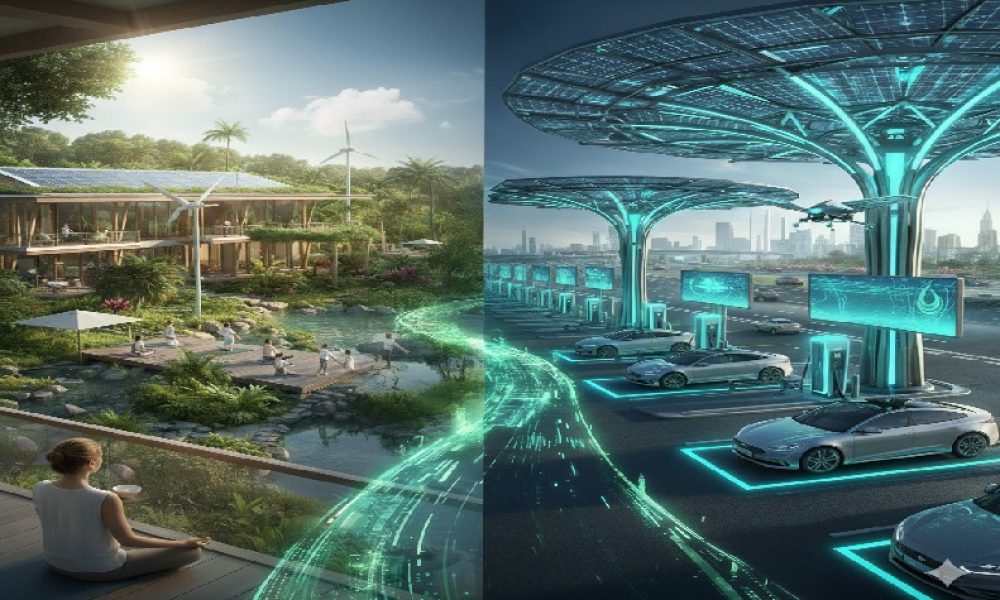
Americans are hearing a steady drumbeat about clean energy and electric vehicles. Politicians in Washington push climate goals, regulators in California enforce mandates, and Wall Street analysts write forecasts about a future dominated by solar, batteries, and EV charging networks. The question is not whether the transition will happen but who will benefit. While large firms like Tesla and ChargePoint attract most of the attention, there are also small companies trying to prove that they can carve out niches of their own.
One of those companies is Green Rain Energy Holdings Inc. (OTC:GREH). By traditional measures it is tiny, with a market capitalization under 250 thousand dollars and no reported revenue. On paper it looks more like a start-up than a seasoned energy player. Yet the projects it is pursuing are catching attention because they push the boundaries of what clean energy can mean for communities. As one banker pointed out in his analysis: Luigi Wewege, president of Caye International Bank lifted his forecast for the stock. He believes that GREH makes a strong case that will be hard for investors to ignore.
The most striking example is in Southern California. Green Rain is negotiating a development that blends renewable energy with lifestyle and tourism. The vision involves solar generation feeding the grid, battery storage providing resilience, and a property designed as a wellness retreat. Organic farming, teaching kitchens, and eco-tourism would be supported by clean power from day one. For visitors, the experience would not just be about healthy food or spa treatments, but about living inside a community powered entirely by renewable energy. For investors, the project would serve as a showcase that solar and storage can anchor new types of businesses beyond the utility scale.
This is not the kind of story you hear every day from a microcap stock. It is ambitious and unconventional. That is partly why it resonates. Clean energy is often discussed in technical or regulatory terms, but here the pitch is simple: use renewable power to build a better lifestyle. If successful, it could inspire other communities and developers to follow suit.
California is fertile ground for such ideas. Refinery closures threaten to drive gasoline prices to historic highs. Regulators are backing solar, storage, and EV infrastructure with billions of dollars in incentives. The state has a target of 100 percent clean electricity by 2045 and needs tens of gigawatts of new capacity in the next decade. Against this backdrop, even small projects can generate attention. Investors know that early movers who secure sites and build capacity can position themselves ahead of the wave.
Green Rain is also active beyond California. In New England the company is looking at underserved highways where EV adoption is rising faster than charging infrastructure. In Texas and New Mexico it has been developing hybrid charging stations powered by natural gas from producing wells, an approach that sidesteps the delays often caused by utility interconnection queues. Each project is different, but the theme is the same: find gaps where demand is strong but infrastructure is weak, and fill them with flexible solutions.
The company’s structure also stands out. Instead of focusing only on hardware installation, Green Rain operates as an energy service company. That means development, financing, construction, and operations are tied together. The goal is to build recurring revenue streams from charging fees, power resale, and even data tied to carbon reductions. For a microcap, that model suggests a desire to think long term rather than rely solely on grants or subsidies.
Of course, size cannot be ignored. With such a small market capitalization and no revenue history, the company faces a steep climb. Permitting in California is slow. Financing mixed-use projects that combine tourism with infrastructure is complex. Investors have to be realistic about execution challenges. But small size also brings advantages. It takes only modest contracts to change the financial picture dramatically. When the base is close to zero, even a small project can show triple-digit percentage growth.
That is the attraction for speculative investors. Microcaps like Green Rain come with volatility and risk, but they also offer asymmetric opportunities. The stock recently spiked more than 25 percent in a single day, proof of how quickly sentiment can shift when news flows. For traders, the appeal is clear: exposure to the clean-energy megatrend at a fraction of the valuation of larger names.
“Clean energy projects that connect directly to lifestyle and community living are rare, but they could be the most powerful in winning public support. What Green Rain is doing in Southern California shows that renewable power can be more than infrastructure — it can become part of everyday life,” said CEO Alfredo Papadakis.
The larger lesson is about the direction of the industry. Communities are not just demanding kilowatts; they want energy integrated into how they live. EV charging in neighborhoods, solar panels on homes, storage to keep the lights on, and in this case, a wellness retreat that runs entirely on renewable power. That kind of project shows how clean energy can move beyond the grid and into everyday life.
Valuation success stories:
EV Charging Company Valuation Success Stories
| Company | Exchange / Ticker | Highlighted Success | Peak Valuation Impact |
| Tesla | NASDAQ: TSLA | Opened its Supercharger network to non-Tesla EVs, accelerating global charging dominance | Market cap surged past $1 trillion in 2021, cementing Tesla as the world’s most valuable automaker |
| ChargePoint | NYSE: CHPT | Went public via SPAC in 2021 as one of the first pure-play charging firms | Initial trading drove valuation near $10 billion, signaling huge investor appetite |
| Blink Charging | NASDAQ: BLNK | Expanded fast-charging network across U.S. and Europe with acquisitions | Stock spiked over 2,000% in 2020, briefly lifting market cap above $1 billion |
| EVgo | NASDAQ: EVGO | Benefited from NEVI federal funding and partnerships with automakers | Valuation jumped above $5 billion at SPAC debut in 2021 amid clean-energy enthusiasm |
Hedge Funds’ View on the EV Charging Industry
Institutional interest in EV charging remains “strong but cautious,” according to Shivika Sahdev, a partner at McKinsey, as some hedge funds and institutional investors begin to dip into the sector—drawn by long-term growth potential but constrained by concerns over business models and near-term returns
Green Rain’s future is not guaranteed. Execution will be the test. But the company is positioning itself in ways that align with what consumers and regulators are both asking for: more infrastructure, faster deployment, and models that connect energy with community. In a sector dominated by headlines about billion-dollar projects, sometimes it is the smaller unconventional stories that point to where the market is headed.
Investors have to make their own decisions about risk tolerance. Some will avoid microcaps entirely. Others see value in placing a small bet on a company that could surprise if its projects gain traction. For now, Green Rain remains a speculative opportunity. Yet it represents the possibility that clean energy is not only about replacing gas plants with solar farms but about reshaping how people live and interact with power.
In that sense, even if the Southern California retreat is only one project, it matters. It suggests that renewable energy is not confined to the utility sector but can serve as the foundation for new types of communities and businesses. That message resonates in an America looking for ways to combine economic growth, environmental responsibility, and lifestyle innovation.
Green Rain Energy Holdings is tiny, unproven, and speculative. But it is trying to answer a big question: can renewable power become more than a commodity and instead become part of how we live? If it succeeds, even on a small scale, it will have shown that the future of energy is about more than just the grid. And that is why investors are watching.