
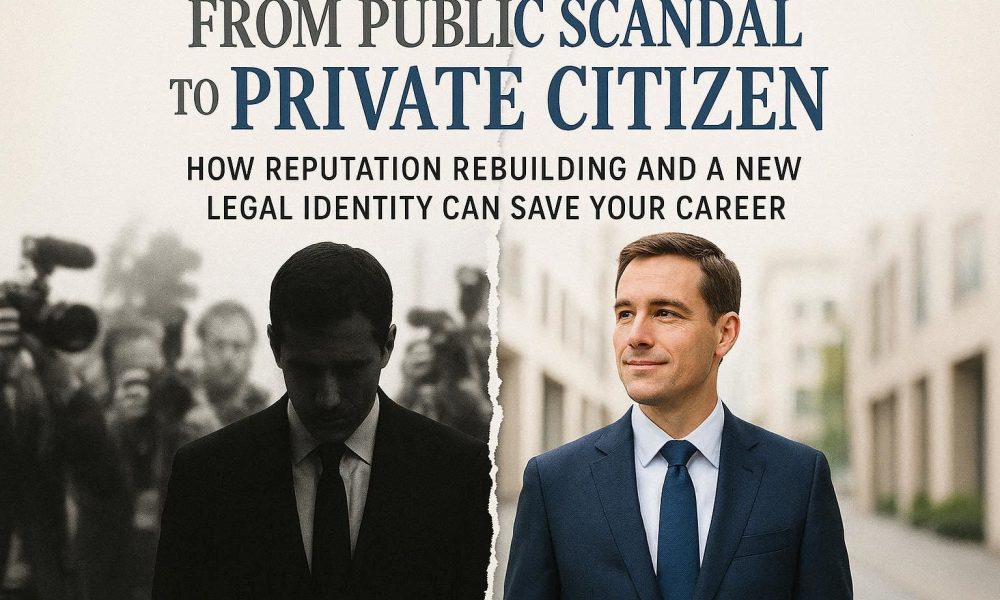
When a digital PR crisis becomes irreversible, a structured identity shift can offer a lawful path toward personal stability, professional continuity, and the privacy needed to rebuild without living in the permanent shadow of a single viral moment.
WASHINGTON, DC, May 1, 2026,
Public scandal used to move through newspapers, television segments, boardrooms, and court filings at a pace that allowed lawyers, advisers, employers, and families to respond before reputational damage became permanent.
Today, a single accusation, leaked message, viral photograph, business dispute, divorce allegation, workplace controversy, court filing, or social media misunderstanding can travel globally within hours, attaching itself to search results, archived screenshots, commentary threads, reaction videos, and artificial intelligence summaries that may outlive the facts.
For executives, entrepreneurs, professionals, investors, public figures, and private citizens caught in a reputational collapse, the practical question is no longer whether the internet will forget; the harsher question is whether a person can ever function normally again under the same searchable identity.
A public scandal can become a permanent digital sentence long after the legal issue is resolved.
A person may win a lawsuit, settle a dispute, leave a company, correct an accusation, complete a regulatory process, or survive a media storm, yet still remain trapped inside search results that repeat the worst moment of their life without context.
This is why reputation rebuilding has moved beyond traditional public relations, because the old playbook of issuing statements, hiring crisis consultants, correcting articles, and waiting for attention to fade does not always work in a digital environment built for permanent recall.
When a digital scandal becomes attached to a legal name, professional identity, family network, business profile, residence history, and online archive, the damage can follow every job application, investor call, border search, banking review, licensing process, media inquiry, and personal relationship.
The modern reputational crisis is not simply embarrassment, because it can become a career barrier, financial restriction, mental health burden, family security problem, and identity trap that prevents the person from rebuilding, even when the underlying event is old, disputed, exaggerated, or resolved.
The internet now punishes visibility because old reputational damage can be revived by anyone at any time.
A scandal no longer needs new facts to regain power because hostile parties can repost archived material, attach misleading captions, create compilation videos, use paid search tactics, generate AI summaries, and circulate old allegations whenever the person attempts a new opportunity.
That creates a uniquely modern problem, because a person may behave responsibly after a crisis, yet still face renewed punishment every time a prospective employer, investor, client, lender, regulator, journalist, date, school administrator, or business partner searches the original name.
Recent coverage of online abuse and digital harassment has shown how reputational attacks can spill into personal safety, mental health, professional participation, and public silence, particularly when coordinated online mobs use anonymity, artificial intelligence, and weak accountability systems to keep controversy alive.
The lesson extends beyond any single demographic or profession, because reputational warfare now affects executives, founders, public communicators, academics, whistleblowers, litigants, celebrities, activists, and ordinary people whose names become attached to viral controversy.
When online attention becomes organized, punitive, and repetitive, the affected person may find that career recovery is not only about explaining the past but also about creating sufficient legal distance from the old identity to build a future.
A New Legal Identity is not a cover-up, because it must be built around compliance, truth, and legitimate privacy.
A lawful identity shift is fundamentally different from an attempt to evade courts, creditors, taxes, licensing boards, immigration authorities, law enforcement agencies, or victims with legitimate claims, because legal privacy cannot be built on deception.
The proper objective is to separate a person’s future civilian life from excessive public exposure, while still preserving required disclosures to banks, courts, tax authorities, immigration officers, regulators, and other institutions that have a lawful right to accurate information.
That distinction matters because reputation rebuilding through legal identity planning is not designed to erase accountability, deny proven misconduct, or mislead regulated systems, but to help a person move forward when perpetual public exposure has become disproportionate, unsafe, or professionally destructive.
For someone who has completed legal obligations, resolved disputes, paid debts, satisfied employment restrictions, or cleared regulatory requirements, a structured identity shift may provide the privacy foundation needed to seek work, relocate, bank, travel, and rebuild social life without constant public harassment.
Where appropriate, lawful new identity planning can support that transition by focusing on recognized documents, compliance review, continuity planning, and practical identity use rather than false records or theatrical reinvention.
Reputation rebuilding now requires more than search suppression and positive press.
Traditional reputation management often focuses on pushing negative articles lower in search results, publishing favorable content, improving social media profiles, removing inaccurate material, and creating a stronger public narrative around the affected person.
Those steps may help in mild or moderate cases, but they may fail when the original scandal is too viral, too emotionally charged, too legally indexed, too visually memorable, or too closely tied to the person’s full name and professional field.
In severe cases, every positive article can paradoxically revive the controversy, because new content gives hostile commentators another opportunity to reattach old allegations, create response threads, and reconnect the person’s current work to the original scandal.
A New Legal Identity becomes relevant when reputation repair alone cannot create separation, because the person needs a lawful route to function as a private citizen rather than a permanent public exhibit attached to a damaging archive.
The shift is not about pretending the past never happened, but about creating a future in which the past no longer controls every search result, first impression, professional conversation, and personal introduction.
The crisis becomes irreversible when the person’s legal name ceases to function as a normal social tool.
A legal name is supposed to identify a person, but after a major public scandal, it can become a trigger phrase that produces hostile content, defamatory commentary, outdated allegations, legal summaries, meme pages, and automated search suggestions before the person ever speaks.
That is the moment when a reputation problem becomes an identity problem, because the name itself no longer performs the ordinary function of introducing a person neutrally to employers, banks, landlords, schools, clients, investors, or social contacts.
Professionals in sensitive industries can suffer disproportionately because finance, law, healthcare, government contracting, education, aviation, security, technology, media, and executive leadership all involve trust screening that may treat past controversy as a present risk.
Even when the person has not been convicted of a crime or when allegations were resolved privately, the digital record may still create enough concern for companies and institutions to avoid the perceived reputational burden.
This creates a private punishment system outside the courtroom, because online permanence can produce economic exclusion, family stress, professional isolation, and reputational exile without formal due process, time limits, or proportional review.
The lawful rebuilding process begins with triage, not reinvention.
A credible identity strategy begins by mapping the crisis honestly, because advisers must understand whether the issue involves criminal charges, civil litigation, regulatory sanctions, employment misconduct, divorce proceedings, media allegations, online harassment, doxxing, financial disputes, or personal defamation.
That triage determines what can be changed, what must be disclosed, what should remain consistent, what legal obligations still exist, and what risks could arise if the person attempts relocation, a name change, the citizenship process, a banking transition, or professional re-entry.
A person under active investigation, court supervision, bankruptcy proceedings, professional discipline, unpaid child support, tax enforcement, or creditor litigation cannot treat identity restructuring as a shortcut around legal obligations, because that would create additional exposure.
By contrast, a person who has resolved legal matters and faces continuing reputational harm may have a stronger argument for privacy-focused restructuring, especially when online abuse, family exposure, employment exclusion, or physical security risks remain active.
The goal is to identify a lawful path that reduces unnecessary public visibility while maintaining accurate disclosure where the law, contract, institution, or professional standard requires it.
Digital cleanup is necessary, but digital cleanup alone is rarely enough after a severe scandal.
The first stage of rebuilding usually involves removing exposed addresses, reducing social media visibility, separating personal and professional communications, correcting inaccurate information, securing accounts, managing search results, and documenting harassment or identity misuse.
Official consumer guidance from the Federal Trade Commission outlines protective steps for people facing identity theft and other online security risks, including reporting fraud, credit protection, and recovery planning when personal information has been misused.
Those tools are important when a scandal is accompanied by impersonation, doxxing, account takeover, fraud, or malicious use of personal information, because reputational attacks often escalate into financial and identity abuse.
However, cleanup does not always remove archived news, third-party commentary, court records, screenshots, forum posts, AI-generated summaries, old podcast episodes, or hostile content hosted in jurisdictions where takedown remedies are slow, expensive, or unavailable.
That is why some clients move from reputation management to identity management: the objective shifts from persuading the internet to forget to building a lawful, quieter life that does not depend on universal deletion.
A structured identity shift must preserve professional credibility without repeating the old exposure pattern.
Rebuilding a career under a New Legal Identity requires careful planning, as a person cannot simply appear with documents and no coherent explanation of education, experience, professional skills, income sources, references, or current business activities.
The safest strategy usually builds forward from present lawful activity, using accurate descriptions of current work, transferable skills, private consulting, investment activity, advisory roles, entrepreneurship, or low-profile employment that does not require fabricated credentials.
Professional credibility must be modest, consistent, and verifiable, because exaggerated claims invite investigation and can expose the transition more quickly than a restrained profile that answers only the questions a counterpart legitimately needs answered.
This is especially important for regulated professions because lawyers, accountants, bankers, brokers, medical professionals, security specialists, and licensed advisers may have disclosure duties that cannot be circumvented by a name change or relocation.
The new professional identity succeeds when it is truthful enough to survive verification, private enough to reduce exposure, and carefully structured enough to prevent old search results from dominating every new opportunity.
Financial continuity is often the hardest part of post-scandal rebuilding.
Banks, payment processors, private bankers, lenders, insurers, and investment platforms do not evaluate clients based solely on passports; they review sources of funds, occupation, residence, tax status, transaction behavior, adverse media, beneficial ownership, and risk geography.
A person emerging from a scandal may therefore face account closures, enhanced due diligence, delayed onboarding, rejected lending, frozen payment channels, or reputational hesitation from institutions that fear association with public controversy.
A lawful identity shift must anticipate that scrutiny, because the person may need proper tax identification, documented income sources, clean banking explanations, compliant corporate structures, and transparent disclosure where required.
This is why private banking continuity must be designed before any move is made: a New Legal Identity without a credible financial infrastructure can fail quickly when the person tries to receive income, invest, rent property, travel, insure assets, or operate internationally.
The objective is not to hide improper funds, but to help a compliant person regain ordinary financial function after reputational damage has made routine transactions harder than they should be.
The social side of rebuilding is quieter but just as important as the legal side.
A public scandal often damages more than employment, because it can destroy friendships, family stability, dating prospects, neighborhood comfort, school relationships, professional associations, and the basic ability to enter new rooms without being defined by old headlines.
A structured identity shift can help restore social peace by allowing the person to rebuild in environments where introductions are based on present conduct rather than viral content, hostile commentary, or a frozen version of the worst public moment.
That does not require elaborate fiction, because the healthiest new life is usually built on restraint, truthful simplicity, limited disclosure, and a disciplined understanding that not every acquaintance deserves access to painful personal history.
The person must also avoid recreating the same exposure pattern through vanity, oversharing, provocative public posts, careless relationships, visible luxury signals, or repeated engagement with critics invested in keeping the scandal alive.
Successful rebuilding often looks ordinary from the outside because the person works, banks, travels, communicates, and lives in a controlled way that does not invite renewed attention or unnecessary verification.
Anonymous living is not disappearance, because it is lawful exposure control.
There is a critical difference between disappearing from legitimate obligations and becoming less visible to the public: the former can create legal problems, while the latter can be a responsible personal security strategy.
For a person recovering from a scandal, lawful anonymous living may involve private addresses, separate communications, data removal, limited professional exposure, careful travel routines, secure devices, controlled banking relationships, and family education around social media risks.
It may also involve relocating to a jurisdiction where the person can live quietly, restart professionally, and avoid the social geography that keeps the scandal alive through gossip, old networks, hostile acquaintances, or industry insiders.
The purpose of anonymous living strategies is to reduce unnecessary visibility while preserving lawful access to banking, residence, travel, employment, communication, and professional support systems.
When done correctly, anonymous living is not a rejection of responsibility, but rather a recognition that personal peace sometimes requires boundaries stronger than ordinary reputation management can provide.
A New Legal Identity can protect mental health when public punishment becomes endless.
Public scandal often produces anxiety, depression, isolation, insomnia, family distress, professional shame, and chronic fear that every new opportunity will collapse as soon as someone performs a search.
The emotional burden becomes heavier when the person has already apologized, corrected behavior, resolved disputes, or endured consequences, yet continues to face a digital environment that allows strangers to restart punishment whenever attention becomes profitable.
A lawful identity transition cannot erase trauma, but it can create space for recovery by reducing the number of daily triggers, hostile encounters, repeated explanations, and humiliating search results attached to ordinary interactions.
This matters because career rebuilding requires confidence, and confidence is difficult to rebuild when every application, meeting, interview, introduction, date, banking review, or lease negotiation feels like a trial.
For some people, privacy is not merely a strategic advantage, because it becomes the psychological condition required to function normally again after online permanence has made the original identity unbearable.
The process must avoid the temptation to fabricate a perfect replacement life.
People emerging from scandal may feel pressure to create an impressive new biography, but that impulse is dangerous because false credentials, invented work histories, fake references, and exaggerated claims can lead to a second scandal worse than the first.
A credible rebuilding strategy is usually humble because it emphasizes present work, lawful residence, practical skills, discreet networks, clean financial behavior, and a private life that does not require constant explanation.
The new identity should be strong enough to support ordinary professional and personal activity, but not so artificially polished that it invites journalists, competitors, compliance officers, or hostile actors to investigate inconsistencies.
In reputation recovery, understatement can be more protective than reinvention because a quiet, truthful profile is far more durable than a dramatic transformation that relies on unsupported claims.
The best identity structures are built to survive scrutiny, not to avoid it completely, because serious advisers assume that banks, borders, employers, counterparties, or journalists may eventually ask questions.
Public accountability and private recovery can coexist when the structure is honest.
Critics may argue that a New Legal Identity allows people to escape accountability, and that concern is legitimate when someone uses identity changes to evade victims, hide assets, avoid court orders, or mislead institutions.
However, there is also a public interest in allowing people to rebuild after consequences have been served, especially when online punishment becomes permanent, disproportionate, inaccurate, or dangerous to family members who had no role in the controversy.
A lawful framework must therefore balance privacy with disclosure, because some facts may remain relevant to regulators, courts, banks, employers, licensing bodies, or counterparties, while other details may not need to follow a person forever into unrelated private life.
The ethical version of identity rebuilding does not deny the past to those legally entitled to know it, but it prevents the past from being weaponized indefinitely by strangers, opportunists, and hostile networks.
That balance is difficult, which is why serious reputation recovery requires legal review, compliance discipline, and professional judgment rather than impulsive attempts to hide behind unsupported documents.
For many professionals, the real question is whether the original name can still carry a future.
Some people can recover under their original name through an apology, litigation, public clarification, hard work, time, and a disciplined reputation campaign that shifts the balance of information available online.
Others cannot, because the scandal has become too searchable, too visual, too emotionally charged, too politically framed, too financially damaging, or too closely associated with the field in which they need to work.
For that second group, a structured legal identity shift may offer the only realistic chance to separate future productivity from past digital punishment, provided the process is lawful, documented, and carefully managed.
The objective is not to trick the world, but to regain the ability to live as a private citizen whose every interaction is not dominated by a permanent public archive.
A career can survive a scandal when there is a path to lawful work, stable banking, safe residence, controlled exposure, and a believable present identity that does not constantly summon the old crisis.
The future of reputation recovery is identity architecture.
Public relations will remain important, but it is no longer sufficient to address the most severe digital scandals, because search engines, data brokers, social platforms, AI systems, and archived media have made reputational harm more persistent than in any previous era.
The next generation of reputation recovery will combine legal identity planning, privacy engineering, cyber protection, banking continuity, relocation strategy, professional re-entry, social discipline, and lawful disclosure protocols into one integrated system.
That system must be built around truth, because any attempt to rebuild through fraud, forged records, false credentials, or illegal concealment will create new exposure that can destroy the recovery effort.
For those who qualify, a New Legal Identity can offer something more practical than reinvention, as it provides breathing room, professional neutrality, family protection, and a chance to be evaluated based on present conduct.
When a digital PR crisis becomes irreversible, the path forward is not louder explanation, endless pleading, or constant engagement with hostile audiences, because the safest path may be a lawful move from public scandal to private citizen.




