
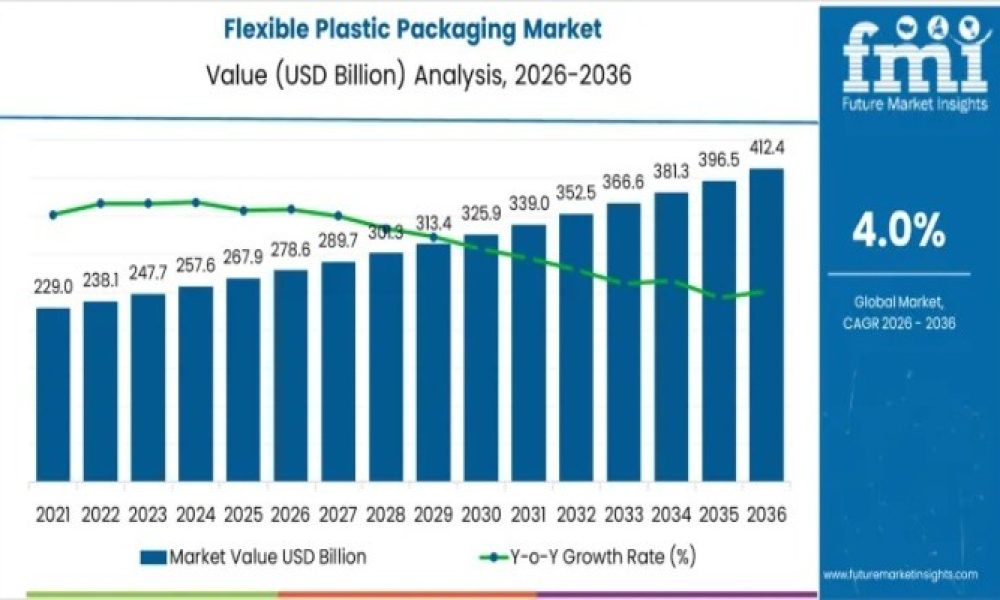
The global flexible plastic packaging market is entering a decade of steady, value-driven expansion as manufacturers, brand owners, and retailers recalibrate packaging strategies around cost efficiency, sustainability, and performance reliability. Valued at USD 278.6 billion in 2026, the market is projected to reach USD 412.4 billion by 2036, expanding at a compound annual growth rate (CAGR) of 4%.
This growth trajectory reflects more than volume expansion. It signals a structural shift in procurement behavior, where buyers increasingly balance price competitiveness with long-term supply stability, regulatory compliance, and environmental accountability. Flexible plastic packaging encompassing pouches, bags, films, and wraps, continues to outperform rigid alternatives due to its lightweight nature, reduced material usage, and superior functional efficiency across food, pharmaceutical, personal care, and consumer goods applications.
Discover Market Opportunities – Get Your Sample of Our Industry Overview Today!
Quick Stats: Flexible Plastic Packaging Market
- Market Value (2026): USD 278.6 Billion
- Forecast Value (2036): USD 412.4 Billion
- Forecast CAGR (2026–2036): 4%
- Leading Product Type: Pouches (43.8% share)
- Dominant Application: Food & Beverage (52% share)
- Key Growth Regions: Asia Pacific, North America
- Major Players: Amcor plc, Berry Global Inc., Sealed Air Corporation, Constantia Flexibles Group GmbH, Huhtamaki Oyj, Mondi Group, Coveris Holdings SA
Market Outlook: Performance Meets Sustainability
Flexible plastic packaging remains a cornerstone of modern supply chains due to its ability to preserve freshness, extend shelf life, and reduce logistics costs. Compared to rigid formats, flexible plastics use less raw material and generate lower transportation emissions, aligning well with corporate sustainability targets.
However, the market is also shaped by risk-averse procurement strategies. Vendor lock-in is common, as many packaging solutions are deeply integrated into filling lines and product designs. Switching suppliers often involves retooling costs, qualification timelines, and regulatory approvals. As a result, buyers favor suppliers with proven performance, global supply capabilities, and a clear roadmap for recyclable, biodegradable, or compostable materials.
Key Takeaways: Flexible Plastic Packaging Market
- Stable, long-term growth supported by essential end-use industries
- Rising demand for lightweight, resealable, and convenience-driven packaging
- Increasing regulatory and consumer pressure for recyclable and eco-friendly materials
- Strong emphasis on supplier reliability and long-term partnerships
- Innovation in barrier coatings, multilayer structures, and printing technologies
Segment-Wise Market Analysis
By Product Type
- Pouches dominate the market with a 43.8% share, driven by their versatility, portability, and efficient material usage.
- Bags, films & wraps, and lidding films follow, supporting a wide range of consumer and industrial applications.
By Application
- Food & Beverage leads with a 52% share, reflecting the critical role of flexible packaging in freshness preservation and convenience.
- Pharmaceuticals & healthcare, personal care & cosmetics, and industrial applications continue to expand steadily.
Why Pouches Lead the Market
Pouches have emerged as the preferred flexible packaging format due to their adaptability across product categories, from snacks and beverages to detergents and personal care items. Their space-efficient design, resealability, and compatibility with advanced barrier technologies make them a cost-effective solution for manufacturers seeking both performance and sustainability benefits.
Key Market Dynamics
Drivers
- Growing consumption of packaged and ready-to-eat foods
- Expansion of e-commerce and home delivery channels
- Lightweight packaging that reduces logistics and fuel costs
- Advances in recyclable and recyclable-ready flexible materials
Restraints
- Environmental concerns related to plastic waste
- Regulatory pressure on single-use plastics
- Recycling infrastructure limitations in emerging markets
- Feedstock price volatility linked to petrochemical inputs
Country-Wise Growth Outlook (CAGR 2026–2036)
- India: 4.8%
- China: 4.5%
- United States: 3.8%
- Germany: 3.6%
- Japan: 3.4%
Asia Pacific leads global growth, driven by urbanization, rising disposable incomes, and strong food & beverage demand. North America and Europe focus more on innovation, sustainability, and regulatory compliance, shaping premium flexible packaging solutions.
Competitive Landscape: Innovation as a Differentiator
Competition in the flexible plastic packaging market centers on material innovation, sustainability credentials, and global supply reliability.
- Amcor plc leads with recyclable, high-barrier materials designed for performance and environmental responsibility.
- Berry Global Inc. offers a broad portfolio of films and pouches with strong customization and global reach.
- Sealed Air Corporation focuses on protective packaging solutions that reduce waste and enhance product safety.
- Constantia Flexibles Group GmbH differentiates through advanced printing and premium lamination technologies.
- Huhtamaki Oyj and Mondi Group emphasize compostable and recyclable packaging aligned with regulatory trends.
- Coveris Holdings SA competes through integrated design services and rapid prototyping for diverse applications.
Across the market, suppliers are aligning product development with sustainability goals while ensuring cost efficiency and operational compatibility for brand owners.
Why FMI: https://www.futuremarketinsights.com/why-fmi
About Future Market Insights (FMI)
Future Market Insights, Inc. (FMI) is an ESOMAR-certified, ISO 9001:2015 market research and consulting organization, trusted by Fortune 500 clients and global enterprises. With operations in the U.S., UK, India, and Dubai, FMI provides data-backed insights and strategic intelligence across 30+ industries and 1200 markets worldwide.



