
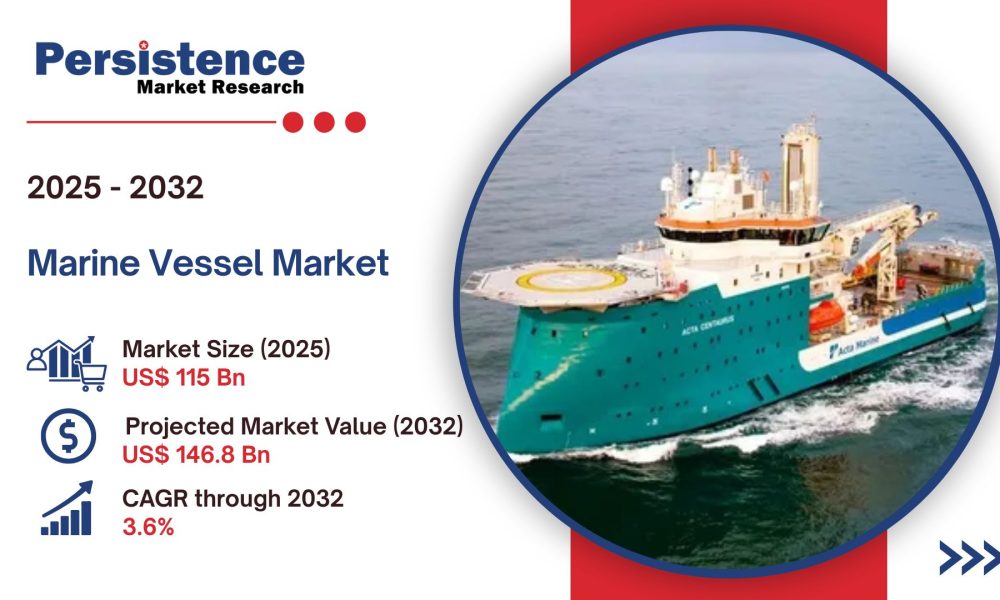
The global marine vessel market is witnessing significant growth, driven by increasing global trade volumes, fleet modernization programs, and investments in sustainable propulsion technologies. According to Persistence Market Research, the global market is projected to be valued at US$115 Billion in 2025 and is expected to reach US$146.8 Billion by 2032, registering a CAGR of 3.6% during the forecast period. This growth highlights the critical role of marine vessels in facilitating global commerce, resource transportation, and maritime defense operations.
With the shipping industry acting as the backbone of international trade, the marine vessel market is expanding steadily across various vessel types, including cargo ships, tankers, container ships, passenger vessels, and specialized ships for offshore and defense applications. Technological advancements, including automation, fuel efficiency improvements, and alternative propulsion systems, are also shaping the industry’s future. Furthermore, governments and private stakeholders are increasingly adopting environmentally sustainable practices to comply with stringent emission regulations, fostering innovation and growth in the market.
Get | Download Sample Copy with TOC, Graphs & List of Figures @ https://www.persistencemarketresearch.com/samples/35689
The marine vessel market is fundamentally tied to the dynamics of global trade and maritime logistics. With trade volumes rising due to economic growth in emerging regions and ongoing globalization, there is a continuous demand for new and replacement vessels. Fleet replacement cycles are accelerating as older vessels are retired to meet modern safety, efficiency, and environmental standards. This trend is particularly significant in regions like North America, Europe, and Asia Pacific, where shipping is a critical economic driver.
Among the various vessel types, cargo ships and container vessels remain the leading segments, primarily due to the surge in e-commerce and cross-border trade. In terms of geographical dominance, Asia Pacific is emerging as the largest and fastest-growing market. Factors such as rapid industrialization, expanding ports, and high regional trade activities, particularly in China, India, and Southeast Asia, contribute to this leadership. The region’s shipbuilding infrastructure and cost advantages further strengthen its position in the global marine vessel market.
Key Highlights from the Report
- The global marine vessel market is expected to grow from US$115 Billion in 2025 to US$146.8 Billion by 2032, at a CAGR of 3.6%.
- Asia Pacific is forecasted to dominate the market, driven by high trade volumes and shipbuilding capacity.
- Increasing investments in sustainable propulsion technologies are expected to reshape fleet composition and reduce carbon emissions.
- Cargo and container vessels continue to account for the largest share of market revenue due to rising global trade.
- Stringent environmental regulations, particularly IMO’s emission targets, are driving demand for modern, compliant vessels.
- The growing defense and offshore shipping sectors present significant opportunities for specialized vessel types.
Market Segmentation
The marine vessel market can be segmented by product type, end-user, and propulsion technology. By product type, the market includes cargo ships, container ships, tankers, passenger ships, offshore vessels, and specialized ships. Cargo and container vessels are the most significant contributors to market revenue due to the expanding e-commerce and bulk commodity trade. Passenger ships are witnessing moderate growth, largely driven by the recovery of global tourism and cruise activities post-pandemic. Offshore vessels, including supply ships and oil tankers, continue to support the energy sector’s exploration and production needs.
By end-user, the market is segmented into commercial, defense, and recreational sectors. The commercial segment dominates due to the high demand for shipping freight, logistics, and bulk transport. Defense spending contributes to market growth through investments in naval fleets and patrol vessels, which are increasingly designed for multipurpose operations. Recreational vessels, including yachts and smaller boats, are experiencing niche demand, particularly in developed regions, where disposable income and leisure activities are rising. Propulsion technology segmentation is also critical, with conventional diesel engines currently dominant, while LNG, hybrid, and electric propulsion technologies are gradually gaining traction.
Regional Insights
Asia Pacific continues to lead the marine vessel market, driven by significant shipbuilding activities in China, Japan, and South Korea. These countries not only supply domestic demand but also export vessels globally. Government initiatives to expand port infrastructure and facilitate international trade further strengthen the market. Additionally, the region’s ability to provide cost-effective shipbuilding services enhances its competitive advantage.
In contrast, Europe and North America exhibit moderate growth rates, primarily driven by fleet replacement, modernization, and strict environmental regulations. Europe is focusing on sustainable and low-emission vessel technologies to comply with the International Maritime Organization’s regulations, while North America emphasizes high-value specialized vessels, including offshore and defense ships. The Middle East and Africa, although smaller markets, show potential growth due to increased port investments and oil & gas sector expansion.
For customization options before purchasing: https://www.persistencemarketresearch.com/request-customization/35689
Market Drivers
The marine vessel market is propelled by multiple factors, with global trade expansion being the primary driver. Rising demand for bulk commodities, containerized goods, and energy resources necessitates larger and more efficient vessels. As countries strengthen trade relations, shipping volumes increase, prompting investments in new fleets and replacement cycles.
Another critical driver is the adoption of sustainable propulsion technologies. Stringent regulations by the IMO and regional authorities on sulfur emissions and carbon reduction encourage shipping companies to invest in LNG, hybrid, and electric-powered vessels. These technologies enhance fuel efficiency, reduce operational costs, and meet environmental compliance requirements. Additionally, technological advancements in automation and digital navigation contribute to operational efficiency, safety, and lower manpower requirements, further driving market growth.
Market Restraints
Despite robust growth, the marine vessel market faces certain challenges. High capital expenditure associated with new vessel construction and fleet replacement can be a barrier, particularly for smaller shipping operators. The cost of retrofitting existing vessels with new emission-compliant engines is also significant, limiting adoption.
Furthermore, volatility in fuel prices and economic uncertainties in global trade can negatively impact market dynamics. Shipping companies are sensitive to fluctuations in crude oil and LNG prices, which directly affect operational costs. Geopolitical tensions, trade restrictions, and port congestion also pose potential risks, slowing market growth in specific regions or segments.
Market Opportunities
Opportunities in the marine vessel market are abundant, particularly in green shipping technologies. The rising emphasis on environmental sustainability encourages innovation in hybrid and fully electric vessels, LNG-powered ships, and zero-emission propulsion systems. Companies that invest in research and development of energy-efficient designs are likely to capture a significant market share.
The growing offshore energy and defense sectors also present lucrative opportunities. Offshore vessel demand is increasing due to oil and gas exploration, wind energy installations, and subsea construction projects. Additionally, defense-related naval modernization programs in countries like India, the US, and South Korea are expected to drive demand for advanced patrol and combat vessels. These emerging opportunities can significantly influence market dynamics over the forecast period.
Company Insights
Key players in the global marine vessel market include:
- Hyundai Heavy Industries Co., Ltd.
- Mitsubishi Heavy Industries, Ltd.
- Daewoo Shipbuilding & Marine Engineering Co., Ltd.
- Fincantieri S.p.A.
- Samsung Heavy Industries Co., Ltd.
- Navantia S.A.
- STX Offshore & Shipbuilding Co., Ltd.
- China State Shipbuilding Corporation (CSSC)
Buy Now: https://www.persistencemarketresearch.com/checkout/35689
Recent Developments:
- Hyundai Heavy Industries announced plans to develop eco-friendly LNG-powered container vessels, expected to reduce emissions by 30% compared to conventional ships.
- Fincantieri launched an autonomous vessel prototype aimed at increasing cargo transport efficiency while minimizing human intervention and operational risks.
Frequently Asked Questions (FAQ)
➤ What are the main factors influencing the Marine Vessel Market 2025-2032?
➤ Which companies are the major sources in the Marine Vessel Market?
➤ What are the market’s opportunities, risks, and general structure?
➤ Which of the top Marine Vessel Market 2025-2032 companies compare in terms of sales, revenue, and prices?
➤ How are market types, applications, deals, revenue, and value explored in the Marine Vessel Market?
Future Opportunities and Growth Prospects
The marine vessel market is poised for sustained growth, driven by modernization, global trade expansion, and the adoption of environmentally friendly technologies. Emerging economies, particularly in Asia Pacific and the Middle East, offer opportunities for both shipbuilding and vessel deployment. The evolution of LNG and electric-powered vessels provides a competitive edge for manufacturers and operators committed to sustainability.
Additionally, digitalization in shipping, including autonomous vessels, real-time navigation systems, and predictive maintenance, offers transformative opportunities. Shipping companies and investors focusing on these innovative solutions are likely to capture higher efficiency, cost savings, and regulatory compliance benefits. The interplay of global trade expansion, technological advancements, and sustainable practices positions the marine vessel market for promising growth through 2032 and beyond.