
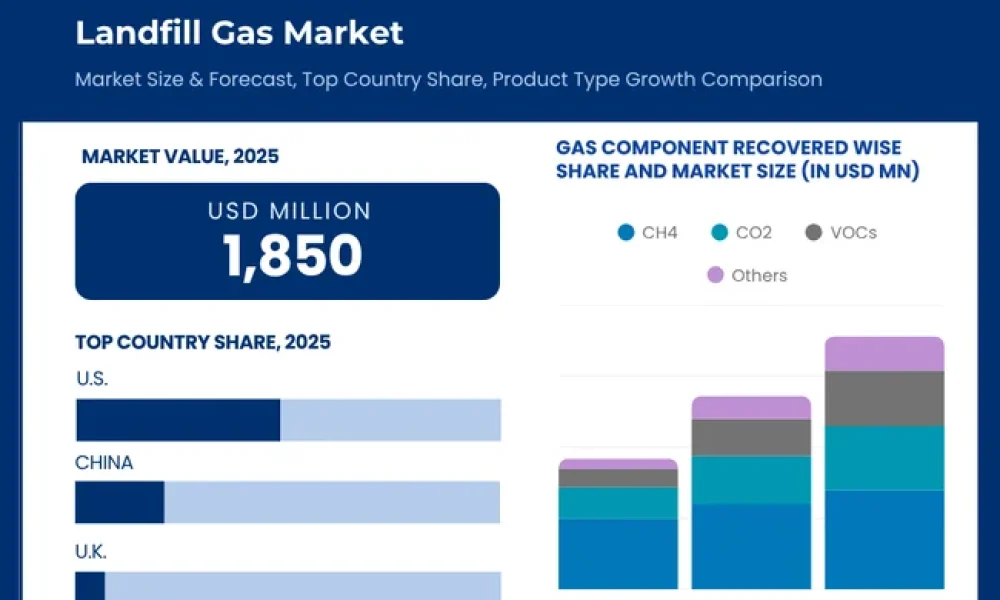
The global landfill gas (LFG) market is poised for robust expansion over the next decade. Market valuations are projected to grow from approximately USD 1.7–1.85 billion in 2024–2025 to USD 4.106 billion by 2035, representing a compound annual growth rate (CAGR) of roughly 8.3% from 2025 to 2035.
This growth trajectory reflects intensifying industry and regulatory emphasis on methane emission reduction, renewable energy integration, and sustainable waste handling.
2. Key Drivers Fueling Market Growth
2.1 Regulatory Push for Emissions Reduction
A core driver is stringent environmental regulation aimed at controlling methane, a potent greenhouse gas. Governments are mandating methane capture, offering tax incentives, carbon credits, and subsidies to landfill operators who install gas collection and utilization systems.
Methane’s high global warming potential has elevated it on climate policy agendas globally, resulting in more landfill gas projects as a route to compliance and emissions reporting benefits.
To access the complete data tables and in-depth insights, request a Discount On The Report here: https://www.factmr.com/connectus/sample?flag=S&rep_id=429
2.2 Renewable Energy Demand and Grid Stability
Landfill gas is increasingly recognized as a dispatchable renewable energy source, complementing intermittent solar and wind. Its use in baseload power generation, combined heat and power (CHP) systems, and grid injection enhances energy portfolio diversification for utilities.
Beyond electricity, renewable natural gas (RNG) — upgraded methane suitable for vehicle fuel or pipeline injection — is gaining traction, driven by decarbonization objectives in transportation and industrial fuels.
2.3 Waste Generation Trends and Urbanization
Rapid urban growth globally has increased municipal solid waste volumes, thereby increasing methane availability at landfill sites. This enlarges the feedstock for LFG systems and creates scalable opportunities for landfill operators to monetize waste streams.
2.4 Technological Advancements
Advances in gas collection, purification, and automation technologies have lowered operational costs and improved system efficiency. Capabilities such as membrane separation and pressure swing adsorption are making methane recovery more viable across different scales of operation.
3. Market Segmentation and Value Streams
3.1 By Application
Electricity Generation is currently the largest application segment, owing to landfill gas’s stability and compatibility with existing grids.
CHP and Direct Use add value in industrial settings.
Vehicle Fuel and Pipeline Injection represent high-growth value streams as RNG adoption accelerates.
3.2 By Gas Component Recovered
Methane (CH₄) leads due to its higher energy value and strategic importance in emissions reduction. Technologies to purify methane for RNG are becoming commercially accessible.
Other components (CO₂, VOCs) may have niche industrial applications but remain secondary.
4. Regional Landscape and Dynamics
North America: Mature Leader
North America dominates in market share, backed by stringent regulations and large landfill infrastructure. The U.S. accounts for the most installations and project investments, supported by federal and state programs.
Europe: Policy-Driven Expansion
Western European nations like the UK, Germany, and France are deploying landfill gas for grid injection, biomethane blending, and CHP as part of broader circular economy mandates. Feed-in tariffs and carbon pricing frameworks in several European markets continue to underpin investment viability.
Asia Pacific: Fastest Growing Frontier
China and Japan have accelerated landfill gas initiatives as part of waste-to-energy reforms, while South and Southeast Asia are gradually scaling projects through foreign investment and pilot programs. India and Southeast Asia represent high-potential future markets, given increasing waste generation and policy momentum toward renewable gas.
Latin America, Middle East & Africa
These regions are in earlier stages of market penetration, with activity largely concentrated on pilot programs and utility-scale projects.
5. Industry Challenges and Restraints
Despite strong growth signals, the market faces several headwinds:
5.1 High Capital Costs and Long Paybacks
Initial investment for landfills and gas utilization infrastructure is significant, and payback periods can be long — deterring smaller landfill operators from participation.
5.2 Technical Complexities
Maintaining consistent gas flow and quality, and integrating purification technologies adds operational complexity and expense.
5.3 Regulatory Variability
In many emerging economies, inconsistent application of emissions control laws weakens investor confidence, delaying market entry and financing.
5.4 Competition from Other Renewables
Solar and wind projects, with relatively shorter development cycles and lower technical barriers, remain highly competitive for renewable investment dollars.
6. Disruption Signals & Emerging Trends
6.1 RNG and the Transportation Sector
The evolving preference for renewable natural gas for heavy-duty transport and industrial heating is a disruptive force, elevating landfill gas from a compliance tool to a strategic RNG feedstock.
6.2 Modular and AI-Powered Systems
New entrants are deploying modular, mobile, and AI-enhanced systems that reduce installation time, optimize yield prediction, and support remote monitoring, potentially lowering barriers for smaller operators.
6.3 Public-Private Partnerships
Successful models increasingly involve structured partnerships between municipalities and private energy firms — a hybrid approach that addresses financing challenges while harnessing operational expertise.
7. Competitive Landscape
The market includes established players such as:
Waste Management Inc.
Veolia Environment SA
SUEZ
Tetra Tech Inc.
Ameresco Inc.
Montauk Renewables
Covanta Holding Corporation
Infinis Energy PLC
These firms compete across technology services, project size, and financing capabilities. Innovative competitive edges come from integrated services (collection, purification, conversion, monitoring) and securing long-term municipal contracts.
8. Strategic Scenarios & Outlook
Base Case (Steady Growth)
Continued regulatory enforcement and renewable energy demand underpin steady market CAGR ~8%. Coalitions around carbon markets and RNG incentives will sustain project pipelines.
Optimistic Case
Widespread alignment of climate policies and enhanced RNG pricing mechanisms could accelerate adoption, particularly in Asia Pacific and emerging markets.
Challenged Scenario
If competing renewables diminish landfill gas attractiveness or financing tightens due to rising interest rates, smaller projects may stall, compressing near-term growth.
9. Conclusion
The landfill gas market stands at a dynamic inflection point, transitioning from regulatory compliance asset to strategic renewable energy contributor. With emissions regulation tightening globally, rising RNG demand, and advancing technologies, stakeholders who navigate technical, financial, and policy complexities are positioned to capture significant value.
Have a specific Requirements and Need Assistant on Report Pricing or Limited Budget please contact us – [email protected]
To View Related Report :
Landfill Gas Industry Analysis in East Asia https://www.factmr.com/report/landfill-gas-industry-analysis-in-east-asia
Landfill Gas Industry Analysis in Middle East & Africa https://www.factmr.com/report/landfill-gas-industry-analysis-in-middle-east-and-africa
Landfill Gas Industry Analysis in Europe https://www.factmr.com/report/landfill-gas-industry-analysis-in-europe
Landfill Gas Industry Analysis in Latin America https://www.factmr.com/report/landfill-gas-industry-analysis-in-latin-america



