
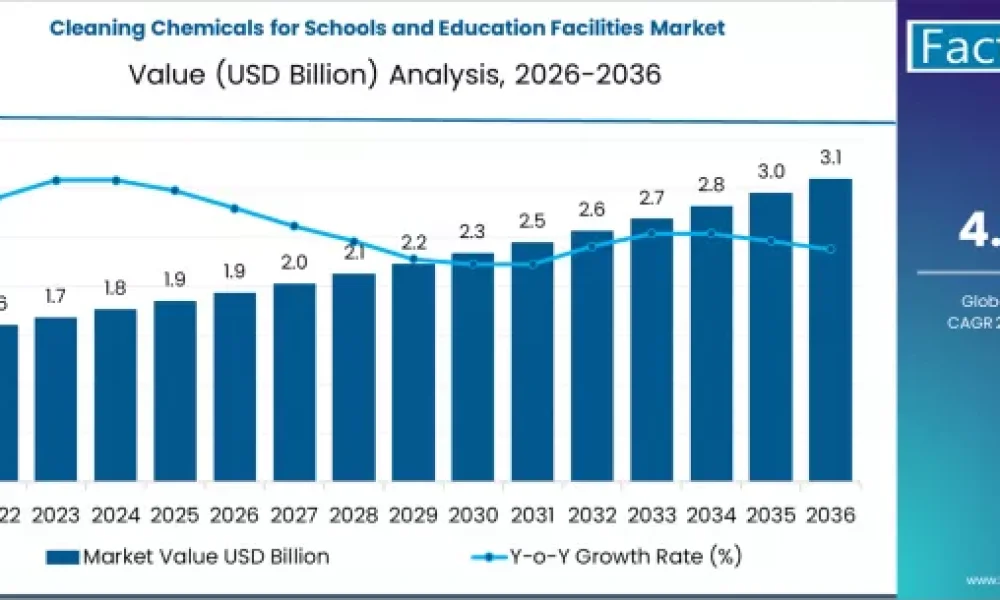
The global market for cleaning chemicals used in schools and education facilities is entering a phase of structurally resilient growth, driven by public health priorities, sustainability mandates, and long-term institutional spending commitments. Valued at approximately USD 2.0 billion in 2026, the market is forecast to reach USD 3.1–3.2 billion by 2036, expanding at a steady CAGR of 4.8% over the decade.
Key Growth Drivers
Institutionalized Hygiene Standards
Unlike episodic demand spikes during pandemic periods, cleaning chemicals in educational facilities benefit from recurring, non-discretionary consumption. Daily sanitation of classrooms, corridors, cafeterias, restrooms, and gyms ensures baseline demand stability across public and private institutions. Surface cleaners and disinfectants alone account for approximately 34% of total market share, reflecting the emphasis on high-touch areas in learning environments.
Public Sector Spending & Enrollment Stability
Education infrastructure spending in both developed and emerging markets remains a critical demand anchor. Growth regions including China, Brazil, North America, and Western Europe are expanding school capacity and upgrading facilities, translating into sustained procurement of janitorial and sanitation chemicals.
Alignment with the Broader Institutional Cleaning Economy
The education segment operates within the much larger industrial and institutional (I&I) cleaning chemicals market, projected to exceed USD 170 billion globally by 2034, growing at over 7% CAGR. This scale enables suppliers to leverage shared R&D, distribution networks, and regulatory frameworks while tailoring formulations to school-specific safety requirements.
To access the complete data tables and in-depth insights, request a Discount On The Report here: https://www.factmr.com/connectus/sample?flag=S&rep_id=13016
Disruption Signals Reshaping the Market
Acceleration of Green & Low-Toxicity Formulations
Environmental and student health considerations are rapidly reshaping procurement criteria. Surveys indicate that over 96% of schools have implemented green cleaning practices to some extent, signaling near-universal adoption of environmentally preferable products. This trend aligns with the broader eco-friendly cleaning products market, expected to grow at ~10% CAGR through 2034, outpacing conventional chemical categories.
Regulatory & Label Transparency Pressure
School districts increasingly require third-party certifications, ingredient disclosure, and compliance with indoor air quality standards. These requirements raise entry barriers for low-cost generic suppliers while favoring established players with compliant product portfolios and traceable supply chains.
Consolidation & Professionalization of Supply Channels
Janitorial and sanitation (Jan-San) distributors currently control over 50% of market share, but direct contracting, bundled service models, and digital procurement platforms are gaining traction. This evolution is pushing suppliers toward value-added offerings such as usage analytics, training, and integrated hygiene programs rather than standalone chemical sales.
Industry Scenarios: 2026–2036 Outlook
Base Case – “Steady Compliance Growth”
Under current policy and funding trajectories, the market maintains its 4.8% CAGR, driven by routine consumption, incremental green product substitution, and stable enrollment. Innovation focuses on safer formulations and cost efficiency.
Upside Scenario – “Sustainable Transformation”
Stronger climate regulations, faster adoption of bio-based chemistries, and increased government funding for healthy school environments accelerate premium product penetration. In this scenario, green and low-toxicity chemicals capture disproportionate value growth, reflecting patterns seen in adjacent sectors.
Downside Scenario – “Budget Compression”
Fiscal tightening in public education could delay facility upgrades and intensify price competition. However, even in this scenario, baseline demand remains resilient due to mandatory hygiene requirements, limiting downside risk compared to other institutional end markets.
Strategic Implications
For manufacturers and investors, the cleaning chemicals for schools market represents a defensive, policy-aligned growth opportunity. Winners will be those that combine regulatory compliance, sustainability leadership, and service-oriented value propositions. As education systems globally prioritize student health, environmental safety, and operational accountability, cleaning chemicals will remain a quiet but essential pillar of the education infrastructure economy.
Have a specific Requirements and Need Assistant on Report Pricing or Limited Budget please contact us – [email protected]
To View Related Report :
Cleaning Chemicals for Retail and Shopping Centres Market https://www.factmr.com/report/cleaning-chemicals-for-retail-and-shopping-centres-market
Cleaning Chemicals for Fitness and Recreation Facilities Market https://www.factmr.com/report/cleaning-chemicals-for-fitness-and-recreation-facilities-market
Cleaning Chemicals for Airports and Transport Hubs Market https://www.factmr.com/report/cleaning-chemicals-for-airports-and-transport-hubs-market
Green Cleaning Chemicals for Industrial Maintenance Market https://www.factmr.com/report/green-cleaning-chemicals-for-industrial-maintenance-market
“



