
Market Overview
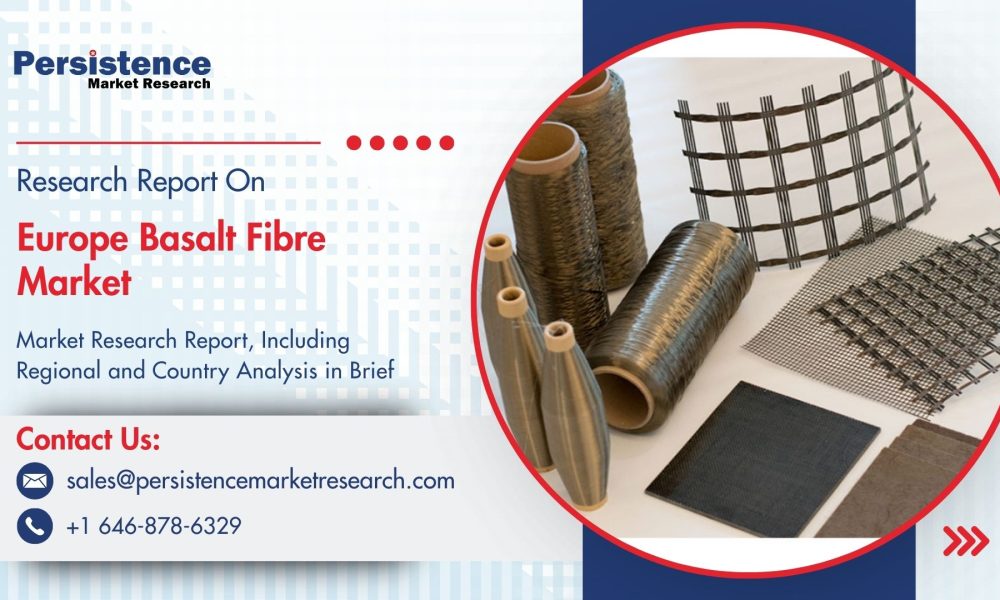
The Europe basalt fibre market is witnessing rapid expansion, driven by the growing demand for sustainable materials across diverse industries. According to the latest study by Persistence Market Research, the market is projected to be valued at US$83.5 million in 2025 and is expected to reach US$195.5 million by 2032, registering a robust CAGR of 12.9% during the forecast period. The adoption of basalt fibre is gaining momentum due to its non-corrosive properties, lightweight strength, and ability to significantly reduce carbon dioxide emissions when used as a substitute for traditional construction materials.
One of the strongest drivers behind this market growth is the European Union’s commitment to achieving Net-Zero emissions by 2050. Basalt fibre aligns with these sustainability goals by offering a cost-effective and eco-friendly alternative to steel and glass fibre. Industries such as construction, automotive, wind energy, and aerospace are increasingly turning to basalt fibre solutions to meet performance and environmental standards. Furthermore, the growing dominance of composites—accounting for 60% of basalt fibre demand in the region—and the 40% market share held by construction applications highlight the material’s rising significance in reshaping Europe’s industrial landscape.
Get a Sample PDF Brochure of the Report (Use Corporate Email ID for a Quick Response): https://www.persistencemarketresearch.com/samples/35621
Market Segmentation
The Europe basalt fibre market can be segmented by product type, form, application, and end-use industry.
By product type, the market includes continuous basalt fibre (CBF) and discrete basalt fibre. Continuous basalt fibre is witnessing the highest adoption due to its superior strength-to-weight ratio, durability, and compatibility with resin systems for composite manufacturing. Discrete fibres, on the other hand, are increasingly utilized in concrete reinforcement and asphalt applications where their crack resistance and thermal stability enhance structural longevity.
In terms of form, basalt fibres are available as roving, chopped strands, fabrics, and mats. Roving dominates the market as it forms the basis for producing high-performance composites used in aerospace, automotive, and wind energy sectors. Chopped strands are particularly popular in construction, as they improve the toughness and corrosion resistance of concrete. Basalt fabrics and mats are increasingly used in thermal insulation, fire protection, and marine applications, benefiting industries that demand high thermal and chemical resistance.
By application, composites dominate with 60% market share. Basalt fibre-reinforced polymers (BFRP) are being adopted as sustainable alternatives to steel reinforcement bars, reducing CO2 emissions by nearly 50% and enhancing durability in corrosive environments. Non-composite applications such as insulation materials, textiles, and fireproof fabrics are also gaining traction as industries prioritize safety and environmental sustainability.
By end-use industry, construction accounts for 40% of the market share, primarily driven by infrastructure projects that demand sustainable, non-corrosive, and durable reinforcement materials. Automotive and aerospace industries are also key contributors, leveraging basalt fibre for lightweighting and performance optimization. Meanwhile, the wind energy sector is rapidly adopting basalt fibre composites for turbine blades and structural components, aligning with Europe’s aggressive renewable energy expansion.
Key Market Drivers
Several factors are propelling the growth of the Europe basalt fibre market. The foremost driver is the EU’s Net-Zero 2050 initiative, which emphasizes reducing carbon emissions across industries. Basalt fibre’s ability to replace steel rebars with BFRP technology offers a significant 50% reduction in CO2 emissions, making it a preferred material in sustainable construction projects.
The rising demand in the aerospace and automotive industries is another critical growth driver. As these sectors pursue lightweight materials to improve fuel efficiency and meet stringent emission standards, basalt fibre composites provide an ideal solution with their combination of strength, heat resistance, and lower cost compared to carbon fibre. Similarly, the wind energy industry is increasingly adopting basalt fibre due to its excellent fatigue resistance and ability to enhance turbine blade performance, contributing to Europe’s renewable energy targets.
Additionally, the construction sector’s growing focus on non-corrosive reinforcement materials is boosting demand for basalt fibre. Traditional steel rebars face durability challenges in harsh environments, leading to higher maintenance costs. Basalt fibre rebars, by contrast, offer superior corrosion resistance, making them ideal for coastal and marine infrastructure projects.
Market Challenges
Despite its strong growth potential, the basalt fibre market in Europe faces certain challenges. The high initial production costs and limited large-scale manufacturing facilities restrict its widespread adoption compared to traditional materials like steel and glass fibre. Additionally, low consumer awareness and a lack of standardized testing methods can slow down the acceptance of basalt fibre products in certain industries.
Another challenge lies in the competition from carbon fibre and glass fibre, which are already well-established in aerospace and automotive sectors. While basalt fibre offers cost and environmental advantages, its market penetration requires significant promotional and educational efforts to highlight its unique value proposition. Addressing these challenges through innovation, strategic partnerships, and expanded production capacity will be critical for unlocking the full potential of the market.
Competitive Landscape
The competitive landscape of the Europe basalt fibre market is characterized by the presence of established international companies and emerging regional players. Key players are focusing on expanding production capacities, investing in research and development, and forming collaborations with end-use industries to strengthen their market presence.
Company Insights
✦ Kamenny Vek
✦ Technobasalt-Invest LLC
✦ Mafic SA
✦ ISOMATEX SA
✦ Sudaglass Fiber Technology Inc.
✦ Basalt Engineering LLC
✦ Zhejiang GBF Basalt Fiber Co. Ltd.
✦ Shanxi Basalt Fiber Technology Co. Ltd.
✦ GMV Group
These companies are leveraging strategies such as product innovation, certifications for construction standards, and partnerships with automotive and aerospace manufacturers to accelerate market growth. For instance, collaborations with infrastructure companies are enabling greater use of basalt fibre rebars in large-scale projects, while partnerships with wind energy firms are expanding applications in turbine blade manufacturing.
For Customized Insights on Segments, Regions, or Competitors, Request Personalized Purchase Options @ https://www.persistencemarketresearch.com/request-customization/35621
Regional Insights
Within Europe, leading markets such as Germany, France, and the UK are driving adoption of basalt fibre, supported by strong regulatory frameworks and significant investments in sustainable infrastructure. Germany, with its advanced automotive and aerospace industries, is particularly active in integrating basalt fibre composites for lightweighting applications. France is witnessing rising demand in wind energy projects, while the UK is embracing basalt fibre in construction and marine infrastructure.
Eastern European countries are also emerging as promising markets due to increasing industrialization and government initiatives promoting renewable energy and sustainable construction. Meanwhile, Northern Europe’s emphasis on eco-friendly building materials and energy-efficient solutions further supports the regional adoption of basalt fibre.
Future Outlook
The future of the Europe basalt fibre market appears highly promising, with significant opportunities arising from the convergence of sustainability, innovation, and industrial transformation. As industries continue to prioritize eco-friendly solutions, basalt fibre’s non-corrosive, lightweight, and high-performance characteristics will drive its adoption across diverse applications.
Technological advancements in basalt fibre production, combined with economies of scale, are expected to reduce costs and improve availability, enabling broader market penetration. The ongoing shift toward renewable energy, coupled with the EU’s decarbonization goals, will further strengthen demand in wind energy, construction, and transportation sectors.
In the long run, the collaboration between governments, industry stakeholders, and research institutions will play a pivotal role in overcoming barriers and unlocking the full potential of basalt fibre in Europe. With rising consumer awareness, regulatory backing, and growing industrial demand, the Europe basalt fibre market is well-positioned for sustained growth and innovation.
The Europe basalt fibre market is set to expand significantly, projected to grow from US$83.5 million in 2025 to US$195.5 million by 2032 at a CAGR of 12.9%. This growth is being driven by the EU’s Net-Zero 2050 targets, increasing adoption of non-corrosive BFRP rebars, and the rising use of basalt fibre in aerospace, automotive, and wind energy sectors. With composites dominating 60% of applications and construction holding 40% of the market share, basalt fibre has become a cornerstone of Europe’s sustainability-driven industrial transformation. Despite challenges such as high production costs and competition from established materials, the market’s long-term outlook remains highly positive, positioning basalt fibre as a key material in Europe’s journey toward a greener future.
Explore the Latest Trending Research Reports:
About Persistence Market Research:
At Persistence Market Research, we specialize in creating research studies that serve as strategic tools for driving business growth. Established as a proprietary firm in 2012, we have evolved into a registered company in England and Wales in 2023 under the name Persistence Research & Consultancy Services Ltd. With a solid foundation, we have completed over 3600 custom and syndicate market research projects, and delivered more than 2700 projects for other leading market research companies’ clients.
Our approach combines traditional market research methods with modern tools to offer comprehensive research solutions. With a decade of experience, we pride ourselves on deriving actionable insights from data to help businesses stay ahead of the competition. Our client base spans multinational corporations, leading consulting firms, investment funds, and government departments. A significant portion of our sales comes from repeat clients, a testament to the value and trust we’ve built over the years.
Contact Us:
Persistence Market Research
G04 Golden Mile House, Clayponds Lane
Brentford, London, TW8 0GU UK
USA Phone: +1 646-878-6329
UK Phone: +44 203-837-5656
Email: [email protected]
Web: https://www.persistencemarketresearch.com




