

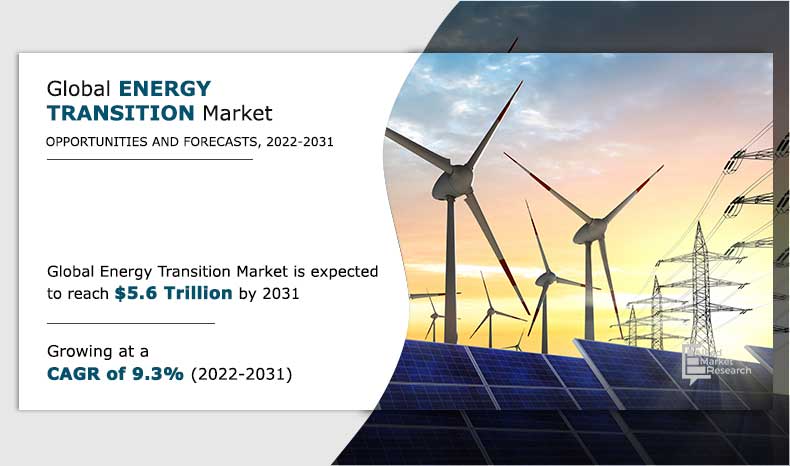
According to a new report published by Allied Market Research, titled, “Energy Transition market by type: global opportunity analysis and industry forecast, 2022–2031 The global energy transition market size was valued at $2.3 trillion in 2021, and projected to reach $5.6 trillion by 2031, with a CAGR of 9.3% from 2022 to 2031.
Energy transition refers to the shift from fossil fuels to renewable energy sources, aiming to reduce carbon emissions and promote sustainable, green energy. Key sectors driving this transition include renewable energy, energy storage, electric vehicles, heating, nuclear energy, hydrogen, and others. In 2021, renewable energy emerged as the leading sector, attracting $366 billion in global investment, including a 6.5% rise in small-scale systems from 2020. Electrified transport was the fastest-growing sector, with investment soaring by 77% to $273 billion. Electrified energy followed with $53 billion, while nuclear energy secured $31 billion in investment.
Download PDF Brochure: https://www.alliedmarketresearch.com/request-sample/A31819
Energy Transition Market Dynamics:
- Shift Toward Decarbonization
A primary driver of the energy transition market is the global push toward decarbonization. Governments and industries are working to reduce greenhouse gas emissions by transitioning from fossil fuels to renewable and low-carbon energy sources. International climate agreements like the Paris Accord have accelerated this shift by mandating emission reduction targets. This move is prompting large-scale investments in clean energy technologies such as solar, wind, hydro, and nuclear power, laying a strong foundation for energy transition growth.
- Growth in Electrification and Renewable Energy
The increasing electrification of energy systems, particularly in transportation and heating, is another significant growth factor. Sectors such as residential heating and electric vehicles are rapidly adopting electricity as a primary energy source, supported by declining costs of renewable generation. The growth of distributed energy resources, including rooftop solar and community wind projects, is decentralizing the grid and making energy more accessible and sustainable. These trends are driving demand for robust infrastructure and smart technologies that support renewable energy integration.
- Advancements in Energy Storage Technologies
Energy storage plays a pivotal role in enabling the energy transition, particularly in addressing the intermittency of renewable sources like wind and solar. Advancements in battery technologies, especially lithium-ion and emerging alternatives such as solid-state and flow batteries, are improving storage efficiency and scalability. These innovations enhance grid stability, provide backup power, and facilitate time-shifting of energy use, all of which are critical for a renewable-powered future. As a result, energy storage solutions are becoming central to energy transition strategies worldwide.
- Policy Support and Investment Flows
Government support in the form of subsidies, tax credits, and regulatory mandates is a major catalyst for the energy transition market. Policies promoting clean energy adoption, such as renewable portfolio standards (RPS), carbon pricing, and net-zero targets, are encouraging both public and private investment. In 2021 alone, global investments in energy transition technologies exceeded $750 billion, with renewable energy and electrified transport accounting for the largest shares. This growing capital flow reflects strong market confidence and accelerates innovation across all transition sectors.
- Emerging Technologies and Market Expansion
Innovative technologies such as hydrogen fuel, smart grids, and digital energy platforms are opening new frontiers in the energy transition market. Hydrogen, in particular, is gaining attention as a clean energy carrier with applications across industry, mobility, and power generation. Meanwhile, digital tools and smart infrastructure enable better energy management, enhance efficiency, and support the integration of diverse energy sources. As these technologies mature and scale, they are expected to further diversify the market, creating significant growth opportunities across regions and industries.
For Purchase Inquiry: https://www.alliedmarketresearch.com/purchase-enquiry/A31819
Energy Transition Market Segment Overview:
The energy transition market forecast is segmented based on technology, end use, and region. By technology, it includes renewable energy (solar, wind, hydro), electrified transport (EVs and charging infrastructure), energy storage, nuclear energy, hydrogen, and heating solutions. By end use, the market is divided into residential, commercial, and industrial sectors, reflecting the diverse applications of clean energy solutions. Regionally, the market is analyzed across North America, Europe, Asia-Pacific, and LAMEA, with each region contributing uniquely to the global shift toward low-carbon energy systems.
Energy Transition Market Regional Analysis
Europe is at the forefront of the global energy transition market, driven by ambitious climate goals, strong policy frameworks, and substantial investments in renewable energy, energy storage, and electrified transportation. Countries like Germany, France, and the Nordic nations have implemented aggressive decarbonization strategies, supported by government incentives, carbon pricing mechanisms, and net-zero emission targets. The region also leads in offshore wind, hydrogen development, and the integration of smart grids, making it a global leader in clean energy adoption and infrastructure transformation.
Asia-Pacific and North America are also key players in the energy transition landscape. In Asia-Pacific, countries such as China, Japan, and South Korea are investing heavily in solar, wind, electric vehicles, and hydrogen projects, driven by growing energy demand, environmental concerns, and industrial decarbonization. China, in particular, is the largest market for renewable energy capacity additions and EV manufacturing. Meanwhile, North America—led by the U.S.—is focusing on modernizing its grid, expanding renewable generation, and promoting clean transport through federal incentives and state-level initiatives. These regions are expected to witness accelerated transition efforts in the coming years.
Energy Transition Market Competitive Analysis
The major companies profiled in this report include Exelon Corporation, Duke Energy Corporation, Pacific Gas and Electric Company, Southern Company, American Electric Power, Inc, Edison International, Repsol, Brookfield Renewable Partners, Ørsted A/S, and NextEra Energy, Inc. Due to rapidly development of industrialization, modernization and spread of information through internet led to the development of tourism industry which in-turn has fuelled the demand for energy transition. Additional growth strategies such as expansion of production capacities, acquisition, partnership, and research & innovation in the solar energy application led to developments in the global energy transition market trends.
Key findings of the study
- The Renewable Energy segment accounted for 31.4% energy transition market share in 2021 and is anticipated to grow at a rate of 9.8% in terms of revenue, increasing its share in the global energy transition market during the forecast period.
- The utility segment is the fastest-growing application segment in the global energy transition market and is expected to grow at a CAGR of 9.6% during 2021–2031.
- In 2021, Asia-Pacific region dominated the global energy transition market with more than 48.7% of the share, in terms of revenue.




