
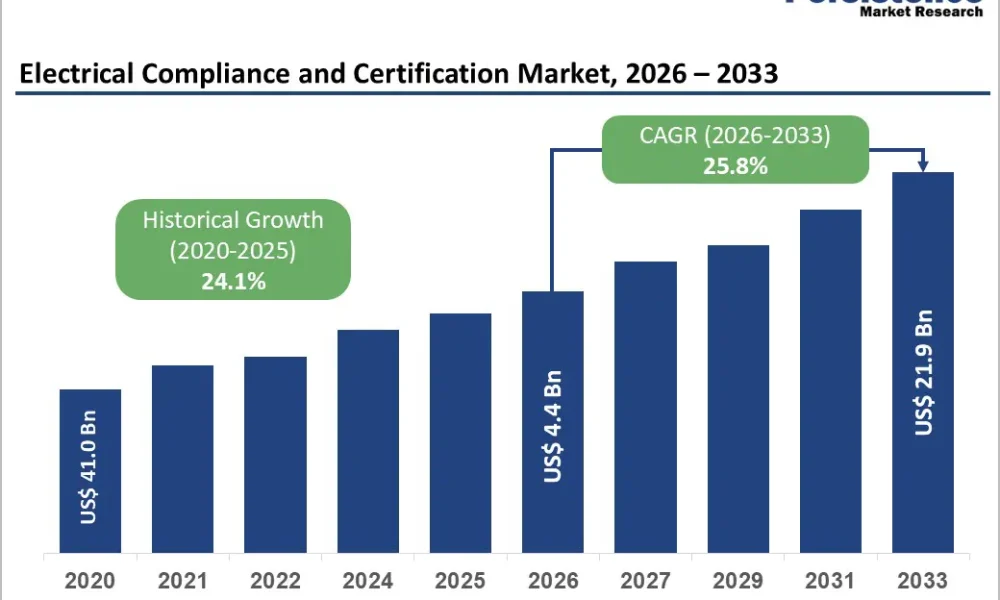
The global electrical compliance and certification market is witnessing exponential growth, driven by increasingly stringent safety regulations, rapid technological advancements, and the global push toward electrification and digital infrastructure. As industries become more reliant on electrical systems, ensuring safety, reliability, and regulatory compliance has become a top priority.
The market is projected to grow from US$ 4.4 billion in 2026 to US$ 21.9 billion by 2033, registering an impressive CAGR of 25.8% during the forecast period. This remarkable growth reflects the rising importance of certification services across sectors such as manufacturing, construction, energy, transportation, and smart technologies.
With the expansion of renewable energy, smart grids, electric vehicles, and IoT-enabled systems, the need for robust compliance frameworks and certification processes is stronger than ever.
Understanding Electrical Compliance and Certification
Electrical compliance and certification refer to the processes of verifying that electrical systems, products, and installations meet established safety, performance, and regulatory standards. These standards are defined by national and international organizations and are essential for ensuring safe operation, preventing hazards, and enabling global trade.
Certification typically involves:
- Product testing and validation
- Inspection of electrical installations
- Documentation and audit processes
- Periodic reassessment and recertification
These services are critical not only for regulatory approval but also for maintaining operational integrity and minimizing risks associated with electrical failures.
Key Market Drivers
Stringent Global Electrical Safety Regulations
One of the most significant drivers of the market is the tightening of electrical safety regulations worldwide. Governments and regulatory bodies are continuously updating standards to address emerging risks associated with modern electrical systems.
Organizations such as the International Electrotechnical Commission (IEC), National Electrical Code (NEC), Occupational Safety and Health Administration (OSHA), and the European Union enforce strict compliance requirements across industries.
For example:
- The EU mandates compliance with Low Voltage and Electromagnetic Compatibility directives
- OSHA regularly updates workplace electrical safety standards in the United States
- Global standards increasingly require cybersecurity features in connected devices
These regulations ensure that only certified products and systems can enter markets, creating sustained demand for compliance and certification services.
Rise of Smart Technologies and Industry 4.0
The adoption of smart technologies, IoT, and Industry 4.0 is significantly increasing the complexity of electrical systems. From smart meters and automated manufacturing lines to connected vehicles and intelligent grids, modern systems require advanced certification processes.
Certification providers are now tasked with validating:
- Interoperability between systems
- Cybersecurity resilience
- Real-time performance reliability
- Integration with cloud-based platforms
Industries such as automotive, aerospace, energy, and telecommunications are particularly dependent on high-level certification due to the critical nature of their operations.
Growth of Renewable Energy and Smart Grid Infrastructure
The global transition toward renewable energy is creating a surge in demand for specialized electrical certification services. Solar farms, wind energy systems, battery storage solutions, and hydrogen technologies must all meet stringent technical and safety standards before deployment.
Certification bodies are increasingly involved throughout the lifecycle of renewable projects, including:
- Design validation
- Installation inspection
- Grid compatibility testing
- Ongoing maintenance and audits
This trend is transforming certification providers into strategic partners in the energy transition.
Market Restraints
High Costs and Complex Certification Processes
Despite strong demand, the high cost and complexity of certification remain major challenges. Certification processes often involve:
- Extensive testing and validation
- Detailed documentation
- Multiple regulatory approvals
- Periodic renewals
For companies operating across multiple countries, navigating different regulatory frameworks adds further complexity. These challenges are particularly burdensome for SMEs, which may lack the resources to manage compliance effectively.
As a result, some businesses delay certification or limit their market expansion, which can hinder overall industry growth.
Shortage of Skilled Professionals
The global shortage of qualified professionals is another critical constraint. Electrical compliance requires highly specialized expertise in areas such as:
- Electrical engineering
- Cybersecurity
- Regulatory standards
- Emerging technologies
Certification bodies often struggle to recruit and retain skilled auditors and inspectors, leading to longer certification timelines and increased operational pressure.
This talent gap is especially pronounced in developing regions, where access to advanced technical training is limited.
Emerging Opportunities
Expansion of Renewable Energy Certification
The rapid growth of renewable energy infrastructure presents a significant opportunity for certification providers. Countries worldwide are investing heavily in clean energy projects, creating demand for specialized testing and compliance services.
Certification bodies are expanding their offerings to include:
- Wind and solar project certification
- Battery storage validation
- Hydrogen technology assessment
- Grid integration testing
These services are essential for ensuring the safety, efficiency, and reliability of renewable energy systems.
Rise of Compliance-as-a-Service (CaaS)
Digital transformation is reshaping the compliance landscape through the emergence of Compliance-as-a-Service (CaaS). Cloud-based platforms enable organizations to manage compliance requirements more efficiently by:
- Automating documentation and reporting
- Providing real-time regulatory updates
- Maintaining audit trails
- Reducing administrative burden
Leading providers are leveraging digital tools to simplify certification processes and make them more accessible to businesses of all sizes.
This shift toward digital compliance solutions is expected to drive significant market growth in the coming years.
Elevate your business strategy with comprehensive market data. Request a sample report now: https://www.persistencemarketresearch.com/samples/29644
Category-Wise Analysis
Certificate Type Insights
The Electrical Installation Certificate segment dominates the market, accounting for approximately 55% of total share. This dominance is driven by mandatory certification requirements for electrical installations in residential, commercial, and industrial settings.
Standards such as IEC 60364 and the UK’s BS 7671 Wiring Regulations require certification before commissioning, ensuring safety and compliance.
The growing number of construction projects, infrastructure developments, and industrial expansions continues to drive demand for installation certificates.
Certification Scheme Insights
Quality management system certification, particularly ISO 9001, holds a leading position in the market with around 30% share.
Organizations pursue this certification to:
- Improve operational efficiency
- Enhance risk management
- Meet regulatory requirements
- Qualify for large contracts and tenders
Its broad applicability across industries makes it one of the most widely adopted certification schemes globally.
Industry Insights
The manufacturing, construction, and engineering sector is the largest end-use segment, accounting for approximately 35% of market share.
This sector relies heavily on electrical systems and automation technologies, making compliance essential for:
- Preventing accidents
- Ensuring equipment reliability
- Avoiding regulatory penalties
Rapid industrialization and infrastructure development further strengthen this segment’s dominance.
Regional Analysis
North America
North America leads the global market, supported by a mature regulatory framework and strong enforcement mechanisms. The United States plays a central role, with organizations such as Underwriters Laboratories (UL) and the National Fire Protection Association (NFPA) driving standardization.
High adoption of advanced technologies, including IoT, electric vehicles, and data centers, further fuels demand for certification services.
Europe
Europe is a highly regulated market with a strong focus on sustainability and safety. Countries such as Germany, the UK, and France are key contributors.
The European Committee for Electrotechnical Standardization (CENELEC) ensures harmonized standards across the region, facilitating cross-border compliance.
Europe’s commitment to renewable energy and carbon reduction is creating new certification requirements, particularly in the automotive and energy sectors.
Asia Pacific
Asia Pacific is the fastest-growing region, driven by rapid industrialization, urbanization, and expanding manufacturing activity.
Countries such as China and India are investing heavily in:
- Smart cities
- Renewable energy
- Industrial automation
- Infrastructure development
Regulatory bodies like China’s CCC and India’s BIS enforce mandatory certification, boosting market growth.
With increasing awareness of electrical safety and strong export-oriented manufacturing, the region is expected to remain a key growth engine.
Competitive Landscape
The electrical compliance and certification market is moderately fragmented, with a mix of global leaders and regional players competing on technical expertise, accreditation, and service capabilities.
Key companies include:
- Eurofins Scientific
- Bureau Veritas Group
- TÜV SÜD
- SGS SA
- Intertek Group PLC
- Element Materials Technology
- Applus Laboratories
These companies are investing in digital platforms, strategic partnerships, and service expansion to strengthen their market position.
Recent Developments
The market is evolving rapidly, with several notable developments:
- TÜV SÜD launched a cloud-based compliance platform to streamline certification processes
- Lloyd’s Register partnered with UL Solutions to harmonize safety standards across regions
- Intertek secured major contracts for EV battery and electronics certification
These initiatives highlight the growing importance of digital transformation and global collaboration in the certification industry.
Future Outlook
The future of the electrical compliance and certification market is highly promising, with strong growth expected across all regions and industries.
Key trends shaping the future include:
- Increased adoption of digital compliance platforms
- Expansion of renewable energy certification services
- Growing importance of cybersecurity in electrical systems
- Rising demand for lifecycle certification solutions
- Development of global harmonized standards
As industries continue to evolve, compliance and certification will play a critical role in ensuring safety, reliability, and regulatory alignment.
Conclusion
The electrical compliance and certification market is poised for exceptional growth, driven by regulatory pressures, technological advancements, and the global transition toward sustainable energy and digital infrastructure.
While challenges such as high costs and skill shortages persist, emerging opportunities in renewable energy, smart technologies, and digital compliance solutions are expected to drive long-term expansion.
Organizations that prioritize compliance and invest in advanced certification solutions will be better positioned to navigate regulatory complexities, enhance operational efficiency, and achieve sustainable growth in an increasingly electrified world.
Related Reports:




